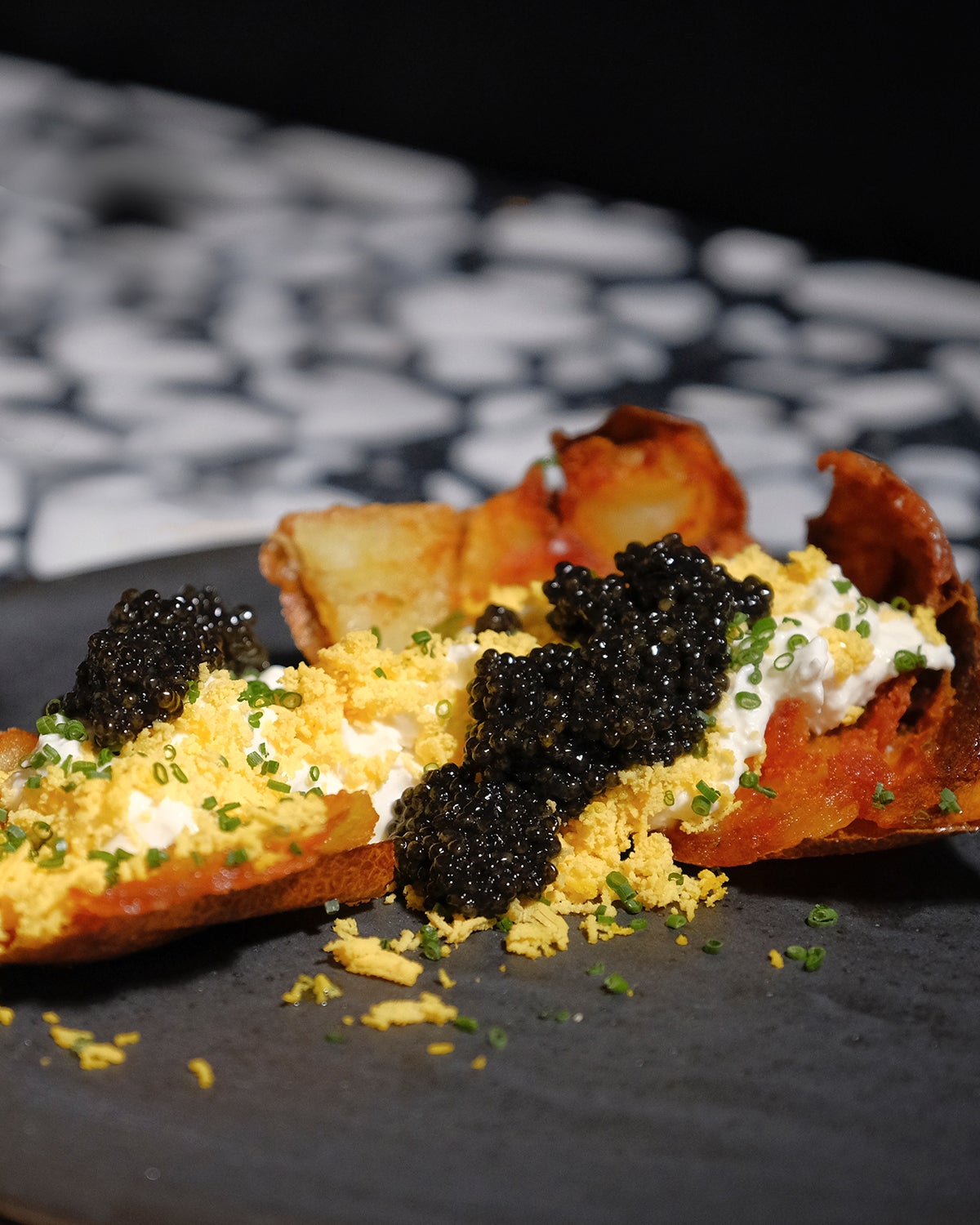
These three are the most expensive things most cooks ever buy, and they’re nothing alike. Saffron is cheap per dish and irreplaceable. Fresh truffle is a brief, seasonal pleasure, and only worth it on very simple food. Caviar is a treat, and for a kosher table the real thing is off the menu anyway; salmon and trout roe are better value and widely kosher. The fakes are everywhere, so knowing what you’re buying is most of the battle.
Worth it? At a glance
| Fresh truffle | Caviar / roe | Saffron | |
|---|---|---|---|
| What it is | Underground fungus | Salt-cured fish eggs | Dried crocus stigmas |
| Typical price | $80–250 per oz black; much more for white | Sturgeon $80–200+ per oz; salmon roe $10–20 per oz | About $10–20 per gram |
| Cost per serving | High ($15–40) | High (sturgeon), modest (salmon roe) | Low (under $1–2) |
| Keeps | 5–7 days | 2–3 days opened | 2 years |
| Kosher? | Yes (parve) | Sturgeon: no. Salmon/trout/whitefish roe: yes, with hechsher | Yes (parve) |
| Common fake | “Truffle oil” (synthetic aroma) | Mislabeled or dyed roe | Safflower, dyed threads, cut powder |
| Nana’s verdict | Once a year, on eggs or pasta | Salmon roe on latkes, yes | Always keep some |
Saffron: the one to keep

Saffron is the dried stigmas of the saffron crocus, three per flower, picked by hand. It takes on the order of 150,000 flowers to make a kilogram, which explains the price. But a dish for four needs only a pinch, about 0.1–0.2 grams, so per serving it’s one of the cheapest luxuries there is.

- What it is
- The dried red stigmas of the saffron crocus, picked by hand, three per flower. It takes roughly 150,000 flowers to make a kilogram.
- Tastes like
- Honeyed, floral and hay-like with a pleasant bitterness, and a golden color nothing else matches.
- Use it for
- Persian rice (tahdig and polo), paella, risotto Milanese, bouillabaisse-style fish stews, Moroccan tagines, challah, saffron buns, Sephardi rice.
The kinds you'll see
- All-red threads (Sargol, Negin, Spanish Coupé) — Only the red tips. Strongest. Buy these.
- Red with yellow (Pushal, Mancha) — Includes some yellow style. Weaker, still real.
- Powder — Convenient but the easiest to adulterate. Only from a trusted brand.
Out of it? Swap in
- A pinch of turmeric plus a pinch of sweet paprikaFor color only. None of the aroma.
- Safflower ("Mexican saffron")Gives a weak yellow color and no flavor. It's not saffron.
Diet & allergens
BuyingThreads, all red, from Iran, Spain, Kashmir or Afghanistan, by the gram from a spice merchant. If it's cheap, it's fake.
Nana's tip: Steep it before using; grind threads with a pinch of sugar or salt, then soak in 2–3 tablespoons warm (not boiling) water for 15–20 minutes.
What good saffron looks like
- Threads, not powder. Powder is easy to cut with turmeric, paprika or worse.
- All deep red, slightly flared trumpet shapes at one end. The yellow-white style (the bottom part) adds weight but almost no flavor.
- Smell: honey, hay and something faintly metallic.
Grades and names. Saffron is graded by laboratory strength under the international standard ISO 3632: Category I is the strongest in color, bitterness and aroma. On the package you’ll more often see trade names:
| Name | Origin | What it is |
|---|---|---|
| Negin | Iran | Long, all-red threads. Top grade. |
| Sargol | Iran | All-red tips, shorter. Excellent. |
| Pushal | Iran | Red with some yellow style. Good, weaker. |
| Coupé | Spain | All red. Top Spanish grade. |
| Mancha / La Mancha | Spain | Protected origin; includes some style. Good. |
| Mongra / Lacha | Kashmir | Deep crimson; highly prized, scarce. |
Spotting fakes
- The water test: drop a thread into a small glass of warm water. Real saffron slowly tints the water golden-yellow over several minutes while the thread itself stays red. Fakes (dyed corn silk, safflower petals, shredded fiber) bleed red or orange right away, and the thread pales or falls apart.
- The price test: if it’s cheap, it isn’t saffron. “Mexican saffron” and “American saffron” are safflower, which colors weakly and tastes of nothing.
- The rub test: rubbed between damp fingers, real saffron leaves a yellow-orange stain, not red.
How to bloom it
Saffron’s color and flavor dissolve slowly, and only in liquid. Dry threads tossed into a pot leave red flecks and waste half their power.
- Crumble or grind the threads. Rub them between your fingertips, or grind them in a mortar with a pinch of sugar or salt for grit.
- Steep in 2–3 tablespoons of warm (not boiling) water, stock or milk for 15–20 minutes, or up to several hours. The liquid turns deep orange.
- Add the liquid and the threads to the dish, usually near the end for rice (drizzled over the top for Persian rice) or with the cooking liquid for risotto and stews.
Some cooks first toast the threads very briefly in a dry pan, about 30 seconds over low heat, to make them brittle for grinding; this is traditional in Spain. Don’t let them darken. More on Blooming Spices & Toasting Nuts.
How much: a generous pinch (about 20–30 threads, 0.1–0.2 g) for rice or a stew for 4–6 people. Too much tastes medicinal and bitter.
Use it in: Persian rice and tahdig, Iraqi and Bukharan rice dishes, paella (a kosher version with chicken and fish instead of shellfish), risotto Milanese, Moroccan tagines, fish stews, saffron challah, Swedish saffron buns, rice pudding. See Cooking Rice & Grains.
Truffle: a seasonal splurge

Truffles are the fruiting bodies of fungi that grow underground on the roots of oak, hazel and other trees. They’re found by trained dogs, can’t be reliably farmed at scale (black truffles can be cultivated, slowly; white can’t), and lose aroma every day after they’re dug. You’re paying for scarcity and smell.

Truffle
Also called black truffle, white truffle
- What it is
- The underground fruiting body of certain fungi that grow on tree roots, found by trained dogs. Prized for aroma, not taste.
- Tastes like
- Almost all smell. Black is earthy, musky, cocoa-like and garlicky; white is sharper, more garlicky and heady.
- Use it for
- Shaved over buttered pasta, risotto, scrambled eggs, mashed potatoes or polenta; the simpler and fattier the dish, the better.
The kinds you'll see
- White (Alba, Tuber magnatum) — October–December, Italy. The most expensive. Raw only; heat kills it.
- Black winter (Périgord, Tuber melanosporum) — December–March. Deep aroma; can be gently warmed, which helps.
- Summer / Burgundy (Tuber aestivum) — Cheaper and much milder. The same species picked in fall (Burgundy) is better.
- Truffle oil — Nearly always olive or neutral oil flavored with a synthetic aroma compound. Skip it.
Out of it? Swap in
- Truffle butter, salt or paste made with real truffleThe best-value way to get genuine truffle flavor. Read the label for actual truffle, not just "aroma."
- Dried porcini plus a little brown butterDeep and earthy, not truffle, but satisfying.
Diet & allergens
BuyingFrom a reputable dealer, in season. Firm, heavy, and powerfully fragrant through the packaging. Buy small; a little goes far.
Nana's tip: Store it in the jar with your eggs (in the shell) overnight; the aroma passes through the shell and gives you truffled scrambled eggs.
Which truffle
| Truffle | Season | Aroma | How to use | Price |
|---|---|---|---|---|
| White (Alba) | Oct–Dec | Intense: garlic, honey, earth | Raw only, shaved paper-thin over hot food | Highest |
| Black winter (Périgord) | Dec–Mar | Deep: earth, cocoa, musk | Raw or gently warmed; under the skin of a chicken, in sauces | High |
| Burgundy (fall) | Sep–Dec | Hazelnut, earthy, moderate | Raw or warm | Moderate |
| Summer | May–Aug | Mild, mushroomy | Raw, generously | Lowest |
If you buy one: a small black winter truffle (an ounce or so) in January, from a reputable dealer. It will perfume several meals for two.
The truth about truffle oil
Most “truffle oil” never touched a truffle. It’s olive or neutral oil flavored with a synthetic compound that mimics one note of truffle aroma; flecks of dried truffle in the bottle add looks, not flavor. It tastes loud, one-dimensional and slightly gassy, and it overwhelms everything it touches. Skip it.
Better value: truffle butter, truffle salt or truffle paste where the label lists real truffle (often summer truffle) as an ingredient, not just “aroma” or “flavor.” They give real, if milder, truffle flavor for a fraction of the cost.
Storing and using a fresh truffle
- Store: wrap each truffle in a paper towel, seal it in a glass jar, and keep it in the fridge. Change the towel daily; truffles release moisture. Use within 5–7 days.
- Don’t store it in rice. It dries the truffle out. (You’ll read this advice often; it’s a waste.)
- Do store it with eggs. Put whole eggs in the jar overnight; the aroma passes through the shells. Those eggs make the best scrambled eggs of your life.
- Shave it with a truffle slicer or the slicing blade of a box grater, directly onto hot, fatty, simple food: buttered pasta, risotto, soft scrambled eggs, mashed potatoes, polenta, a plain potato latke. Fat carries truffle aroma; strong flavors (tomato, garlic, chiles) bury it.
- Brush, don’t wash. Clean off soil with a soft brush and a barely damp towel just before using.
Truffles and kashrus
Fresh truffles are parve. Truffle oils, butters, salts and pastes are processed foods and need a hechsher; truffle butter is, of course, dairy. As with any produce from soil, brush and inspect a fresh truffle.
Caviar and roe: what’s kosher, what’s worth it
“Caviar,” strictly, means salt-cured sturgeon roe. Other fish roe is sold as “salmon caviar,” “trout caviar” and so on, which is legal as long as the fish is named.

Caviar & fish roe
Also called roe, salmon roe, ikura, trout roe
- What it is
- True caviar is salt-cured sturgeon roe. Salmon, trout and whitefish roe are sold as roe or "caviar" with the fish named.
- Tastes like
- Briny, buttery and clean; the eggs pop on the tongue. Salmon roe is big, juicy and bright; sturgeon is subtle and nutty.
- Use it for
- On blini or potato latkes with crème fraîche, on deviled eggs, over scrambled eggs, with sushi rice, on a baked potato.
The kinds you'll see
- Sturgeon caviar (osetra, kaluga, white sturgeon) — Farmed today. Graded by bead size, color, firmness and flavor. Not kosher.
- Salmon roe (ikura) — Large orange beads. Kosher when from a kosher-certified source. Best value.
- Trout roe — Smaller, golden-orange, milder. Kosher with a hechsher.
- Whitefish roe — Tiny, crunchy, golden; cheap. Often kosher.
Out of it? Swap in
- Finely diced smoked salmon with a few capersBriny and silky, no pop.
Diet & allergens
BuyingLook for "malossol" (lightly salted) and a recent pack date. For kosher, salmon or trout roe with a hechsher.
Nana's tip: Serve it cold, on a mother-of-pearl, bone or plastic spoon; silver and some metals give it a metallic taste. Never stir it, which bursts the eggs.
Kinds of roe
| Roe | Fish | Beads | Flavor | Kosher? | Price |
|---|---|---|---|---|---|
| Beluga | Huso huso sturgeon | Large, gray | Buttery, delicate | No | Highest; wild import banned in US |
| Osetra | Russian sturgeon | Medium, golden-brown | Nutty, rich | No | Very high |
| Kaluga hybrid | Farmed sturgeon | Large, dark | Buttery, mild | No | High |
| American / white sturgeon | Farmed sturgeon | Medium, dark | Clean, briny | No | High |
| Salmon roe (ikura) | Salmon | Large, bright orange | Juicy, bright, pops | Yes, with hechsher | Moderate |
| Trout roe | Trout | Medium, golden-orange | Mild, clean | Yes, with hechsher | Moderate |
| Whitefish roe | Whitefish | Tiny, golden | Crunchy, mild | Often, with hechsher | Low |
Grades. Sturgeon caviar is graded by its producer on bead size, color, firmness, separation and flavor; “Grade 1” or “Royal” means larger, uniform, intact beads. Look for malossol (“little salt”) on any roe: about 3–5% salt, enough to preserve but not to bury the flavor. Farmed caviar is now the norm, because wild sturgeon are endangered and their trade is controlled under international (CITES) rules.
Why sturgeon caviar isn't kosher
A kosher fish needs fins and scales, and its roe is kosher only if it comes from a kosher fish. Sturgeon has hard, bony plates rather than scales that can be removed without tearing the skin, so Orthodox authorities hold that sturgeon, and therefore true caviar, is not kosher. (The Conservative movement has historically permitted sturgeon; follow your own community.) Because roe is hard to identify once processed, buy any roe with a reliable hechsher, which confirms it came from a kosher fish. Salmon, trout and whitefish roe are commonly available certified.
Fish and fish roe are parve, but many people keep the custom of not eating fish together with meat; serve roe in a dairy or parve course.
Serving and storing
- Keep it very cold: the coldest part of the fridge, ideally 28–32°F (−2–0°C); set the tin on ice to serve.
- Opened, eat it within 2–3 days. Unopened, follow the date.
- Use a non-metal spoon: mother-of-pearl, bone, horn, glass or plastic. Silver and some other metals give it a metallic taste.
- Don’t stir it or spread it; you’ll burst the beads. Spoon it gently on top.
- Classic partners: blini or small potato latkes, crème fraîche or sour cream, chopped hard-boiled egg, chives. For roe-on-latkes at Hanukkah, see The Hanukkah Table.
How to tell what you’re paying for
| Label says | What it usually means |
|---|---|
| “Truffle oil,” “truffle flavor,” “truffle aroma” | Synthetic aroma. Skip. |
| “Contains black truffle (Tuber melanosporum) 3%” | Real truffle, small amount. Fine. |
| “Caviar” alone | Should be sturgeon; check the species. Not kosher. |
| “Salmon caviar,” “trout roe” | Fish named; check for a hechsher. |
| “Saffron” powder, very cheap | Likely cut with other spices or safflower. |
| “Safflower,” “Mexican saffron,” “azafrán” sold cheap | Not saffron. |
Common mistakes
- Buying truffle oil to taste truffle. It tastes of a lab. Buy real truffle butter or salt.
- Cooking white truffle. Heat destroys it. Shave it raw at the table.
- Shaving truffle onto busy food. Garlic, tomato and spice drown it out; use butter, eggs, potatoes and pasta.
- Dropping saffron threads in dry. Bloom them in warm liquid first.
- Using too much saffron. It turns bitter and medicinal. A pinch.
- Buying cheap saffron. It’s fake. Pay for threads from a spice merchant.
- Assuming any “caviar” is kosher. Sturgeon isn’t; other roe needs a hechsher.
- Serving roe warm or with a silver spoon. Cold, and a non-metal spoon.