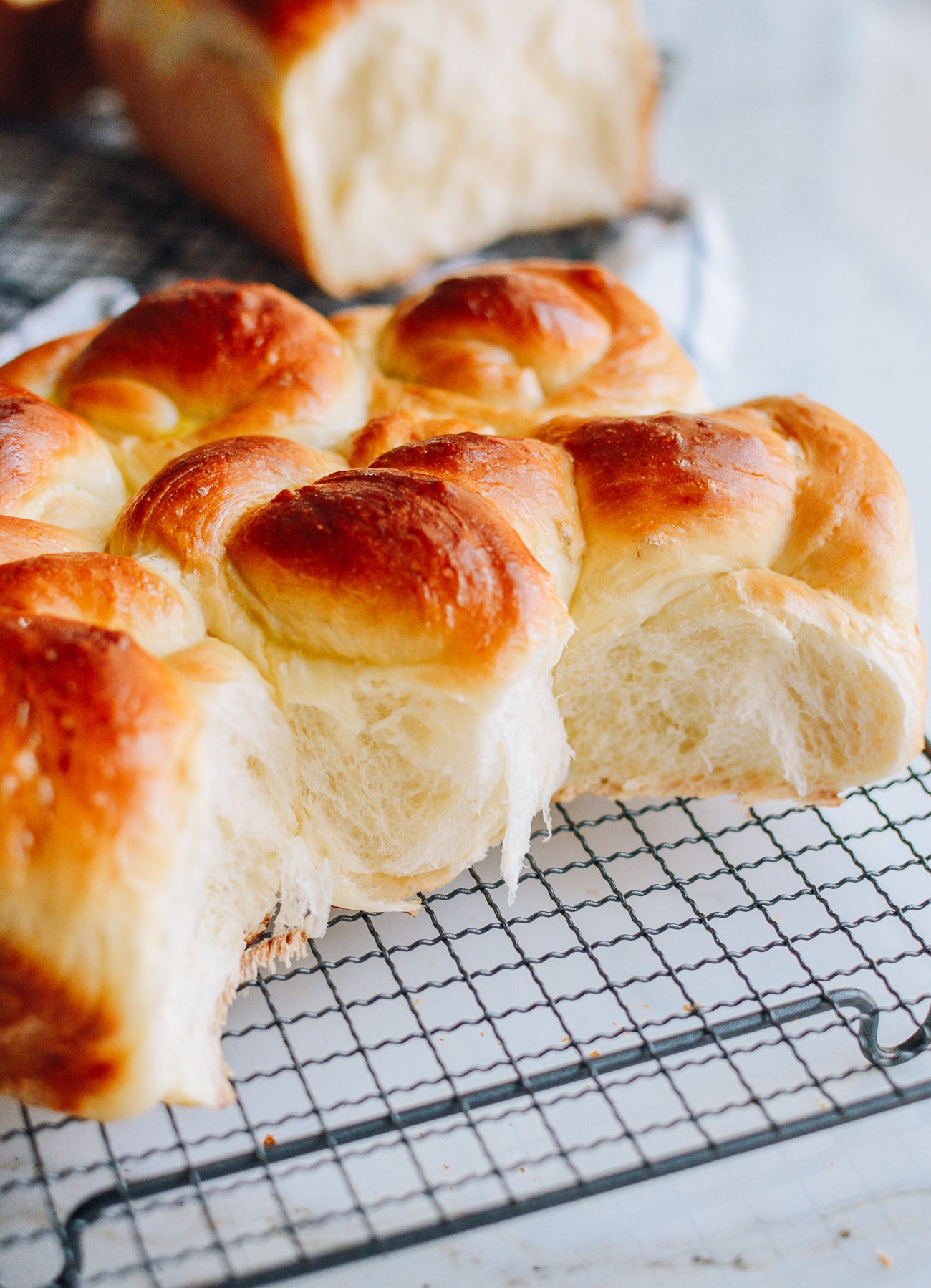
The question: what is gluten actually doing in my dough — and why does the same flour make chewy bread one day and tender cake the next?
The plain answer: wheat flour holds two proteins, glutenin and gliadin. Add water and they link into gluten: an elastic, stretchy net. Work the dough (kneading, mixing, time) and the net gets stronger and more organized, so it can trap the gas from yeast or baking powder and hold a tall, chewy loaf. Fat, sugar, acid, little water and minimal mixing keep the net weak, which is what you want for tender cakes, cookies, muffins and flaky pastry.
The science, one level deeper
Two proteins, two jobs
- Glutenin makes long, springy chains: elasticity. It’s why dough bounces back.
- Gliadin is smaller and slippery: extensibility. It’s why dough stretches without tearing.
Good bread dough needs both — elastic enough to hold gas, extensible enough to expand.
How gluten develops
- Hydration. Water lets the proteins unfold and start bonding. No water, no gluten. That’s why a rest (autolyse) after mixing flour and water builds gluten on its own. See Why We Rest Meat & Dough.
- Work. Kneading stretches and folds the proteins, lining them up into sheets and strands. Ten minutes of kneading by hand ≈ 5–7 minutes in a stand mixer with a dough hook.
- Time. Long, slow fermentation (no-knead bread, overnight doughs) develops gluten with almost no kneading. Enzymes and gentle movement do the work.
- Salt tightens and strengthens the network; dough without salt is slack and sticky.
What weakens it (on purpose)
- Fat (butter, oil, egg yolk) coats proteins so they can’t link. Hence “shortening”: it shortens gluten strands.
- Sugar competes for water.
- Low protein flour — cake and pastry flour — simply has less to work with.
- Little water, as in pie crust and shortbread.
- Minimal mixing — “stir until just combined.”
- Acid and bran: whole-wheat flour’s bran cuts strands, which is why whole-wheat loaves are denser.
Flour by protein
| Flour | Protein (approx.) | Gluten | Best for |
|---|---|---|---|
| Cake flour | 7–9% | Weak | Layer cakes, sponge, tender biscuits |
| Pastry flour | 8–9% | Weak | Pie, tart, cookies |
| All-purpose flour | 10–12% | Medium | Almost everything: cookies, quick breads, challah, pizza |
| 00 flour | 11–12.5% (varies) | Medium, very fine milled | Neapolitan pizza, fresh pasta |
| Bread flour | 12–14% | Strong | Crusty breads, bagels, chewy pizza |
| Whole wheat flour | 13–14% | Strong but cut by bran | Whole-grain breads; mix with white for lighter loaves |
More on choosing flour in Flour: Which Bag for Which Bake.
Tender vs. chewy

| You want | Do this |
|---|---|
| Chewy, open bread | Bread flour, more water, long knead or long rise, salt |
| Soft, rich bread (challah, brioche) | AP or bread flour, eggs, sugar and fat; knead longer to make up for the fat |
| Tender cake | Cake flour; cream fat and sugar; mix flour in briefly (see Creaming & Folding) |
| Tender muffins, pancakes, quick breads | Stir until just combined; lumps are fine |
| Flaky pie crust | Cold fat in pieces, little water, minimal handling, rest before rolling |
| Crisp, tender cookies | AP flour, plenty of fat and sugar, don’t overmix |
Kneading and the windowpane test

By hand: turn the dough onto a lightly floured counter. Push it away with the heel of your hand, fold it back over itself, give it a quarter-turn, repeat. In the first few minutes it’s shaggy and sticky; by 8–12 minutes it turns smooth, satiny and springy. Resist adding lots of flour — sticky dough often gets less sticky as gluten forms.
By mixer: dough hook, low-medium speed, 5–8 minutes until the dough clears the sides of the bowl.
The windowpane test: pinch off a walnut-sized piece and gently stretch it between your fingers, turning. Well-developed dough stretches so thin you can see light through it without tearing. If it tears quickly, knead 2 more minutes and test again. Enriched doughs (challah) and whole-wheat doughs won’t go quite as thin; a slightly rough pane is fine.
Poke test for proofing (a related check): after rising, press a floured finger ½ inch in. If it springs back slowly and leaves a slight dent, it’s ready. Springs back fast: needs more time. Doesn’t spring back: overproofed.
What it means at the stove
- Knead bread fully; under-kneaded dough bakes into a dense, crumbly loaf.
- Don’t knead cakes and muffins. Mix briefly after the flour goes in.
- Rest dough that fights you; gluten relaxes in 10–20 minutes.
- Add salt with the flour, not on top of the yeast directly, and don’t leave it out.
- Cold butter, cold water, quick hands for pastry.
- Weigh flour. A “cup” of flour ranges from 120 to 150 g depending on how you scoop. More in The Baking Shelf.
- Use time instead of muscle: an overnight rise in the fridge builds both gluten and flavor.
Gluten-free baking
Without wheat, rye or barley, there’s no gluten network to trap gas or hold a shape. Gluten-free recipes replace its jobs:
- Starches — rice flour, Potato starch, tapioca, Cornstarch — provide structure when they set in the oven.
- Binders — xanthan gum, psyllium husk, ground flax or chia, extra eggs — add stretch and hold gas. A typical blend uses about ½ teaspoon xanthan per cup of flour for cakes, more for bread.
- More liquid and a rest. Gluten-free batters and doughs are often wetter, and a 20–30 minute rest before baking lets the starches hydrate and reduces grittiness.
- No kneading needed — there’s nothing to develop. Mix well and handle like a thick batter.
- Use a recipe written for it, or a 1:1 blend with binder already in. Swapping a gluten-free flour into a regular bread recipe rarely works.
- Cross-contact: for anyone who must avoid gluten, use clean bowls, boards and pans, and check labels; oats are often contaminated unless labeled gluten-free.
Kosher note
On Passover, wheat flour mixed with water and left to rise becomes chametz, so ordinary baking is out. Matzo meal and matzo cake meal are made from matzo that’s already baked, so they can’t become chametz and won’t build a real gluten network; Passover cakes rely on whipped eggs and potato starch for structure. For the bread blessing (hamotzi) and challah separation, the dough must contain one of the five grains (wheat, barley, spelt, rye, oats); gluten-free breads made without them follow different rules. Ask your rabbi. See The Passover Kitchen and Cooking for Shabbat.
Myths
- “Sticky dough needs more flour.” Often it needs more kneading or a rest. Add flour by the tablespoon only.
- “Overkneading is easy by hand.” Very hard to do by hand; possible in a powerful mixer, where dough turns slack and tears.
- “No-knead bread has no gluten.” It has plenty — time built it.
- “Bread flour makes everything better.” It makes cakes and cookies tough.
Related techniques
- Why We Rest Meat & Dough — gluten relaxation and hydration
- Baking Soda vs. Baking Powder — the gas gluten traps
- Creaming & Folding — keeping gluten low in cakes
- Baking Troubleshooting — dense, tough and crumbly fixes