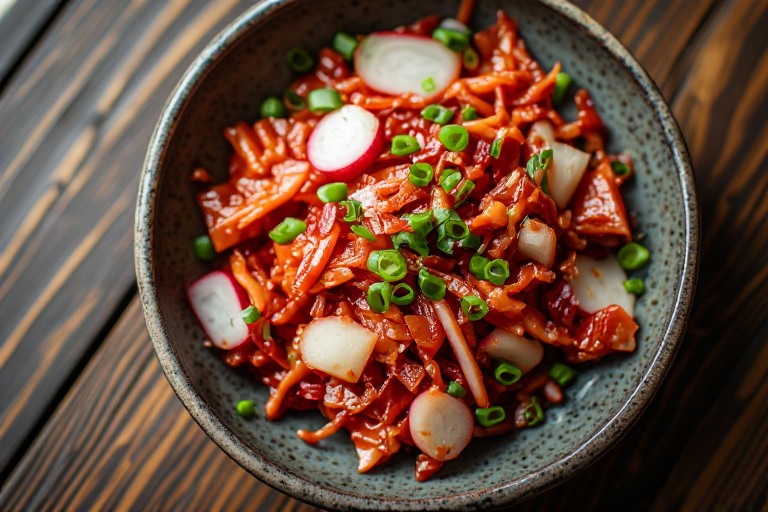
Napa Cabbage Kimchi
Printed from nanasfogon.com/recipe/napa-cabbage-kimchi-e804c1
- Prep
- 4 hr
- Cook
- 5 min
- Total
- 4 hr 5 min
Ingredients
- 1 large napa cabbage, about 4 lb (2 kg) About napa cabbage →
- ½ cup kosher salt (Diamond Crystal), for salting About kosher salt →
- For the paste
- 1 tbsp sweet (glutinous) rice flour About rice flour →
- ½ cup water
- ⅓ to ½ cup gochugaru (Korean chili flakes) Medium (1,500–10,000 SHU). Swap: 2 parts sweet paprika + 1 part red pepper flakes, same total amount
- 8 cloves garlic, minced About garlic →
- 1 tbsp grated ginger About fresh ginger →
- 3 tbsp fish sauce (or soy sauce) About fish sauce →
- 1 tbsp sugar
- To mix in
- 1 cup Korean radish or daikon, cut into matchsticks About daikon →
- 4 scallions, cut into 1-inch lengths About scallion →
- 1 small carrot, cut into matchsticks (optional)
Out of something?
- Sweet rice flour
- For thickening: for 1 tbsp, use 1/2 tbsp potato starch or cornstarch, mixed into cold liquid first. Clearer, glossier sauce. Add at the end and don't boil long: starches thin out if overcooked.
- For dredging: for 1 cup, use 1 cup potato starch, rice flour or matzo cake meal. Starch gives a thinner, crisper coating; matzo cake meal browns like flour. Rice is kitniyot for Ashkenazim.
- Garlic
- for 1 clove, use 1/8 tsp garlic powder, or 1/2 tsp jarred minced garlic. Powder is mellow and toasty, not pungent; fine in rubs and soups, poor in aioli or garlic bread.
- Ginger
- for 1 tbsp grated, use 1/4 tsp ground ginger. Warm and dusty, not bright and juicy. Fine in baking and braises; weak in stir-fries.
- Fish sauce
- for 1 tbsp, use 1 tbsp kosher-certified fish sauce, or 1 minced anchovy + 2 tsp soy sauce. Kosher fish sauce exists; look for the hechsher. Anchovy plus soy is close for dressings.
- Scallion
- for 1/4 cup sliced, use Chives (for the greens), or minced shallot or red onion (for the whites). Chives are milder and grassier.
Prep first
Get these done before you turn on the heat. Cooks call it mise en place.
Steps
-
1
Cut the cabbage lengthwise into quarters, keeping the core so the leaves hold together. Rinse each quarter.
-
2
Sprinkle the salt between every leaf, using more near the thick white stems. Lay the quarters in a large bowl or pan and leave 2 to 3 hours, turning them every 30 minutes, until the stems bend without snapping.
-
3
Rinse the cabbage three times in cold water to remove the extra salt, then drain it cut side down in a colander for 30 minutes. Taste a leaf: it should be pleasantly salty, not harsh.
-
4
Make the porridge: whisk the rice flour into the water in a small pot and cook over medium heat, stirring, until it thickens and turns translucent, 2 to 3 minutes. Let it cool.
-
5
Stir the gochugaru, garlic, ginger, fish sauce and sugar into the cooled porridge. Mix in the radish, scallions and carrot. Wear gloves for the next step; chili burns.
-
6
Spread the paste between every leaf of each quarter, then fold each quarter in half and pack it tightly into a large jar or container, pressing out the air. Leave 2 inches of space at the top for the juices.
-
7
Leave it covered at room temperature 1 to 2 days, pressing it down once a day, until it smells sour and you see small bubbles. Then refrigerate. It's good right away and keeps getting more sour for weeks. Cut it into bite-size pieces to serve.
Flavor map
How Nana pairs flavors →This one is garlicky, spicy and savory.
Goes well with
 Put it on
Sheet-Pan Gochujang Chicken and Roasted Vegetables
79% flavor match
Gochujang loves gochugaru; they share radish and scallion.
 Put it on
Biang Biang Noodles With Hot Spiced Oil
79% flavor match
Both lean on gochugaru and napa cabbage; celery loves carrot.
 Put it on
Kimchi Jjigae (Kimchi Soup)
78% flavor match
Both are savory and spicy; kimchi loves gochugaru.
 Put it on
Vietnamese Pork Chops
77% flavor match
The sweetened condensed milk takes the edge off the gochugaru; lemongrass with fish sauce is a natural match.
Log in to tell Nana which pairings are good. Your votes improve the map.
More about this recipe
Nutrition
1 of 24 servings · about 103 g Whole recipe · about 2476 g · High confidence
| % DV* | ||
|---|---|---|
| Total Fat | 0.11 g | 0% |
| Saturated Fat | 0.033 g | 0% |
| Trans Fat | 0 g | |
| Cholesterol | 0 mg | 0% |
| Sodium | 2553 mg | 111% |
| Total Carbohydrate | 6.6 g | 2% |
| Dietary Fiber | 2.3 g | 8% |
| Total Sugars | 3.5 g | |
| Protein | 1.4 g | 3% |
| Vitamin D | 0 mcg | 0% |
| Calcium | 41 mg | 3% |
| Iron | 0.52 mg | 3% |
| Potassium | 179 mg | 4% |
* % Daily Value is based on a 2,000-calorie diet.
- Carbs 80%
- Fat 3%
- Protein 17%
Vitamins & minerals
| Vitamin A | 22.9 mcg | 3% |
|---|---|---|
| Vitamin C | 32.1 mg | 36% |
| Vitamin D | 0 mcg | 0% |
| Vitamin E | 0.15 mg | 1% |
| Vitamin K | 68.9 mcg | 57% |
| Thiamin (B1) | 0.059 mg | 5% |
| Riboflavin (B2) | 0.043 mg | 3% |
| Niacin (B3) | 0.32 mg | 2% |
| Pantothenic acid (B5) | 0.2 mg | 4% |
| Vitamin B6 | 0.13 mg | 8% |
| Folate | 41.2 mcg DFE | 10% |
| Vitamin B12 | 0.011 mcg | 0% |
| Choline | 10 mg | 2% |
| Calcium | 41 mg | 3% |
| Iron | 0.52 mg | 3% |
| Potassium | 179 mg | 4% |
| Magnesium | 16 mg | 4% |
| Phosphorus | 26 mg | 2% |
| Zinc | 0.2 mg | 2% |
| Copper | 0.028 mg | 3% |
| Manganese | 0.17 mg | 8% |
| Selenium | 0.76 mcg | 1% |
Fats & carbs in detail
| Monounsaturated fat | 0.017 g | |
|---|---|---|
| Polyunsaturated fat | 0.025 g | |
| Omega-3 | 0.002 g | 0% |
| Omega-6 | 0.023 g | 0% |
| Starch | 0.03 g | |
| Net carbs | 4.3 g | |
| Omega-6 : Omega-3 ratio | 11.5 : 1 |
Amino acids (protein building blocks)
| Histidine | 0.023 g | |
|---|---|---|
| Isoleucine | 0.033 g | |
| Leucine | 0.046 g | |
| Lysine | 0.046 g | |
| Methionine | 0.013 g | |
| Cystine | 0.013 g | |
| Phenylalanine | 0.035 g | |
| Tyrosine | 0.02 g | |
| Threonine | 0.039 g | |
| Tryptophan | 0.011 g | |
| Valine | 0.045 g |
How we calculated this
| Ingredient | Counted as | g | kcal |
|---|---|---|---|
| 1 large napa cabbage, about 4 lb (2 kg) | Cabbage, raw | 2000 | 500 |
| ½ cup kosher salt (Diamond Crystal), for salting | Salt, table | 146 | 0 |
| 1 tbsp sweet (glutinous) rice flour | Wheat flour, white, all-purpose, enriched, bleached | 8 | 28 |
| ½ cup water | Water | 0 | |
| ⅓ to ½ cup gochugaru (Korean chili flakes) | Not found — no matching food | ||
| 8 cloves garlic, minced | Garlic, raw | 24 | 36 |
| 1 tbsp grated ginger | Ginger root, raw | 6 | 5 |
| 3 tbsp fish sauce (or soy sauce) | Sauce, fish, ready-to-serve | 54 | 19 |
| 1 tbsp sugar | Sugars, granulated | 12 | 48 |
| 1 cup Korean radish or daikon, cut into matchsticks | Radishes, raw | 116 | 19 |
| 4 scallions, cut into 1-inch lengths | Onions, spring or scallions (includes tops and bulb), raw | 60 | 19 |
| 1 small carrot, cut into matchsticks (optional) | Carrots, raw | 50 | 20 |
Matched to the USDA FoodData Central database (SR Legacy). Amounts are converted with USDA portion weights where they exist, otherwise typical sizes. Open in the analyzer to adjust a match →
Estimated from the ingredient list — brands, exact sizes and cooking losses vary. Not medical advice.
Allergens
-
Fish › Anchovy
In: 3 tbsp fish sauce (or soy sauce)
Finned fish. Fish sauce, Worcestershire and Caesar dressing usually contain anchovy.
-
Carrot
In: 1 small carrot, cut into matchsticks (optional)
-
Nightshades › Hot chili peppers
In: ⅓ to ½ cup gochugaru (Korean chili flakes)
Tomato, potato, peppers (sweet and hot), eggplant, tomatillo and goji. Sweet potatoes are not nightshades.
-
Onion & garlic family › Garlic
In: 8 cloves garlic, minced
Onions, shallots, garlic, leeks, scallions and chives, including powders.
-
Ginger
In: 1 tbsp grated ginger
-
Onion & garlic family › Leek, scallion & chives
In: 4 scallions, cut into 1-inch lengths
Onions, shallots, garlic, leeks, scallions and chives, including powders.
-
Rice
In: 1 tbsp sweet (glutinous) rice flour
-
Soy › Soy sauce & tamari (brewed)
In: 3 tbsp fish sauce (or soy sauce)
Fermented soy sauces. Much of the protein is broken down in brewing.
-
Gluten › Wheat
In: 3 tbsp fish sauce (or soy sauce)
Wheat, barley, rye and oats (oats are often cross-contaminated). Celiac disease and wheat allergy are different — pick just Wheat if only wheat is the problem.
Found by reading the ingredient names. Brands and "may contain" warnings vary, so always check the label.
Questions about this recipe
- Can I make this ahead of time?
- Yes, it is meant to be made in advance; it takes a day or two at room temperature to begin fermenting before it can be stored in the fridge.
- How do I store or freeze the kimchi?
- Store it in an airtight jar in the refrigerator where it will keep for several weeks; freezing is not recommended as it destroys the cabbage's crunch.
- What can I use if I don't have gochugaru?
- You can substitute with a mix of crushed red pepper flakes and a pinch of paprika, though the flavor and color will differ from traditional Korean chili flakes.
- How do I know when the fermentation is complete?
- It is ready for the refrigerator once you notice small bubbles forming in the jar and it develops a characteristic sour smell.
- What should I serve with this kimchi?
- It pairs perfectly with steamed white rice, grilled meats, or used as a topping for bowls and sandwiches.
My notes
Log in to keep private notes on recipes.
Learn while you cook
Learn library →Words in this recipe
- Fold
- To combine a light, airy mixture (whipped cream, egg whites) into a heavier one with gentle cutting and turning strokes, keeping as much air as possible. Learn more
Handy for this recipe Safe Cooking TemperaturesMeasurements & ConversionsSubstitution Finder