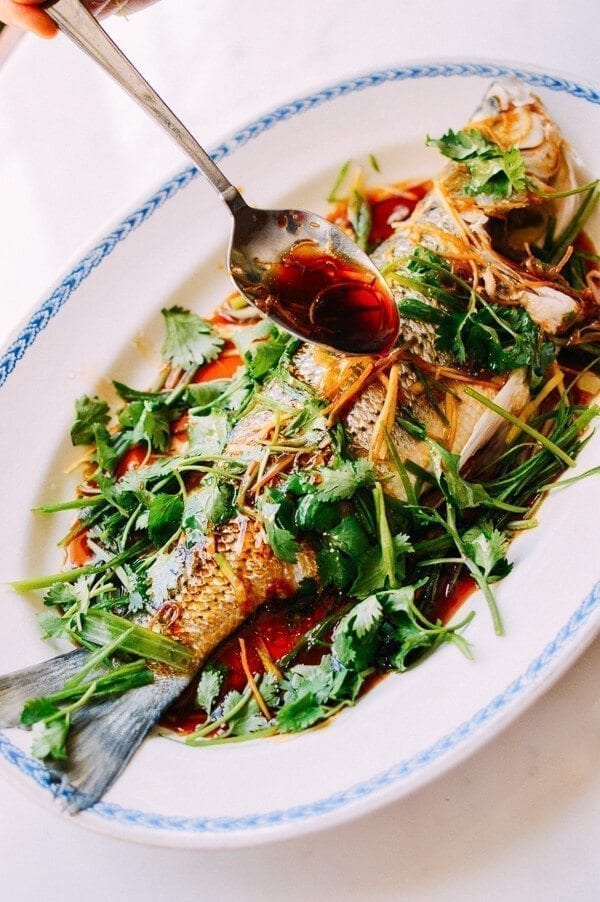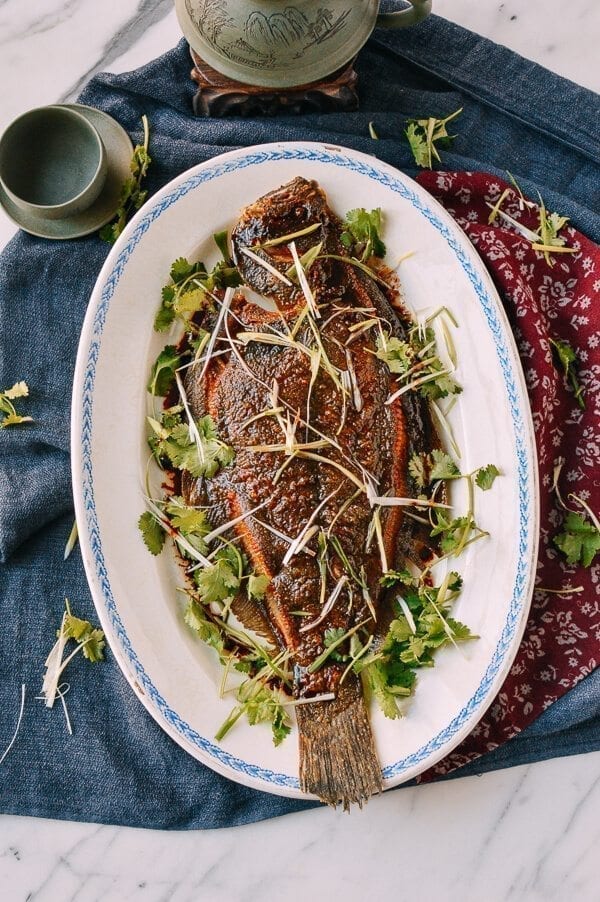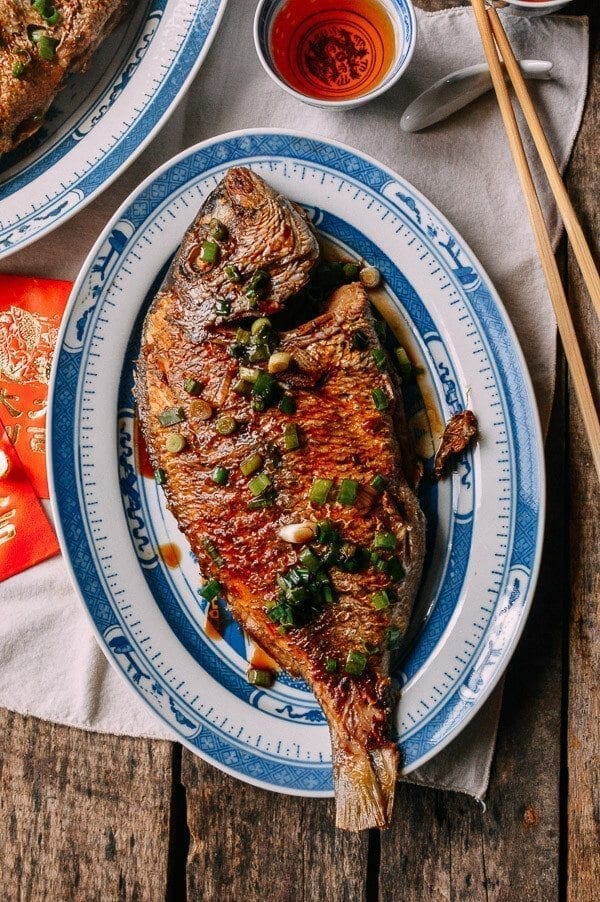
Pan Fried Fish: Chinese Whole Fish Recipe
- Prep
- 30 min
- Cook
- 15 min
- Total
- 45 min
Nana's pick of 3 versions. Compare them →
Ingredients
- 2 porgies (about 1 to 1½ pounds each; 450g-650g)
- 1/4 teaspoon salt About table salt →
- 3 tablespoons vegetable oil About neutral oil →
- 5 slices ginger (1/8-inch thick) About fresh ginger →
- 1 teaspoon sugar
- 2 tablespoons hot water
- 2 tablespoons soy sauce About soy sauce →
- Pinch fresh ground white pepper About white pepper →
- ¼ teaspoon sesame oil (optional) About toasted sesame oil →
- 2 tablespoons Shaoxing wine About shaoxing wine →
- 2 scallions (chopped) About scallion →
Steps
-
1
Clean the fish, removing all scales, making sure to pay attention to scales on the belly, the head, and near the fins. Even if you have it cleaned at your fish market, fish mongers always tend to miss some scales. Make sure you clean out the inside of the fish as well.
-
2
Let the fish drain in a colander and pat both sides dry with a paper towel. Transfer to a plate. Sprinkle salt on both sides of both fish--use about 1/4 teaspoon in total. Set aside for 15 minutes.
-
3
Heat your wok over medium-high heat, and spread 3 tablespoons of oil around the perimeter. Add the ginger. After about 10 seconds, turn the ginger over for another 10 seconds and push them to the side. The wok should be hot but not smoking too much (an indication that the wok is too hot). The ginger should be slightly caramelized but not burned.
-
4
Use a paper towel to pat the fish dry again, and carefully place into the wok in one motion. Do not move the fish! After about 1 minute, turn the heat down to medium; you want to get a nice light crust on the skin without it burning. Tilt the wok carefully one side at a time so the oil distributes around the perimeter of the fish, including the head and the tail. You can add more oil around the perimeter of the wok if you want some extra insurance against sticking.
-
5
Continue frying the fish for 5 to 6 minutes on the first side. At this point, a light crust should have formed, and you can give the wok a little shake now--the fish should slide around easily. If not, you can use a metal spatula to lift the fish slightly and peek underneath to check the color and to make sure the fish is not sticking. The fish should be a nice golden brown.
-
6
If the fish still sticks, then you probably have the heat too low, so turn it up slightly, add a little more oil, and let it cook for another 1 to 2 minutes! Once you have the fish sliding around in the wok or pan and the first side is golden brown, then you are ready for the flip! Carefully slide the spatula under the middle of the fish on the side towards the middle of the wok and in one steady motion, lift and flip it towards the outside of the wok. Repeat the same “flip” for the other fish.
-
7
Let the fish fry on the second side for another 4 minutes and again, add some oil if you think it is necessary. While the fish is frying, dissolve the sugar and hot water in a small bowl, and add the soy sauce, white pepper, and sesame oil (if using). Set aside.
-
8
Shake the wok to make sure the fish is not stuck. Next, add the Shaoxing wine around the perimeter of the wok and let cook off for 30 seconds. Pour the soy sauce mixture around the perimeter of the wok and turn the heat back up until the sauce is simmering (about 30 seconds). Add in the chopped scallions.
-
9
Turn off the heat, and use your spatula to carefully transfer the fish to serving plates. Scoop up the rest of the remaining sauce, pour evenly over the fish and serve!
More about this recipe
Nutrition
1 of 6 servings · about 25 g Whole recipe · about 150 g · High confidence
| % DV* | ||
|---|---|---|
| Total Fat | 7.1 g | 9% |
| Saturated Fat | 1.1 g | 6% |
| Trans Fat | 0.036 g | |
| Cholesterol | 0 mg | 0% |
| Sodium | 391 mg | 17% |
| Total Carbohydrate | 1.8 g | 1% |
| Dietary Fiber | 0.22 g | 1% |
| Total Sugars | 0.89 g | |
| Protein | 0.56 g | 1% |
| Vitamin D | 0 mcg | 0% |
| Calcium | 6 mg | 0% |
| Iron | 0.19 mg | 1% |
| Potassium | 51 mg | 1% |
* % Daily Value is based on a 2,000-calorie diet.
- Carbs 10%
- Fat 87%
- Protein 3%
Vitamins & minerals
| Vitamin A | 2.5 mcg | 0% |
|---|---|---|
| Vitamin C | 1 mg | 1% |
| Vitamin D | 0 mcg | 0% |
| Vitamin E | 0.59 mg | 4% |
| Vitamin K | 23 mcg | 19% |
| Thiamin (B1) | 0.005 mg | 0% |
| Riboflavin (B2) | 0.015 mg | 1% |
| Niacin (B3) | 0.17 mg | 1% |
| Pantothenic acid (B5) | 0.025 mg | 1% |
| Vitamin B6 | 0.017 mg | 1% |
| Folate | 4.2 mcg DFE | 1% |
| Vitamin B12 | 0 mcg | 0% |
| Choline | 2 mg | 0% |
| Calcium | 6 mg | 0% |
| Iron | 0.19 mg | 1% |
| Potassium | 51 mg | 1% |
| Magnesium | 6 mg | 2% |
| Phosphorus | 12 mg | 1% |
| Zinc | 0.08 mg | 1% |
| Copper | 0.012 mg | 1% |
| Manganese | 0.076 mg | 3% |
| Selenium | 0.085 mcg | 0% |
Fats & carbs in detail
| Monounsaturated fat | 1.6 g | |
|---|---|---|
| Polyunsaturated fat | 4 g | |
| Omega-3 | 0.47 g | 29% |
| Omega-6 | 3.5 g | 21% |
| Starch | 0 g | |
| Net carbs | 1.6 g | |
| Omega-6 : Omega-3 ratio | 7.5 : 1 |
Amino acids (protein building blocks)
| Histidine | 0.011 g | |
|---|---|---|
| Isoleucine | 0.022 g | |
| Leucine | 0.036 g | |
| Lysine | 0.026 g | |
| Methionine | 0.006 g | |
| Cystine | 0.006 g | |
| Phenylalanine | 0.023 g | |
| Tyrosine | 0.016 g | |
| Threonine | 0.019 g | |
| Tryptophan | 0.006 g | |
| Valine | 0.023 g |
How we calculated this
| Ingredient | Counted as | g | kcal |
|---|---|---|---|
| 2 porgies (about 1 to 1½ pounds each; 450g-650g) | Not found — no matching food | ||
| 1/4 teaspoon salt | Salt, table | 2 | 0 |
| 3 tablespoons vegetable oil | Oil, soybean, salad or cooking | 41 | 361 |
| 5 slices ginger (1/8-inch thick) | Ginger root, raw | 11 | 9 |
| 1 teaspoon sugar | Sugars, granulated | 4 | 16 |
| 2 tablespoons hot water | Water | 0 | |
| 2 tablespoons soy sauce | Soy sauce made from soy and wheat (shoyu) | 32 | 17 |
| Pinch fresh ground white pepper | Spices, pepper, black | 0 | 0 |
| ¼ teaspoon sesame oil (optional) | Oil, sesame, salad or cooking | 1 | 10 |
| 2 tablespoons Shaoxing wine | Alcoholic beverage, wine, table, red | 29 | 25 |
| 2 scallions (chopped) | Onions, spring or scallions (includes tops and bulb), raw | 30 | 10 |
Matched to the USDA FoodData Central database (SR Legacy). Amounts are converted with USDA portion weights where they exist, otherwise typical sizes. Open in the analyzer to adjust a match →
Estimated from the ingredient list — brands, exact sizes and cooking losses vary. Not medical advice.
Allergens
-
Alcohol
In: 2 tablespoons Shaoxing wine
Not a true allergy, but listed for people who must avoid it.
-
Black & white pepper
In: Pinch fresh ground white pepper
-
Ginger
In: 5 slices ginger (1/8-inch thick)
-
Onion & garlic family › Leek, scallion & chives
In: 2 scallions (chopped)
Onions, shallots, garlic, leeks, scallions and chives, including powders.
-
Sesame
In: ¼ teaspoon sesame oil (optional)
Sesame seeds and oil, tahini, halva; za'atar and furikake usually contain sesame.
-
Soy › Soy sauce & tamari (brewed)
In: 2 tablespoons soy sauce
Fermented soy sauces. Much of the protein is broken down in brewing.
-
Sulfites
In: 2 tablespoons Shaoxing wine
Sulfites are preservatives found in wine, wine and balsamic vinegar, dried fruit and pickled foods.
-
Gluten › Wheat
In: 2 tablespoons soy sauce
Wheat, barley, rye and oats (oats are often cross-contaminated). Celiac disease and wheat allergy are different — pick just Wheat if only wheat is the problem.
Found by reading the ingredient names. Brands and "may contain" warnings vary, so always check the label.
My notes
Log in to keep private notes on recipes.
Learn while you cook
Learn library →- Ingredient Deep-Dives · 8 min read The Onion Family Yellow onions for cooking, red for raw, shallots for sauces; the finer you cut garlic or onion, the stronger it gets, a…
- Why It Works · 4 min read Browning: Maillard vs. Caramelization Browning is two different reactions — Maillard (proteins plus sugars, from about 280°F) and caramelization (sugar alone…
Words in this recipe
- Caramelize
- To brown sugar with heat, creating hundreds of new flavor compounds. Loosely, also used for browning onions and vegetables, which mostly involves the Maillard reaction too. Learn more
- Simmer
- Liquid just below a boil, about 185 to 205°F, with small bubbles rising gently.
- Rest
- To let food sit after cooking (meat) or mixing (dough, batter) so juices redistribute or gluten relaxes. Learn more
Handy for this recipe Safe Cooking TemperaturesSubstitution Finder