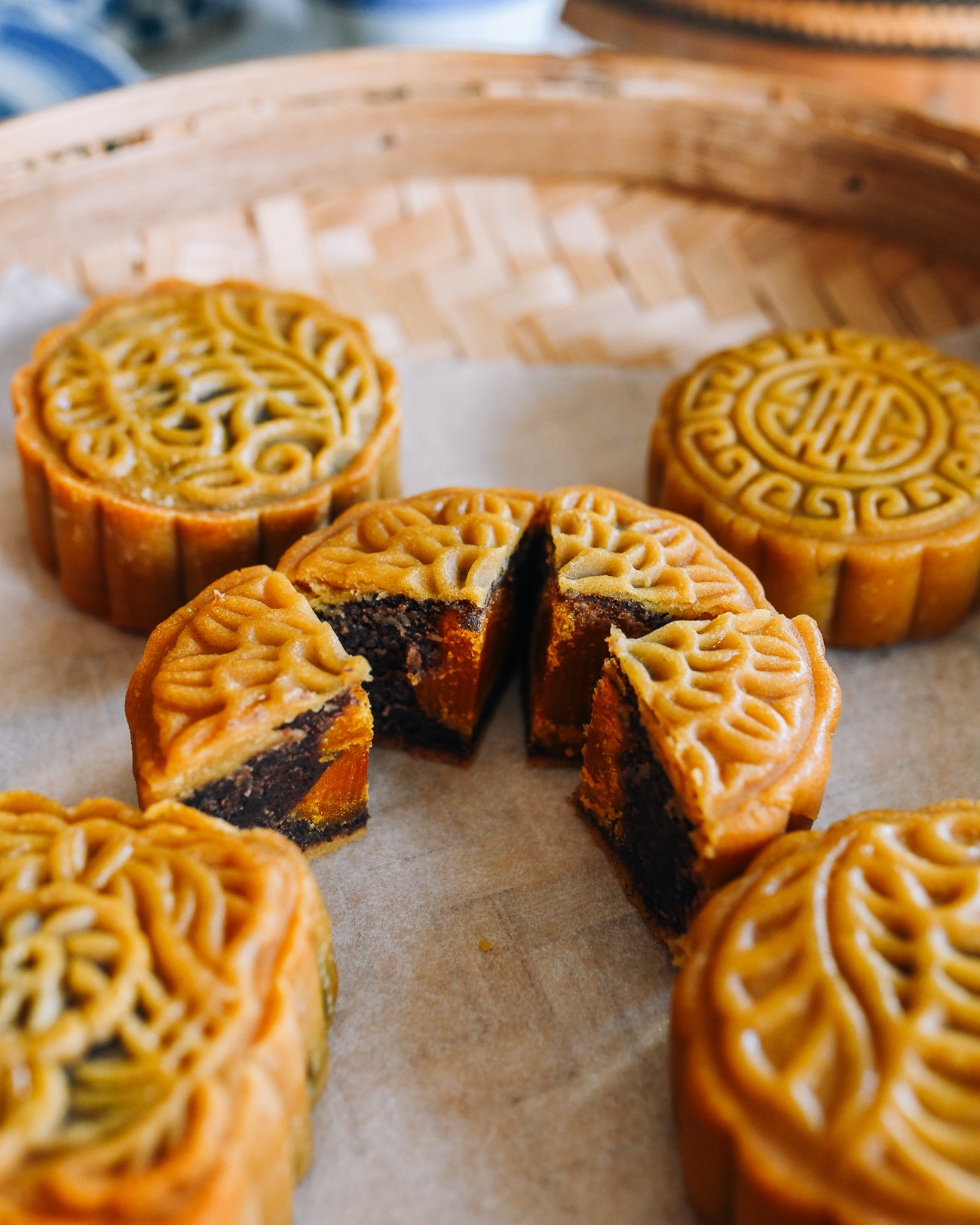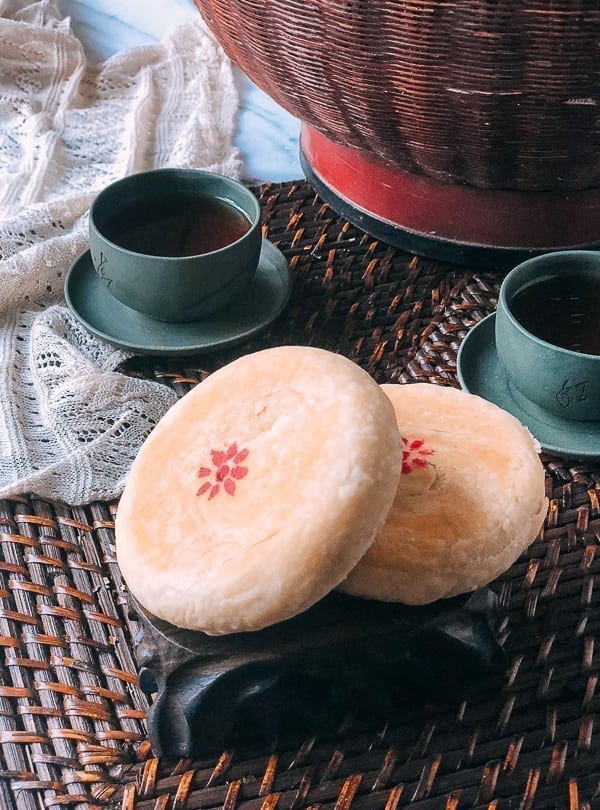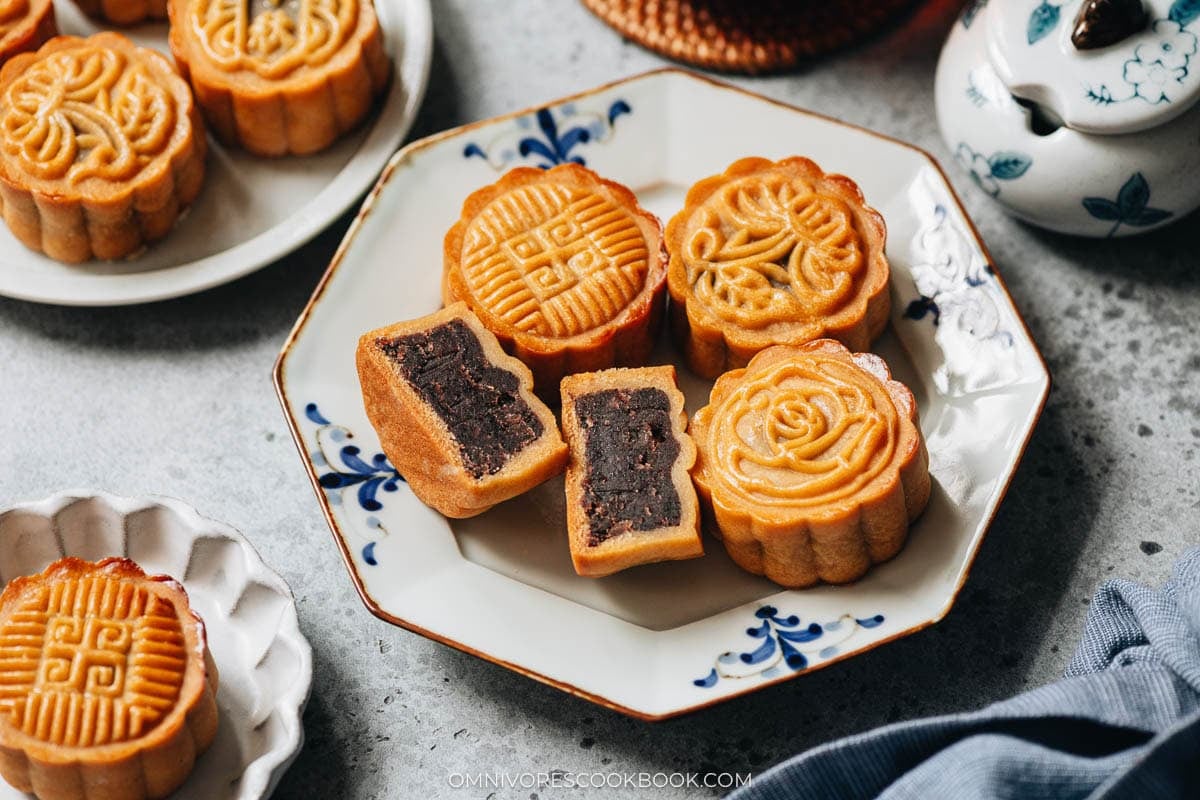
Red Bean Mooncake (红豆沙月饼)
- Prep
- 150 min
- Cook
- 90 min
- Total
- 4 hr
Ingredients
Dairy-free version. Swapped:
milk → unsweetened oat milk
Good for vegan, lactose-free and kosher meat meals. Check labels: some plant butters and creamers aren't certified parve or contain nuts or coconut.
- 200 grams dried red beans
- 100 grams maltose (*Footnote 1)
- 100 grams sugar (*Footnote 2)
- 80 grams vegetable oil About neutral oil →
- 140 grams golden syrup
- 4 grams (3/4 teaspoon) teaspoon kansui (*Footnote 3)
- 50 grams vegetable oil About neutral oil →
- 1/8 teaspoon salt About table salt →
- 200 grams cake flour About cake flour →
- 9 salted egg duck yolks , halved (*Footnote 4) About eggs →
- 1 egg yolk About eggs →
- 1 teaspoon milk (or water) About whole milk →
- 50 g mooncake mold
- Rolling pin
- Scale (*Footnote 5)
- Pastry brush
Steps
-
1
Make the red bean filling
-
2
Cook the red beans: Add the red beans and 1 1/2 cups water (*Footnote 6) to an Instant Pot. Cook on high pressure for 45 minutes, then allow the pressure to release naturally. (*Footnote 7)
-
3
Blend the red beans: Transfer the cooked red beans to a food processor. Blend on the lowest speed setting until mostly smooth. (*Footnote 8) It is fine if a few small pieces of bean remain.
-
4
Incorporate the sugar: Transfer the red bean mixture to a 9-inch nonstick frying pan. At this point, the paste should be quite thick and not runny at all. (*Footnote 9) Add the maltose and sugar. Cook over medium heat until the pan heats up and the maltose starts to bubble, then reduce to medium-low heat. Cook, stirring constantly, until the sugar and maltose have dissolved and are fully incorporated. The paste will become softer and more spreadable at this stage.
-
5
Emulsify the oil: Add the vegetable oil about 2 tablespoons at a time, stirring vigorously and constantly. Wait until each addition is completely absorbed and there is no visible oil left in the pan before adding more. Continue cooking and stirring until the paste is cohesive, pulls away cleanly from the pan, and holds a soft mound. This took me about 20 minutes over medium-low heat. Do not cook the paste until it becomes very firm, as it will firm up considerably as it cools.
-
6
Cool the paste: Transfer the red bean paste to a large plate or shallow bowl. Press and smooth the paste a few times to remove any air pockets. Let cool until no longer piping hot, then press plastic wrap directly against the surface to prevent a skin from forming. Refrigerate until completely cooled. Once chilled, the paste should look glossy and feel soft and pliable, but it should be easy to shape with your hands without sticking.
-
7
Make the mooncake dough
-
8
Combine the liquid ingredients: Add the golden syrup, kansui, vegetable oil, and salt to a large bowl. Mix with a spatula until fully emulsified.
-
9
Make the dough: Add the cake flour. Gently fold, scraping from the bottom of the bowl to the top as you would when folding cake batter. Avoid stirring vigorously in a circular motion, which can make the dough tough. Once the flour is fully incorporated, gently shape the dough into a ball with your hands. The dough should be soft and slightly sticky but able to hold its shape.
-
10
Rest the dough: Cover tightly with plastic wrap and let rest for 2 hours.
-
11
Assemble the mooncakes
-
12
Shape the filling: If not using salted egg yolks, divide the completely cooled red bean paste into 30 g portions and roll each portion into a ball. If using salted egg yolks, place half a yolk (about 7 to 8 g) on a scale and add enough red bean paste to bring the total weight to 30 g. Shape the paste into a ball, then flatten it into a disk. Place the egg yolk in the center and wrap the paste around it until completely covered. Roll into a smooth ball. Place the filling balls on a tray and keep covered.
-
13
Shape the mooncake dough: Once the dough has rested, divide it into 20 g portions. Shape each piece into a ball and place on a large tray. Cover with plastic wrap to prevent the dough from drying out.
-
14
Preheat the oven: Preheat the oven to 400°F (200°C). Line a baking sheet with parchment paper.
-
15
Assemble: Place one dough ball between two pieces of parchment paper. Press it down with your palm, then roll it into a round disk about 4 inches (10 cm) in diameter. Remove the top sheet of parchment and place a filling ball in the center. Carefully peel the dough from the bottom parchment and wrap it around the filling. Gently squeeze out as many air pockets as possible while spreading the dough until the filling is completely enclosed. If any filling remains exposed, pinch off a small piece of dough from a thicker spot and use it to patch the area. The dough does not need to look perfectly even at this stage as long as the filling is fully covered. Roll gently between your hands to form a smooth ball. Place on the prepared baking sheet and repeat with the remaining dough and filling.
-
16
Mold the mooncakes: Insert the pattern disc into the mooncake mold, pattern side down, and secure it according to the mold's instructions. Lightly dust a mooncake ball with cake flour and shake off any excess. Place the mooncake dough into the mold with the side that has the thicker layer of dough facing the pattern disc. Set the mold on a clean work surface lightly dusted with flour and press the handle down firmly until it cannot move any farther. Hold for about 5 seconds to set the pattern. Lift the mold and press the handle to release the mooncake onto the lined baking sheet. Repeat with the remaining mooncakes, spacing them about 1 inch apart.
-
17
Set the pattern: Very lightly mist the mooncakes with water to help prevent cracking. Bake for 5 minutes, until the patterns are set and the edges are just beginning to turn pale golden.
-
18
Make the egg wash: Meanwhile, beat the egg yolk with the milk or water in a small bowl until smooth.
-
19
Brush with egg wash: Remove the mooncakes from the oven. Very lightly brush the raised surfaces of the patterns with egg wash, avoiding the sides and recessed areas as much as possible. If too much egg wash collects in the pattern, use a small clean brush to remove the excess.
-
20
Finish baking: Return the mooncakes to the oven and immediately lower the temperature to 350°F (176°C). Bake until the mooncakes are golden all over and the edges are golden brown, 12 to 15 minutes. Let cool on the baking sheet for 20 minutes, then transfer to a plate or cooling rack to cool completely.
-
21
Rest the mooncakes: Once completely cooled, transfer the mooncakes to an airtight container. They can be served after 24 hours, but their color and texture will continue to improve over the next 2 to 3 days. (*Footnote 10)
-
22
Storage
-
23
Store the mooncakes in an airtight container in a cool, dark place for up to 1 week. For longer storage, refrigerate for 2 to 3 weeks or freeze for up to 2 months. Bring refrigerated mooncakes to room temperature before serving. Thaw frozen mooncakes overnight in the refrigerator, then bring to room temperature before serving.
More about this recipe
Nutrition
1 of 18 servings · about 34 g Whole recipe · about 606 g · Rough estimate
| % DV* | ||
|---|---|---|
| Total Fat | 9.8 g | 13% |
| Saturated Fat | 2 g | 10% |
| Trans Fat | 0.038 g | |
| Cholesterol | 103 mg | 34% |
| Sodium | 21 mg | 1% |
| Total Carbohydrate | 14.6 g | 5% |
| Dietary Fiber | 0.19 g | 1% |
| Total Sugars | 5.7 g | |
| Protein | 2.4 g | 5% |
| Vitamin D | 0.51 mcg | 3% |
| Calcium | 14 mg | 1% |
| Iron | 1.1 mg | 6% |
| Potassium | 22 mg | 0% |
* % Daily Value is based on a 2,000-calorie diet.
- Carbs 37%
- Fat 57%
- Protein 6%
Vitamins & minerals
| Vitamin A | 36.1 mcg | 4% |
|---|---|---|
| Vitamin C | 0 mg | 0% |
| Vitamin D | 0.51 mcg | 3% |
| Vitamin E | 0.84 mg | 6% |
| Vitamin K | 13.4 mcg | 11% |
| Thiamin (B1) | 0.12 mg | 10% |
| Riboflavin (B2) | 0.099 mg | 8% |
| Niacin (B3) | 0.76 mg | 5% |
| Pantothenic acid (B5) | 0.33 mg | 7% |
| Vitamin B6 | 0.037 mg | 2% |
| Folate | 45.1 mcg DFE | 11% |
| Vitamin B12 | 0.19 mcg | 8% |
| Choline | 79 mg | 14% |
| Calcium | 14 mg | 1% |
| Iron | 1.1 mg | 6% |
| Potassium | 22 mg | 0% |
| Magnesium | 2 mg | 1% |
| Phosphorus | 47 mg | 4% |
| Zinc | 0.29 mg | 3% |
| Copper | 0.023 mg | 3% |
| Manganese | 0.076 mg | 3% |
| Selenium | 5.9 mcg | 11% |
Fats & carbs in detail
| Monounsaturated fat | 2.8 g | |
|---|---|---|
| Polyunsaturated fat | 4.6 g | |
| Omega-3 | 0.51 g | 32% |
| Omega-6 | 4.1 g | 24% |
| Starch | 0 g | |
| Net carbs | 14.4 g | |
| Omega-6 : Omega-3 ratio | 8.0 : 1 |
Amino acids (protein building blocks)
| Histidine | 0.058 g | |
|---|---|---|
| Isoleucine | 0.12 g | |
| Leucine | 0.19 g | |
| Lysine | 0.15 g | |
| Methionine | 0.051 g | |
| Cystine | 0.045 g | |
| Phenylalanine | 0.11 g | |
| Tyrosine | 0.09 g | |
| Threonine | 0.09 g | |
| Tryptophan | 0.03 g | |
| Valine | 0.13 g |
How we calculated this
| Ingredient | Counted as | g | kcal |
|---|---|---|---|
| 200 grams dried red beans | Not found — no matching food | ||
| 100 grams maltose (*Footnote 1) | Not found — no matching food | ||
| 100 grams sugar (*Footnote 2) | Sugars, granulated | 100 | 387 |
| 80 grams vegetable oil | Oil, soybean, salad or cooking | 80 | 707 |
| 140 grams golden syrup | Not found — no matching food | ||
| 4 grams (3/4 teaspoon) teaspoon kansui (*Footnote 3) | Not found — no matching food | ||
| 50 grams vegetable oil | Oil, soybean, salad or cooking | 50 | 442 |
| 1/8 teaspoon salt | Salt, table | 1 | 0 |
| 200 grams cake flour | Wheat flour, white, cake, enriched | 200 | 724 |
| 9 salted egg duck yolks , halved (*Footnote 4) | Egg, yolk, raw, fresh | 153 | 493 |
| 1 egg yolk | Egg, yolk, raw, fresh | 17 | 55 |
| 1 teaspoon milk (or water) | Milk, whole, 3.25% milkfat, with added vitamin D | 5 | 3 |
| 50 g mooncake mold | Not counted — kitchen equipment | ||
| Rolling pin | Not counted — no amount (to taste / garnish) | ||
| Scale (*Footnote 5) | Not counted — no amount (to taste / garnish) | ||
| Pastry brush | Not counted — no amount (to taste / garnish) |
Matched to the USDA FoodData Central database (SR Legacy). Amounts are converted with USDA portion weights where they exist, otherwise typical sizes. Open in the analyzer to adjust a match →
Estimated from the ingredient list — brands, exact sizes and cooking losses vary. Not medical advice.
Allergens
-
Legumes › Beans: black, kidney, pinto, white…
In: 200 grams dried red beans
Beans, peas, lentils, chickpeas and their relatives, including lupin, fenugreek and guar gum. Peanut and soy are legumes too: checking the whole family avoids them as well.
-
Poultry meat › Duck & goose
In: 9 salted egg duck yolks , halved (*Footnote 4)
Chicken, turkey, duck and goose meat (separate from egg allergy).
-
Egg
In: 9 salted egg duck yolks , halved (*Footnote 4); 1 egg yolk
Whole eggs, yolks, whites and egg-based sauces like mayonnaise, aioli and hollandaise.
-
Milk / dairy
In: 1 teaspoon milk (or water)
Cow's milk and anything made from it: butter, cream, cheese, yogurt, whey, casein, ghee.
-
Gluten › Wheat
In: 200 grams cake flour
Wheat, barley, rye and oats (oats are often cross-contaminated). Celiac disease and wheat allergy are different — pick just Wheat if only wheat is the problem.
Found by reading the ingredient names. Brands and "may contain" warnings vary, so always check the label.
Questions about this recipe
- Can I make the red bean paste ahead of time?
- Yes, the paste should be made and refrigerated until completely cooled before you begin assembling the mooncakes.
- How do I store these mooncakes, and can they be frozen?
- Store them in an airtight container at room temperature; they can be frozen in airtight bags for several weeks and thawed overnight in the fridge.
- What can I use if I can't find kansui or maltose?
- You can substitute maltose with a similar thick syrup like corn syrup, and for kansui, a tiny pinch of baking soda mixed with water can work, though the texture may vary slightly.
- How can I tell when the mooncakes are done baking?
- They are done when the crust turns a soft, glossy golden brown, usually occurring shortly after the high-heat burst.
- What is the best way to serve these?
- Serve them with a hot pot of oolong or jasmine tea to balance the richness of the red bean and salted egg yolk.
My notes
Log in to keep private notes on recipes.
Learn while you cook
Learn library →- Techniques · 5 min read Emulsions An emulsion is fat broken into droplets small enough to hang in water — you need an emulsifier, a slow start, and the r…
- Why It Works · 5 min read Why We Rest Meat & Dough Meat keeps cooking after it leaves the heat, so pull it early and let it rest; dough rests so gluten relaxes and flour …
- Why It Works · 4 min read Browning: Maillard vs. Caramelization Browning is two different reactions — Maillard (proteins plus sugars, from about 280°F) and caramelization (sugar alone…
Words in this recipe
- Reduce
- To simmer a liquid so water evaporates, concentrating flavor and thickening it. Learn more
- Fold
- To combine a light, airy mixture (whipped cream, egg whites) into a heavier one with gentle cutting and turning strokes, keeping as much air as possible. Learn more
- Rest
- To let food sit after cooking (meat) or mixing (dough, batter) so juices redistribute or gluten relaxes. Learn more
- Egg wash
- Beaten egg, sometimes with water, milk or yolk only, brushed on dough for shine and color.
Handy for this recipe Safe Cooking TemperaturesMeasurements & ConversionsSubstitution Finder