
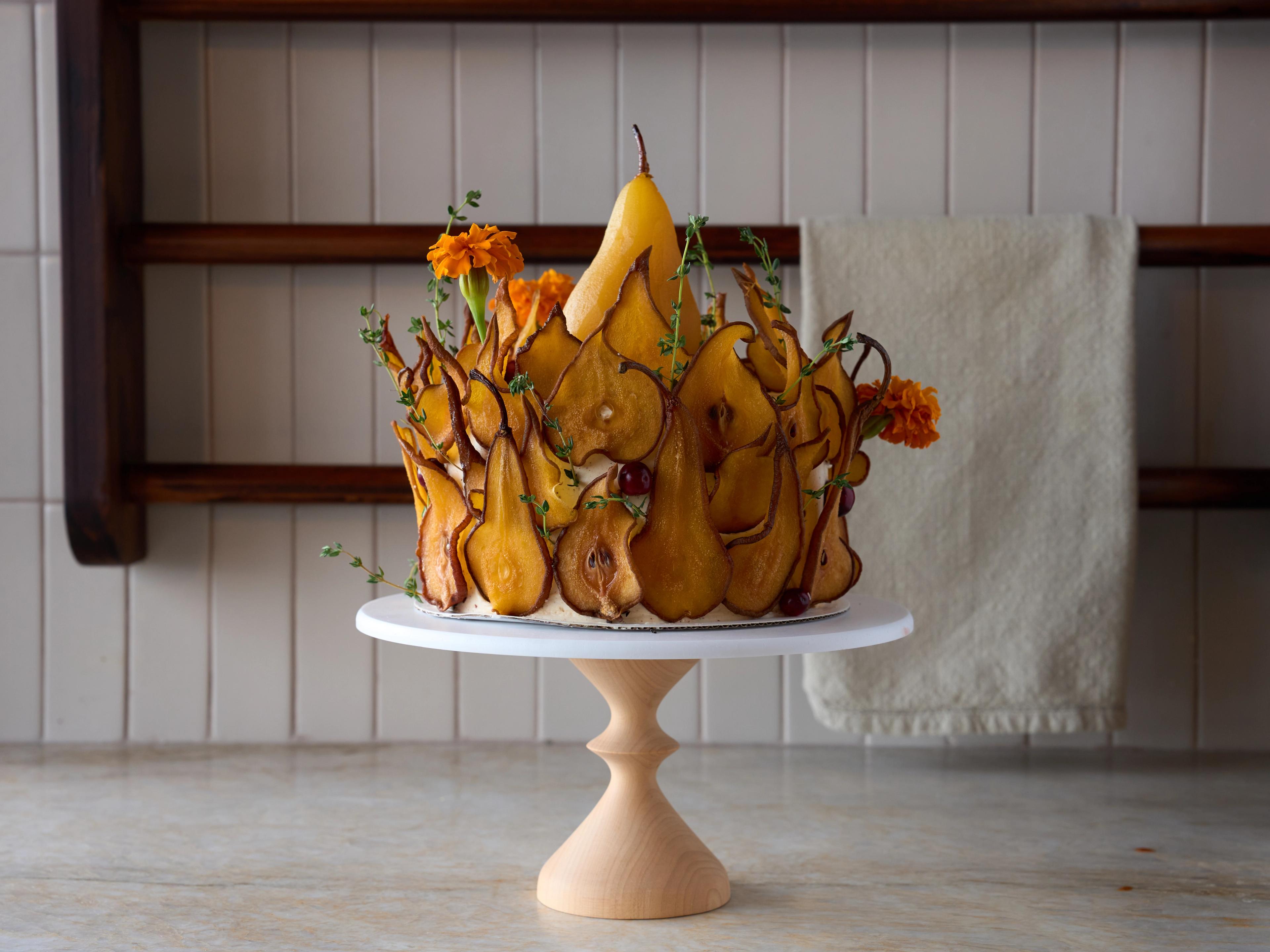
Saffron Pear Cake
Printed from nanasfogon.com/recipe/saffron-pear-cake · Original: https://food52.com/recipes/saffron-pear-cake
- Total
- About 14 hr 30 min
Ingredients
Dairy-free version. Swapped:
butter → dairy-free plant butter (pareve); whole milk → unsweetened oat milk; mascarpone → Violife Supreme Cream Cheese; whipping cream → full-fat coconut cream or pareve non-dairy whipping cream; Softened cream cheese → Violife Supreme Cream Cheese; cream cheese → Violife Supreme Cream Cheese; salted butter → dairy-free plant butter (pareve)
Good for vegan, lactose-free and kosher meat meals. Check labels: some plant butters and creamers aren't certified parve or contain nuts or coconut.
- Cardamom & Vanilla Bean Cake Sponge
- 200 g granulated sugar About granulated sugar →
- 90 g vegetable oil About neutral oil →
- 135 g browned butter (cooled until the consistency of room temp. butter)
- 4 large eggs (~250 g) About eggs →
- 5 g vanilla bean paste or powder About vanilla extract →
- 105 g cake or pastry flour About cake flour →
- 120 g all purpose flour (optionally toasted) About all-purpose flour →
- 4 g baking powder About baking powder →
- Generous pinch of salt About table salt →
- 3 g green cardamom powder (freshly ground is best)
- 200 g whole milk About whole milk →
- Roasted Pear & Saffron Compote
- 380 g Bosc pears (~5 medium sized pears)
- 10 g granulated sugar About granulated sugar →
- Generous pinch of salt About table salt →
- 1/4 lemon, juiced About lemon →
- 20 g water + more as you cook
- 10 strands of saffron About saffron →
- Splash of boiling water (~40 g)
- If you live in southern Canada or the northern US and you have access to beautiful, high quality Bosc pears - use them. I live in Ontario and use local pears, the flavour is unbeatable.
- Try to source high quality saffron [I only use Iranian saffron]. You don’t need a whole bunch for this recipe, less than 1g in total, but the good quality stuff is well worth it. Your local Persian or Middle Eastern grocer will carry it. About saffron →
- Whipped Mascarpone Cream
- 90g mascarpone cheese (softened) About mascarpone →
- 30 g powdered sugar About powdered sugar →
- 1/2 fresh vanilla bean pod or ~3g vanilla bean paste About vanilla extract →
- 105 g chilled 35% whipping cream About heavy cream →
- Pinch of salt About table salt →
- Softened cream cheese is a wonderful and welcomed substitute for mascarpone if you don’t have it. I actually sometimes prefer the cream cheese version because of the tang. About cream cheese →
- Caramel Milk
- 200 g whole milk About whole milk →
- 40 g salted caramel
- For the salted caramel, you can use store bought caramel and add 1 teaspoon to 40 g of caramel.
- Brown Butter Italian Meringue Buttercream
- 4 large egg whites (~120-150g) About eggs →
- 250 g granulated sugar About granulated sugar →
- 80 g water
- 300 g browned butter, softened (remaining from the cake batter)
- 154 g salted butter, softened About unsalted butter →
- 5 g pure vanilla bean paste/vanilla extract (large splash) About vanilla extract →
- Candied Saffron Pears
- 5-6 Bosc pears
- 700 g water
- 150 g sugar
- ~15-20 saffron strands + a splash of boiling water About saffron →
- You must use Bosc pears, Bartlett ones won’t hold their shape. The Bosc pears you use should also be firm and not super ripe - they’ll sweeten up when they are cooked in the sugar saffron syrup.
- 5 to 6 medium-large pears is enough to cover a 6” cake that’s approximately 4” tall.
- Saffron Poached Pear
- 2-3 Bosc pears (peeled)
- 150 g sugar
- 400 g water
- ~10-15 strands bloomed saffron + splash of water About saffron →
Out of something?
- Browned butter
- Melted, in cakes & muffins: for 1 cup, use 3/4 cup neutral oil. Moister, more tender, keeps longer; no buttery flavor. Not for recipes that cream butter and sugar.
- For sautéing: for 1 tbsp, use 1 tbsp olive oil or neutral oil, or schmaltz in meat dishes. Less browning flavor. Schmaltz gives savory depth to onions, potatoes and kasha.
- Vegan, for baking: for 1 cup, use 1 cup refined coconut oil: solid for creaming, melted where melted butter is called for. Refined has no coconut taste. Coconut oil is 100% fat, so cookies spread more and pastry is crumblier; chill doughs well.
- Egg
- As a binder: for 1 large, use 1 tbsp ground flaxseed + 3 tbsp water, rested 10 minutes until gloppy. Binds cookies, muffins and quick breads. It won't lift a sponge cake or set a custard, and adds a nutty flavor and flecks.
- For moisture: for 1 large, use 1/4 cup unsweetened applesauce or mashed ripe banana. Denser, moister crumb; banana flavor shows. Best when the recipe calls for only 1–2 eggs.
- for 1 large, use 2 large egg yolks + 1 tbsp water. Richer, more tender, slightly denser. Handy when you have leftover yolks.
- Flour
- For thickening: for 1 tbsp, use 1/2 tbsp potato starch or cornstarch, mixed into cold liquid first. Clearer, glossier sauce. Add at the end and don't boil long: starches thin out if overcooked.
- For dredging: for 1 cup, use 1 cup potato starch, rice flour or matzo cake meal. Starch gives a thinner, crisper coating; matzo cake meal browns like flour. Rice is kitniyot for Ashkenazim.
- Baking powder
- for 1 tsp, use 1/4 tsp baking soda + 1/2 tsp cream of tartar. This is single-acting: it starts working when it gets wet, so get the batter into the oven right away.
- Milk
- for 1 cup, use 1/2 cup evaporated milk + 1/2 cup water, or 2/3 cup skim milk + 1/3 cup half-and-half. Evaporated milk tastes slightly cooked; fine in baking.
- Strand saffron
- for pinch, use 1/4 tsp turmeric (color only), or a little sweet paprika. Nothing replaces saffron's aroma; this only gets the gold.
- Powdered sugar
- for 1 cup, use 1 cup granulated sugar + 1 tbsp cornstarch (or potato starch for Passover), blitzed in a dry blender until powdery. A touch grittier than store-bought. Let the dust settle before opening the blender.
- Egg white
- For whipping: for 1 large, use 3 tbsp aquafaba (the liquid from a can of chickpeas), whipped with a pinch of cream of tartar. Whips into meringue and mousse; takes longer than egg whites. Chickpeas are kitniyot, which Ashkenazi custom avoids on Passover.
Steps
- To make the Cardamom & Vanilla Bean Cake Sponge
-
1
A play on a classic pound cake with some intentional swaps for the best eating experience. Uses reverse creaming method for a plush crumb & toasted flour for a slightly more complex flavour.Makes three 6” or two 8” cakes.
-
2
Start by browning all 454 g of your butter, and set aside 135 g for the cake batter. We’ll use the rest for the Italian meringue buttercream later. Pop the butter in shallow dishes and allow them to fully solidify until they’re the texture of good ol’ room temp butter.
-
3
Preheat your oven to 350°F (convection, if you have it) before you begin making the batter. Grease three 6” round cake pans (two 8” pans works too) and line the bottoms with a parchment circle.
-
4
(Optional) Toast the AP flour. In a dry saucepan, add the all purpose flour and toast over medium to medium-high heat until nutty, fragrant and light brown. Constantly stir, as the flour can burn. I’ve translated this technique from traditional wheat-based Persian halva.
-
5
Whisk the dry ingredients together. In the mixing bowl of a stand mixer, combine both flours, baking powder, salt and cardamom (freshly ground if you can) and sift them. Cake flour NEEDS to be sifted, it’s often super clumpy.
-
6
Reverse cream the butter & dry ingredients. Add in 135 g of the softened, room-temp browned butter to the dry ingredients and mix on low. You want the butter to be broken down into small pieces (no bigger than a pea) and fully coated in the dry mix. It should resemble wet sand. This is what will give us an irresistibly plush cake crumb.
-
7
Combine & add wet ingredients. In a separate bowl, whisk vegetable oil, eggs, milk and vanilla bean paste until thoroughly mixed (eggs should be fully incorporated). Slowly add this mixture to the butter + dry mix until homogenous. Do not overmix!
-
8
Divide batter into pans & bake. Roughly divide the batter into the three prepared 6” cake pans (or more specifically, 300-330 g of batter per pan) OR into two 8” pans (~490 g per pan). Bake at 350°F for anywhere between 22-27 minutes or until a toothpick inserted into the centre comes out mostly clean (a few moist crumbs are encouraged, we want to avoid liquid batter on the pick).
-
9
Cool the cakes. Once the cakes come out of the oven, I like to flip them over on a tray immediately (a habit I developed from making chiffon cakes almost daily) and let them cool at room temp, upside down, for about an hour.
- To make the Roasted Pear & Saffron Compote
-
10
Roasted pears offer a warm, caramelized component that pairs magically with the floral and freshness of saffron.
-
11
Preheat your oven to 400°F.
-
12
Bloom the saffron. Grind your saffron using a mortar & pestle until it’s a fine powder. Add a splash of boiling water and stir using the pestle to get any extra bits off. Alternatively, you can bloom the saffron by melting an ice cube, but this way takes a bit longer and the ladies in my family have traditionally done it with hot water! So, I’m doing it the old school way.
-
13
Prepare the pear mixture. Peel and chop pears into mini bite sized pieces and transfer them to a large bowl. Add sugar, lemon juice, half of the saffron mixture (we’ll use the rest later) and salt. Mix until combined.
-
14
Transfer the pear mixture to an oven tray and bake for 15-20 minutes or until deeply caramelized. I recommend checking on the pears at ~8 minutes and give them a stir or flip using the spatula. You want to make sure nothing is burning. You’ll know they are done when they are fragrant and a form pierces through them easily, but they don’t turn to mush - we still want the pears to have some bite.
- To make the Whipped Mascarpone Cream
-
15
The perfect, most essential cake filling. A light and airy cream that is the perfect complement to the roasted saffronpears.
-
16
Whip cheese, sugar & vanilla. Using a stand or hand mixer, whip mascarpone (or cream cheese), sugar and vanilla bean until super smooth and glossy.
-
17
Whip the cream. In a separate bowl, add chilled cream and whip until stiff peaks.
-
18
Combine everything together. Take approximately 1/4 of the whipped cream and add it to the cheese mixture and vigorously whisk together. This will deflate some of the cream, but it also makes the initial cheese mixture lighter to allow for easier folding. Gently fold in the rest of the cream, trying your best to preserve the air. Keep the filling covered in the fridge until you need it.
- To make the Caramel Milk
-
19
This is brushed onto each cake layer to emphasize the caramel notes in the pear compote - it also keeps things nice and moist.
-
20
Combine the milk and caramel in a small saucepan and stir until the caramel is fully dissolved. Immediately turn off heat and set aside until ready to use.
- To make the Brown Butter Italian Meringue Buttercream
- It is absolutely integral that all utensils used when making this buttercream are completely clean and have absolutely no grease residue. I clean all my tools with hot water + dish soap, then wipe down with some white vinegar.
-
21
Italian meringue buttercream is the absolute best when it comes to frostings. It’s better than Swiss meringue - and the only difference between these two is technique. It’s light, fluffy, buttery and airy; absolutely perfect for this cake. This recipe is loosely based off Preppy Kitchen’s Italian meringue buttercream.
-
22
To a freshly cleaned pot, add 200 g sugar and water and stir using a (clean) whisk. Bring the sugar water to a boil and monitor until 235°F - 240°F using an instant-read thermometer.
-
23
While the sugar mixture is heating up, add egg whites and remaining 50g of sugar to a clean stand mixer bowl (or use a hand mixer) and whip on a low-medium speed until frothy. Timing is key here, you don’t want the egg whites to be fully opaque/whipped - they should be frothy and translucent, so keep the whipping speed low.
-
24
Once the sugar mixture is up to temperature, increase the egg white whipping speed and slowly stream in the hot sugar (be very, very careful). The sugar mixture stream should hit the inside of the bowl before the egg whites. Once all the sugar syrup is added, increase whipping speed until you have glossy medium soft peaks. The meringue should be stable, but shouldn’t be super firm, it should fold over itself when probed with a whisk.
-
25
While mixing on low speed, add softened butters and vanilla and whip until homogenous. (If you have extra bloomed saffron, add it in here). The frosting will be a beige/yellowish colour with specks of brown butter. [*If you find your mixture curdling after adding the butter, it means your butter was too cold. Fear not, it can be fixed. Bring the mixture on top of a double boiler (a pot with water boiling) until you see the curdles start to melt a little bit, then rewhip. This might take some trial and error, but if it’s still curdled, bring it back to the double boiler, if it’s too runny, pop it in the fridge and re-whip. Meringue based buttercreams are VERY forgiving.]
- To make the Candied Saffron Pears
-
26
This is the most key part to this recipe and the show-stopping element of this cake. It’s not a difficult process, but it takes time and attention to details.
-
27
Grind your saffron. Using a mortar and pestle, crush your saffron until it's a finepowder. I like to use gentle pounding motions and then apply pressure and move the pestle in circular motions until all the saffron is crushed.
-
28
Add hot water to the ground saffron. Add a splash of boiling water (~2 tablespoons), stir and set aside.
-
29
Slice your pears. You can either use a mandolin or a knife, but just ensure the pears are not cut too thin (like, not paper thin or else they’ll stick to the parchment when dehydrating)! Aim for just under a 1/4” thickness. I prefer to use a knife because I have more control and can easily keep pieces with the top stem intact - I really like the look of these ones. Small/end or miscut pieces should be kept, they’re great for filling in gaps!
-
30
Simmer the pears in syrup. In a pot, add sugar and saffron mixture to water, whisk and bring to a light/gentle boil. Add your slices pears in - you’ll probably need to do about 3 batches depending on your pot size. The pears should be fully (mostly) submerged in the syrup. Simmer the pears for ~10 minutes at medium heat. You don’t want a rolling boil, as you can risk the pear slices getting mushed.
-
31
After simmering, turn off the heat, put a lid on your pot and let the pears steep for about an hour. Alternatively, you can do this the night before and have the pears soaking in the syrup overnight in the fridge. The pears will be dyed yellow at this point from the saffron. They should still completely hold their shape after cooking. Keep any remaining syrup for tea or at-home lattes.
-
32
Dehydrate pears. Once the pears have soaked up the syrup, they’ll be a beautiful saffron-yellow colour. Preheat your oven to 175°F and line two sheet trays with parchment and lay each pear slice flat, side by side. Be sure that there’s not too much liquid on the pears, I like to use a slotted spoon to fish them out of the syrup. Don’t overlap the pears, they need space to dry out. They’ll take around 6-8 hours to fully dehydrate, but check in on them at the 4 hour mark. You’ll know they’re done when they are dry to the touch (maybe slightly sticky) and they’ve shrunk by half.
- To make the Saffron Poached Pear
-
33
I like to pop one right in the centre of the decorated cake. I make more than one as a security measure, the extra can be eaten as a separate dessert, maybe with some leftover mascarpone cream.
-
34
In the same way we did before, bloom the saffron with boiling water and set aside.
-
35
Select your favourite pears for this step & peel them. I like to use long and skinny pears here with a wonky stem. You can also manipulate the shape of the pear when using your peeler, by peeling certain sides to create a shape of your liking.
-
36
Bring sugar, water and bloomed saffron to a soft boil. Add in your pears and cover your pot with a lid. Reduce the heat to low, simmer and cook pears for 1-2 hours.
-
37
Pears will be done once they’ve soaked up the saffron-yellow colour and are fork-tender, but hold their shape perfectly. Allow these to completely cool before placing one on the cake!
- To make the Putting it All Together
-
38
Finally, all the components have been made, now it’s time to assemble!
-
39
Cut each cake into 2 even layers.
-
40
Soak your cake layer. As you assemble each layer, apply the caramel milk soak using a pastry brush or by spooning it over the cake layer.
-
41
Pipe buttercream border. Put buttercream into a piping or Ziplock bag (no special tip required) and pipe a border around the perimeter of the layer. This ensures the filling doesn’t spill out.
-
42
Add cream filling & compote. Spoon approximately 4-5 tablespoons of the whipped mascarpone filling inside the buttercream border. Using an offset spatula, spread into a nice flat thin layer. Top with saffron-pear compote (~2-3 tbsp) and place another cake layer on top, soak with caramel milk and repeat.
-
43
Once assembled, pop the cake in the freezer for 10-20 minutes or the fridge for 30-60 minutes.
-
44
Frosting the cake. Ensure your buttercream is at room temperature or even slightly warmer. It’s much easier to work with soft (even slightly runny) buttercream than something that’s stiff. Since the cake is getting covered in the candied pears, the coating of frosting doesn’t need to be absolutely perfect. I just use an offset spatula, do an initial crumb coat, pop the cake in the freezer (~5 minutes) and then do a second and final buttercream coat. I personally also like to slightly curve the outer top ridge of the cake to make it dome-shaped.
-
45
Add candied pears. While the buttercream is still soft, add your candied pears so they stick! I like to place larger slices at the bottom and smaller ones on top. Use the small bits to fill in any gaps. Pears placed on the top perimeter should be angled slightly inwards to emphasize the dome shape.
-
46
Add garnishes. I like to complete the cake decoration with fresh thyme and edible flowers from the garden (i.e., marigolds, dianthus, sulfur cosmos). Also, cranberries! They add the most gorgeous pops of wine red.
-
47
Top with poached pear. Select your favourite poached pear and pat completely dry with a paper towel. Insert three toothpicks (in a triangle formation) into the bottom of the pear and insert on the top of your cake (this will keep it in place).
-
48
Admire your beautiful creation! Congratulations, it’s a showstopper. Be proud of this dessert and indulge with friends and family! This cake is a labour of love, but it is absolutely worth every step.
Flavor map
How Nana pairs flavors →This one is rich, sweet and warmly spiced.
Goes well with
 After
Coconut Chicken Curry With Cashews
73% flavor match
The mascarpone cools things down after the heat; saffron strand and cardamom are a classic pair.
 After
Chicken Biryani Recipe
70% flavor match
Saffron strand and cardamom are a classic pair; they share saffron and cardamom.
 Pour
Easy Vegan Eggnog Recipe
67% flavor match
They share vanilla; saffron strand with cashew is a natural match.
 Pour
Make-Ahead Chilled Mulled Wine Punch
65% flavor match
Saffron strand and cardamom are a classic pair; they share cardamom and vanilla.
Log in to tell Nana which pairings are good. Your votes improve the map.
More about this recipe
Nutrition
1 of 16 servings · about 414 g Whole recipe · about 6627 g · servings estimated · High confidence
| % DV* | ||
|---|---|---|
| Total Fat | 47.2 g | 60% |
| Saturated Fat | 25 g | 125% |
| Trans Fat | 1.4 g | |
| Cholesterol | 327 mg | 109% |
| Sodium | 469 mg | 20% |
| Total Carbohydrate | 91.4 g | 33% |
| Dietary Fiber | 5.8 g | 21% |
| Total Sugars | 70.1 g | |
| Protein | 14.8 g | 30% |
| Vitamin D | 1.7 mcg | 8% |
| Calcium | 121 mg | 9% |
| Iron | 2.4 mg | 13% |
| Potassium | 418 mg | 9% |
* % Daily Value is based on a 2,000-calorie diet.
- Carbs 43%
- Fat 50%
- Protein 7%
Vitamins & minerals
| Vitamin A | 410 mcg | 46% |
|---|---|---|
| Vitamin C | 8.1 mg | 9% |
| Vitamin D | 1.7 mcg | 8% |
| Vitamin E | 2.3 mg | 15% |
| Vitamin K | 21.3 mcg | 18% |
| Thiamin (B1) | 0.18 mg | 15% |
| Riboflavin (B2) | 0.62 mg | 48% |
| Niacin (B3) | 1.3 mg | 8% |
| Pantothenic acid (B5) | 1.4 mg | 28% |
| Vitamin B6 | 0.18 mg | 11% |
| Folate | 86.4 mcg DFE | 22% |
| Vitamin B12 | 0.79 mcg | 33% |
| Choline | 208 mg | 38% |
| Calcium | 121 mg | 9% |
| Iron | 2.4 mg | 13% |
| Potassium | 418 mg | 9% |
| Magnesium | 31 mg | 7% |
| Phosphorus | 211 mg | 17% |
| Zinc | 1.3 mg | 12% |
| Copper | 0.23 mg | 25% |
| Manganese | 0.26 mg | 11% |
| Selenium | 30.5 mcg | 56% |
Fats & carbs in detail
| Monounsaturated fat | 12.8 g | |
|---|---|---|
| Polyunsaturated fat | 6.1 g | |
| Omega-3 | 0.6 g | 38% |
| Omega-6 | 5 g | 30% |
| Starch | 0.043 g | |
| Net carbs | 85.6 g | |
| Omega-6 : Omega-3 ratio | 8.4 : 1 |
Amino acids (protein building blocks)
| Histidine | 0.36 g | |
|---|---|---|
| Isoleucine | 0.78 g | |
| Leucine | 1.3 g | |
| Lysine | 1 g | |
| Methionine | 0.43 g | |
| Cystine | 0.3 g | |
| Phenylalanine | 0.8 g | |
| Tyrosine | 0.58 g | |
| Threonine | 0.61 g | |
| Tryptophan | 0.19 g | |
| Valine | 0.98 g |
How we calculated this
| Ingredient | Counted as | g | kcal |
|---|---|---|---|
| 200 g granulated sugar | Sugars, granulated | 200 | 774 |
| 90 g vegetable oil | Oil, soybean, salad or cooking | 90 | 796 |
| 135 g browned butter (cooled until the consistency of room temp. butter) | Butter, salted | 135 | 968 |
| 4 large eggs (~250 g) | Egg, whole, raw, fresh | 1000 | 1430 |
| 5 g vanilla bean paste or powder | Vanilla extract | 5 | 14 |
| 105 g cake or pastry flour | Wheat flour, white, cake, enriched | 105 | 380 |
| 120 g all purpose flour (optionally toasted) | Wheat flour, white, all-purpose, enriched, bleached | 120 | 437 |
| 4 g baking powder | Leavening agents, baking powder, double-acting, sodium aluminum sulfate | 4 | 2 |
| Generous pinch of salt | Salt, table | 0 | 0 |
| 3 g green cardamom powder (freshly ground is best) | Spices, cardamom | 3 | 9 |
| 200 g whole milk | Milk, whole, 3.25% milkfat, with added vitamin D | 200 | 122 |
| 380 g Bosc pears (~5 medium sized pears) | Pears, raw | 380 | 217 |
| 10 g granulated sugar | Sugars, granulated | 10 | 39 |
| Generous pinch of salt | Salt, table | 0 | 0 |
| 1/4 lemon, juiced | Lemons, raw, without peel | 14 | 4 |
| 20 g water + more as you cook | Water | 0 | |
| 10 strands of saffron | Trace amount | 0 | |
| Splash of boiling water (~40 g) | Water | 0 | |
| If you live in southern Canada or the northern US and you have access to beautiful, high quality Bosc pears - use them. I live in Ontario and use local pears, the flavour is unbeatable. | Not counted — no amount (to taste / garnish) | ||
| Try to source high quality saffron [I only use Iranian saffron]. You don’t need a whole bunch for this recipe, less than 1g in total, but the good quality stuff is well worth it. Your local Persian or Middle Eastern grocer will carry it. | Not counted — no amount (to taste / garnish) | ||
| 90g mascarpone cheese (softened) | Cheese, cream | 90 | 315 |
| 30 g powdered sugar | Sugars, powdered | 30 | 117 |
| 1/2 fresh vanilla bean pod or ~3g vanilla bean paste | Vanilla extract | 2 | 6 |
| 105 g chilled 35% whipping cream | Cream, fluid, heavy whipping | 105 | 357 |
| Pinch of salt | Salt, table | 0 | 0 |
| Softened cream cheese is a wonderful and welcomed substitute for mascarpone if you don’t have it. I actually sometimes prefer the cream cheese version because of the tang. | Not counted — no amount (to taste / garnish) | ||
| 200 g whole milk | Milk, whole, 3.25% milkfat, with added vitamin D | 200 | 122 |
| 40 g salted caramel | Candies, caramels | 40 | 153 |
| For the salted caramel, you can use store bought caramel and add 1 teaspoon to 40 g of caramel. | Not counted — no amount (to taste / garnish) | ||
| 4 large egg whites (~120-150g) | Egg, white, raw, fresh | 480 | 250 |
| 250 g granulated sugar | Sugars, granulated | 250 | 968 |
| 80 g water | Water | 0 | |
| 300 g browned butter, softened (remaining from the cake batter) | Butter, salted | 300 | 2151 |
| 154 g salted butter, softened | Butter, salted | 154 | 1104 |
| 5 g pure vanilla bean paste/vanilla extract (large splash) | Vanilla extract | 5 | 14 |
| 5-6 Bosc pears | Pears, raw | 979 | 558 |
| 700 g water | Water | 0 | |
| 150 g sugar | Sugars, granulated | 150 | 580 |
| ~15-20 saffron strands + a splash of boiling water | Not counted — no amount (to taste / garnish) | ||
| You must use Bosc pears, Bartlett ones won’t hold their shape. The Bosc pears you use should also be firm and not super ripe - they’ll sweeten up when they are cooked in the sugar saffron syrup. | Not counted — no amount (to taste / garnish) | ||
| 5 to 6 medium-large pears is enough to cover a 6” cake that’s approximately 4” tall. | Pears, raw | 979 | 558 |
| 2-3 Bosc pears (peeled) | Pears, raw | 445 | 254 |
| 150 g sugar | Sugars, granulated | 150 | 580 |
| 400 g water | Water | 0 | |
| ~10-15 strands bloomed saffron + splash of water | Not counted — no amount (to taste / garnish) |
Matched to the USDA FoodData Central database (SR Legacy). Amounts are converted with USDA portion weights where they exist, otherwise typical sizes. Open in the analyzer to adjust a match →
Estimated from the ingredient list — brands, exact sizes and cooking losses vary. Not medical advice.
Allergens
-
Cardamom
In: 3 g green cardamom powder (freshly ground is best)
-
Egg
In: 4 large eggs (~250 g); 4 large egg whites (~120-150g)
Whole eggs, yolks, whites and egg-based sauces like mayonnaise, aioli and hollandaise.
-
Citrus › Lemon & lime
In: 1/4 lemon, juiced
-
Milk / dairy
In: 135 g browned butter (cooled until the consistency of room temp. butter); 200 g whole milk; 90g mascarpone cheese (softened); 105 g chilled 35% whipping cream; Softened cream cheese is a wonderful and welcomed substitute for mascarpone if you don’t have it. I actually sometimes prefer the cream cheese version because of the tang.; 200 g whole milk; 300 g browned butter, softened (remaining from the cake batter); 154 g salted butter, softened
Cow's milk and anything made from it: butter, cream, cheese, yogurt, whey, casein, ghee.
-
Pear
In: 380 g Bosc pears (~5 medium sized pears); If you live in southern Canada or the northern US and you have access to beautiful, high quality Bosc pears - use them. I live in Ontario and use local pears, the flavour is unbeatable.; 5-6 Bosc pears; You must use Bosc pears, Bartlett ones won’t hold their shape. The Bosc pears you use should also be firm and not super ripe - they’ll sweeten up when they are cooked in the sugar saffron syrup.; 5 to 6 medium-large pears is enough to cover a 6” cake that’s approximately 4” tall.; 2-3 Bosc pears (peeled)
-
Soy › Miso & fermented soybean pastes
In: 5 g vanilla bean paste or powder; 1/2 fresh vanilla bean pod or ~3g vanilla bean paste; 5 g pure vanilla bean paste/vanilla extract (large splash)
Fermented pastes: miso, doenjang, gochujang, hoisin, black bean sauce.
-
Vanilla
In: 5 g vanilla bean paste or powder; 1/2 fresh vanilla bean pod or ~3g vanilla bean paste; 5 g pure vanilla bean paste/vanilla extract (large splash)
-
Gluten › Wheat
In: 105 g cake or pastry flour; 120 g all purpose flour (optionally toasted)
Wheat, barley, rye and oats (oats are often cross-contaminated). Celiac disease and wheat allergy are different — pick just Wheat if only wheat is the problem.
Found by reading the ingredient names. Brands and "may contain" warnings vary, so always check the label.
Questions about this recipe
- Can I make this cake ahead of time?
- Yes, you can bake the sponge layers in advance and store them in airtight containers; the roasted pear compote and whipped mascarpone cream also keep well in the fridge until assembly.
- How do I store or freeze the finished cake?
- Store the assembled cake in the refrigerator due to the mascarpone cream. To freeze, wrap individual cake layers tightly in plastic wrap before frosting.
- What can I use if I can't find mascarpone cheese?
- Softened cream cheese is a great substitute and adds a pleasant tang to the filling.
- How do I tell when the cake and roasted pears are done?
- The cake is done when a toothpick comes out mostly clean with a few moist crumbs. The pears are ready when they are fragrant, caramelized, and a fork pierces them easily without them becoming mush.
- What should I serve with this cake?
- This cake pairs beautifully with a light Earl Grey tea, a glass of chilled dessert wine, or a side of fresh berries to complement the saffron and pear.
My notes
Log in to keep private notes on recipes.
Learn while you cook
Learn library →- Techniques · 5 min read Creaming & Folding Cream cool-room-temperature butter (65°F) with sugar for 3–5 minutes until pale and fluffy to build air; fold gently in…
- Ingredient Deep-Dives · 7 min read Cream, Milk & Cultured Dairy Fat is the whole story. You need about 30% or more to whip, 36% or more to boil with acid safely; below that, add dairy…
- Why It Works · 4 min read Baking Soda vs. Baking Powder Baking soda is a base that needs an acid in the recipe to work; baking powder is soda with its acid already mixed in — …
Words in this recipe
- Creaming
- Beating softened butter and sugar until pale and fluffy. The sugar crystals cut tiny air pockets into the fat, and those pockets lift the cake or cookie in the oven. Learn more
- Rest
- To let food sit after cooking (meat) or mixing (dough, batter) so juices redistribute or gluten relaxes. Learn more
- Meringue
- Egg whites beaten with sugar into a glossy foam. French is uncooked; Swiss is warmed over water; Italian is made with hot syrup.
- Caramelize
- To brown sugar with heat, creating hundreds of new flavor compounds. Loosely, also used for browning onions and vegetables, which mostly involves the Maillard reaction too. Learn more
Handy for this recipe Safe Cooking TemperaturesMeasurements & ConversionsSubstitution Finder


