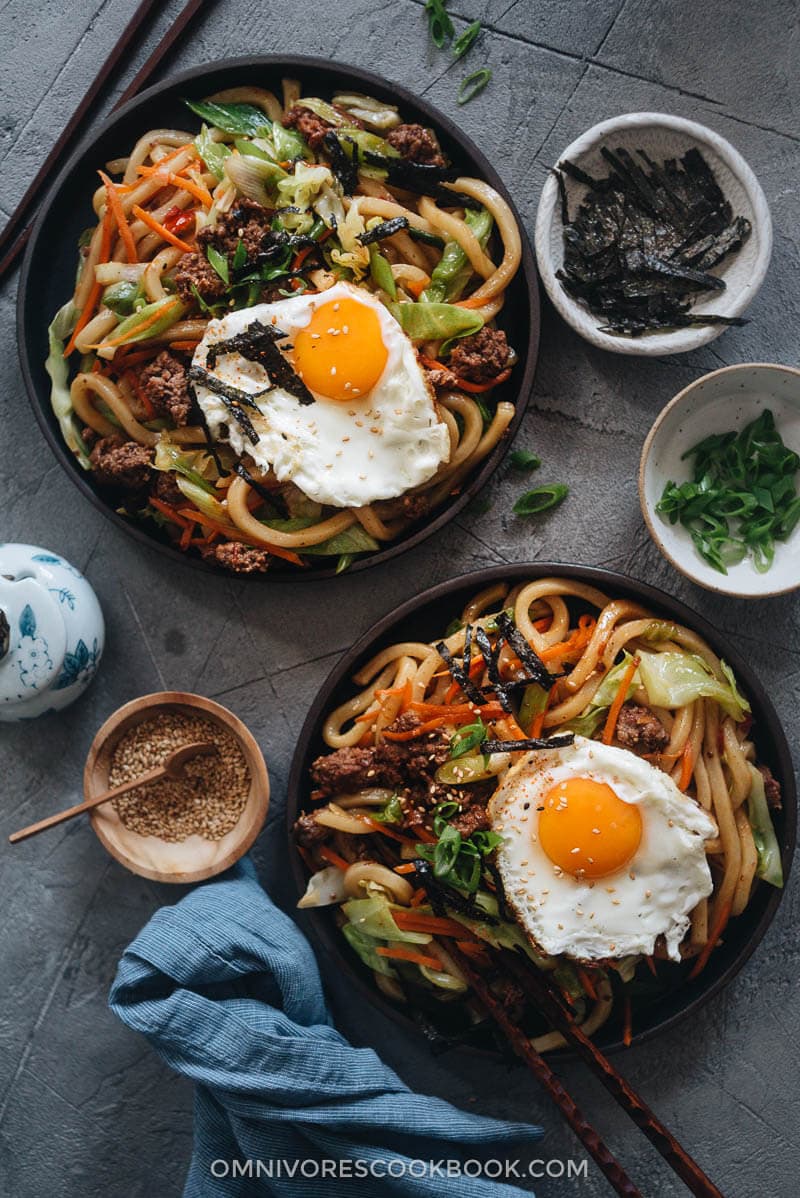
Yaki Udon
Printed from nanasfogon.com/recipe/yaki-udon · Original: https://thewoksoflife.com/yaki-udon/
- Prep
- 15 min
- Cook
- 25 min
- Total
- 40 min
Ingredients
Dairy-free version. Swapped:
butter → dairy-free plant butter (pareve)
Good for vegan, lactose-free and kosher meat meals. Check labels: some plant butters and creamers aren't certified parve or contain nuts or coconut.
- 1 pound frozen udon noodles ((450g, or 200g dry udon noodles) )
- 2 tablespoons butter (30g)
- 1 clove garlic (minced) About garlic →
- 2 teaspoons dashi powder Can't find it? Low-sodium vegetable or chicken broth cut half with water, with 2 or 3 dried shiitake soaked in it
- 1 tablespoon oil
- 4 ounces pork shoulder (115g, julienned; can substitute chicken, beef, seafood, pressed tofu, or more vegetables)
- 4 ounces oyster or shiitake mushrooms (115g, thinly sliced) About shiitake mushrooms →
- 2 tablespoons mirin About mirin →
- 2 cups cabbage (shredded)
- 1 medium carrot (julienned)
- 1/8 teaspoon black pepper About black pepper →
- 2 tablespoons low sodium soy sauce About soy sauce →
- 1 tablespoon water
- 2 scallions (julienned) About scallion →
Out of something?
- Butter
- Melted, in cakes & muffins: for 1 cup, use 3/4 cup neutral oil. Moister, more tender, keeps longer; no buttery flavor. Not for recipes that cream butter and sugar.
- For sautéing: for 1 tbsp, use 1 tbsp olive oil or neutral oil, or schmaltz in meat dishes. Less browning flavor. Schmaltz gives savory depth to onions, potatoes and kasha.
- Vegan, for baking: for 1 cup, use 1 cup refined coconut oil: solid for creaming, melted where melted butter is called for. Refined has no coconut taste. Coconut oil is 100% fat, so cookies spread more and pastry is crumblier; chill doughs well.
- Garlic
- for 1 clove, use 1/8 tsp garlic powder, or 1/2 tsp jarred minced garlic. Powder is mellow and toasty, not pungent; fine in rubs and soups, poor in aioli or garlic bread.
- Mirin
- for 1 tbsp, use 1 tbsp sake or dry sherry + 1/2 tsp sugar; alcohol-free: 1 tbsp rice vinegar + 1/2 tsp sugar. The vinegar version is sharper; add a little extra sugar for glazes.
- Sodium soy sauce
- Gluten-free: for 1 tbsp, use 1 tbsp tamari (check the label for wheat-free) or coconut aminos. Tamari is a bit richer; coconut aminos are sweeter and much less salty.
- Scallion
- for 1/4 cup sliced, use Chives (for the greens), or minced shallot or red onion (for the whites). Chives are milder and grassier.
Prep first
Get these done before you turn on the heat. Cooks call it mise en place.
Steps
-
1
Start by bringing a large pot of water to a boil. Add the udon noodles. Boil for 30 seconds - 1 minute to loosen them. If using dried noodles, cook according to package instructions. Drain, rinse in cold water to remove excess starch, and drain thoroughly again. Set aside.
-
2
Place a large Dutch oven, non-stick pot, or large cast iron skillet over medium heat. When the pan is heated, add the butter. Once partially melted, stir in the garlic and dashi granules. Cook for 30 seconds, until the dashi partially dissolves. At this point, the butter should be a light brown color.
-
3
Add the drained noodles and toss to coat them in the butter. Cook for 5 minutes over medium heat, until the noodles have dried out and are slightly crisped. Remove and set aside.
-
4
Add a tablespoon of oil to the pot, along with the pork shoulder. Brown the pork until crisp on the edges. Add the mushrooms and mirin, and cook until caramelized.
-
5
Add the cabbage, carrot, pepper, soy sauce, and water. Stir-fry until the vegetables are wilted, and add the noodles back in, along with the scallions. Stir-fry for another minute. Serve!
Flavor map
How Nana pairs flavors →This one is savory, garlicky and rich.
Goes well with
 Serve it with
Chinese Chicken Salad
74% flavor match
Soy sauce and sesame oil are a classic pair; they share noodle and cabbage.
 Serve it with
Japanese-Style Tuna Noodle Salad
73% flavor match
Both lean on mirin and noodle; sesame oil and soy sauce are a classic pair.
 Start with
Grilled Shiitake With Ponzu
83% flavor match
Same Japanese roots; sake loves mirin.
 Finish with
Mango Sticky Rice
72% flavor match
The mango keeps it light after a rich meal; mango suits a Japanese meal.
 Pour
Iced Tea With Hibiscus Tea Ice Cubes
72% flavor match
Tea suits a Japanese meal; the citrus cuts through a rich meal.
Log in to tell Nana which pairings are good. Your votes improve the map.
More about this recipe
Nutrition
1 of 4 servings · about 257 g Whole recipe · about 1028 g · High confidence
| % DV* | ||
|---|---|---|
| Total Fat | 17.1 g | 22% |
| Saturated Fat | 6.8 g | 34% |
| Trans Fat | 0.25 g | |
| Cholesterol | 36 mg | 12% |
| Sodium | 384 mg | 17% |
| Total Carbohydrate | 90.8 g | 33% |
| Dietary Fiber | 5.5 g | 20% |
| Total Sugars | 5.7 g | |
| Protein | 22.1 g | 44% |
| Vitamin D | 0.057 mcg | 0% |
| Calcium | 59 mg | 5% |
| Iron | 4.6 mg | 26% |
| Potassium | 589 mg | 13% |
* % Daily Value is based on a 2,000-calorie diet.
- Carbs 60%
- Fat 25%
- Protein 15%
Vitamins & minerals
| Vitamin A | 182 mcg | 20% |
|---|---|---|
| Vitamin C | 16.1 mg | 18% |
| Vitamin D | 0.057 mcg | 0% |
| Vitamin E | 0.8 mg | 5% |
| Vitamin K | 51.2 mcg | 43% |
| Thiamin (B1) | 1.3 mg | 107% |
| Riboflavin (B2) | 0.69 mg | 53% |
| Niacin (B3) | 10.8 mg | 67% |
| Pantothenic acid (B5) | 1.3 mg | 25% |
| Vitamin B6 | 0.39 mg | 23% |
| Folate | 476 mcg DFE | 119% |
| Vitamin B12 | 0.22 mcg | 9% |
| Choline | 32 mg | 6% |
| Calcium | 59 mg | 5% |
| Iron | 4.6 mg | 26% |
| Potassium | 589 mg | 13% |
| Magnesium | 82 mg | 20% |
| Phosphorus | 322 mg | 26% |
| Zinc | 2.6 mg | 23% |
| Copper | 0.46 mg | 51% |
| Manganese | 1.2 mg | 54% |
| Selenium | 81.8 mcg | 149% |
Fats & carbs in detail
| Monounsaturated fat | 5.2 g | |
|---|---|---|
| Polyunsaturated fat | 3.5 g | |
| Omega-3 | 0.3 g | 19% |
| Omega-6 | 3.1 g | 18% |
| Starch | 71 g | |
| Net carbs | 85.3 g | |
| Omega-6 : Omega-3 ratio | 10.2 : 1 |
Amino acids (protein building blocks)
| Histidine | 0.58 g | |
|---|---|---|
| Isoleucine | 0.89 g | |
| Leucine | 1.6 g | |
| Lysine | 0.87 g | |
| Methionine | 0.32 g | |
| Cystine | 0.37 g | |
| Phenylalanine | 1 g | |
| Tyrosine | 0.48 g | |
| Threonine | 0.85 g | |
| Tryptophan | 0.29 g | |
| Valine | 1.1 g |
How we calculated this
| Ingredient | Counted as | g | kcal |
|---|---|---|---|
| 1 pound frozen udon noodles ((450g, or 200g dry udon noodles) ) | Pasta, dry, enriched | 454 | 1683 |
| 2 tablespoons butter (30g) | Butter, salted | 28 | 203 |
| 1 clove garlic (minced) | Garlic, raw | 3 | 4 |
| 2 teaspoons dashi powder | Soup, chicken broth, ready-to-serve | 10 | 1 |
| 1 tablespoon oil | Oil, soybean, salad or cooking | 14 | 120 |
| 4 ounces pork shoulder (115g, julienned; can substitute chicken, beef, seafood, pressed tofu, or more vegetables) | Pork, fresh, ground, raw | 113 | 298 |
| 4 ounces oyster or shiitake mushrooms (115g, thinly sliced) | Mushrooms, white, raw | 113 | 25 |
| 2 tablespoons mirin | Alcoholic beverage, rice (sake) | 29 | 39 |
| 2 cups cabbage (shredded) | Cabbage, raw | 140 | 35 |
| 1 medium carrot (julienned) | Carrots, raw | 61 | 25 |
| 1/8 teaspoon black pepper | Spices, pepper, black | 0 | 1 |
| 2 tablespoons low sodium soy sauce | Soy sauce made from soy and wheat (shoyu), low sodium | 32 | 18 |
| 1 tablespoon water | Water | 0 | |
| 2 scallions (julienned) | Onions, spring or scallions (includes tops and bulb), raw | 30 | 10 |
Matched to the USDA FoodData Central database (SR Legacy). Amounts are converted with USDA portion weights where they exist, otherwise typical sizes. Open in the analyzer to adjust a match →
Estimated from the ingredient list — brands, exact sizes and cooking losses vary. Not medical advice.
Allergens
-
Alcohol
In: 2 tablespoons mirin
Not a true allergy, but listed for people who must avoid it.
-
Red meat (alpha-gal) › Beef & veal
In: 4 ounces pork shoulder (115g, julienned; can substitute chicken, beef, seafood, pressed tofu, or more vegetables)
Mammalian meat and by-products. Alpha-gal syndrome, often from a tick bite, causes delayed reactions to beef, pork, lamb and gelatin; some people also react to dairy.
-
Black & white pepper
In: 1/8 teaspoon black pepper
-
Carrot
In: 1 medium carrot (julienned)
-
Poultry meat › Chicken
In: 4 ounces pork shoulder (115g, julienned; can substitute chicken, beef, seafood, pressed tofu, or more vegetables)
Chicken, turkey, duck and goose meat (separate from egg allergy).
-
Fish
In: 2 teaspoons dashi powder
The recipe doesn't say which kind, so treat it as any fish.
Finned fish. Fish sauce, Worcestershire and Caesar dressing usually contain anchovy.
-
Onion & garlic family › Garlic
In: 1 clove garlic (minced)
Onions, shallots, garlic, leeks, scallions and chives, including powders.
-
Onion & garlic family › Leek, scallion & chives
In: 2 scallions (julienned)
Onions, shallots, garlic, leeks, scallions and chives, including powders.
-
Milk / dairy
In: 2 tablespoons butter (30g)
Cow's milk and anything made from it: butter, cream, cheese, yogurt, whey, casein, ghee.
-
Mushrooms & fungi
In: 4 ounces oyster or shiitake mushrooms (115g, thinly sliced)
-
Shellfish › Molluscs › Oyster
In: 4 ounces oyster or shiitake mushrooms (115g, thinly sliced)
Clams, mussels, oysters, scallops, squid, octopus, snails.
-
Red meat (alpha-gal) › Pork
In: 4 ounces pork shoulder (115g, julienned; can substitute chicken, beef, seafood, pressed tofu, or more vegetables)
Mammalian meat and by-products. Alpha-gal syndrome, often from a tick bite, causes delayed reactions to beef, pork, lamb and gelatin; some people also react to dairy.
-
Shellfish
In: 4 ounces pork shoulder (115g, julienned; can substitute chicken, beef, seafood, pressed tofu, or more vegetables)
The recipe doesn't say which kind, so treat it as any shellfish.
Crustaceans (shrimp, crab, lobster) and molluscs (clams, oysters, squid). Many people are allergic to only one of the two groups.
-
Soy › Soy protein: tofu, edamame, soy milk, TVP
In: 4 ounces pork shoulder (115g, julienned; can substitute chicken, beef, seafood, pressed tofu, or more vegetables)
Whole soybeans and foods that keep their protein intact.
-
Soy › Soy sauce & tamari (brewed)
In: 2 tablespoons low sodium soy sauce
Fermented soy sauces. Much of the protein is broken down in brewing.
-
Gluten › Wheat
In: 1 pound frozen udon noodles ((450g, or 200g dry udon noodles) ); 2 tablespoons low sodium soy sauce
Wheat, barley, rye and oats (oats are often cross-contaminated). Celiac disease and wheat allergy are different — pick just Wheat if only wheat is the problem.
Found by reading the ingredient names. Brands and "may contain" warnings vary, so always check the label.
Questions about this recipe
- Can I make this ahead of time?
- Yaki udon is best served immediately; however, you can prep the julienned vegetables and pork in advance to speed up the stir-fry process.
- How should I store or reheat leftovers?
- Store in an airtight container in the fridge for up to 3 days. Reheat in a skillet with a splash of water or oil to restore the noodles' texture.
- What can I use if I don't have dashi powder?
- You can substitute the dashi powder with a small amount of fish sauce or a concentrated mushroom broth to maintain the savory depth.
- How do I tell when the noodles are ready in the first stage?
- The noodles are ready to be removed from the pot once they have loosened from their frozen state, typically after 30 to 60 seconds.
- What are the best side dishes to serve with this?
- This dish pairs well with a side of steamed edamame, a crisp cucumber salad, or a bowl of miso soup.
My notes
Log in to keep private notes on recipes.
Learn while you cook
Learn library →- Techniques · 7 min read Knife Skills Pinch the blade, curl your fingertips into a claw, and keep the knife sharp — even cuts cook evenly, and a sharp knife …
- Ingredient Deep-Dives · 8 min read The Onion Family Yellow onions for cooking, red for raw, shallots for sauces; the finer you cut garlic or onion, the stronger it gets, a…
- Why It Works · 4 min read Browning: Maillard vs. Caramelization Browning is two different reactions — Maillard (proteins plus sugars, from about 280°F) and caramelization (sugar alone…
Words in this recipe
- Caramelize
- To brown sugar with heat, creating hundreds of new flavor compounds. Loosely, also used for browning onions and vegetables, which mostly involves the Maillard reaction too. Learn more
Handy for this recipe Safe Cooking TemperaturesSubstitution Finder