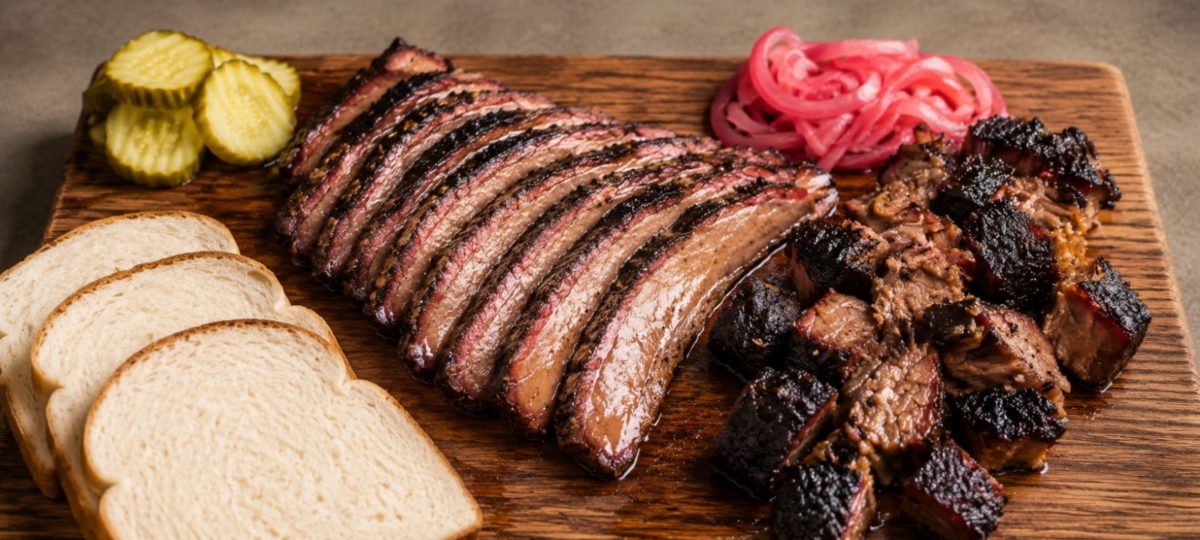
Braising is browning a piece of meat, then cooking it slowly, covered, partly submerged in liquid. It’s how tough, cheap, well-worked cuts become spoon-tender: low, moist heat over hours melts their connective tissue into gelatin, which makes the meat silky and the sauce glossy. Brisket, flanken, pot roast and cholent are all braises.
It’s also the most forgiving technique in the kitchen. A braise is better the next day, reheats beautifully, and waits for latecomers.
Cuts that braise well
You want cuts with lots of collagen and some fat — the muscles an animal used. Lean, tender cuts (fillet, chicken breast) get dry and stringy instead.
| Cut | What it is | Time at 300–325°F (150–165°C) | Notes |
|---|---|---|---|
| Brisket, first cut (flat) | Lean, even slab from the chest | 3–4 hrs | Slices neatly; can dry if overcooked or uncovered |
| Brisket, second cut (point/deckle) | Fattier, more marbled | 3½–4½ hrs | Juicier and more forgiving; shreds |
| Chuck roast / shoulder | Marbled shoulder muscle | 3–3½ hrs | Classic pot roast; also cubed for stew (2–2½ hrs) |
| Flanken | Short ribs cut across the bones, ½–1 in thick | 2–2½ hrs | Rich; thin strips cook faster; great in cholent |
| English-cut short ribs | Thick single-bone pieces | 3 hrs | Meaty; lots of fat to skim |
| Beef shank / osso buco-style veal shank | Cross-sections with marrow bone | 2½–3 hrs | Very gelatinous sauce |
| Lamb shoulder or neck | Bone-in chunks | 2–3 hrs | Pairs with cumin, apricots, tomatoes |
| Veal breast | Bony, fatty, often stuffed | 2½–3 hrs | A holiday classic |
| Chicken thighs and legs | Bone-in, skin on | 45–60 min | The only poultry that really braises |
Kosher note
In the U.S., kosher beef almost always comes from the forequarter. The hindquarter is permitted in principle, but removing the forbidden fats and sciatic nerve (nikkur) is laborious and few butchers do it outside Israel. That’s why kosher butchers are full of chuck, brisket, flanken and shoulder — exactly the cuts that braise best. Kosher meat has also been soaked and salted, so taste before adding much salt. Ask your butcher or rabbi about local practice.
Gear
- A heavy Dutch oven (5–7 qt / 5–7 L) with a tight lid. Enameled cast iron is ideal. For a whole brisket, a roasting pan covered tightly with foil works.
- Tongs for browning, a wooden spoon for scraping, a fat separator or ladle for skimming.
Step by step

- Dry and season. Pat the meat dry. Season lightly (koshered meat needs little), with pepper and spices. Bring it out of the fridge 20–30 minutes before.
- Brown it well. In 1–2 tablespoons of oil or Schmaltz over medium-high, brown on all sides, in batches if needed — 8–12 minutes total for a roast. Deep brown, not gray. See Searing. Set it aside.
- Build the base. Pour off all but 2 tablespoons of fat. Cook onions (and carrots, celery, garlic) over medium until soft and starting to color, 8–10 minutes. Stir in a tablespoon or two of Tomato paste and spices and cook a minute more until it darkens.
- Deglaze. Add wine, stock or water and scrape up every brown bit. That Fond is the sauce’s backbone.
- Add the meat and liquid. Nestle the meat back in with its juices. Add liquid until it reaches one-third to halfway up the meat — not over it. The exposed top browns gently and the sauce stays concentrated; a fully submerged roast is boiled, not braised.
- Bring to a bare simmer, cover, and cook low. Into a 300–325°F (150–165°C) oven, or on the lowest stovetop flame. You want a lazy bubble or two, never a rolling boil, which tightens and dries the meat.
- Turn once or twice, and check the liquid level. Add a splash of water if it’s dropping below a third.
- Cook until fork-tender (see below). The meat will be well past any safety temperature — tenderness is the goal.
- Rest and chill (best). Cool, then refrigerate overnight in its liquid. The next day, lift off the hardened fat, slice the meat cold against the grain (much neater), and reheat it in the sauce.
- Finish the sauce. Strain or blend the vegetables into it, then reduce on the stove until it coats a spoon. Brighten with a splash of vinegar or lemon.
Food safety
Cool a braise within 2 hours of cooking: divide into shallow containers and refrigerate. It keeps 3–4 days chilled, or about 3 months frozen. Reheat to 165°F (74°C), until it’s bubbling throughout.
Oven or stovetop?
| Oven | Stovetop | |
|---|---|---|
| Heat | Surrounds the pot; even and gentle | From the bottom only; hotter at the base |
| Attention | Little — check every hour | Stir and check more often; can scorch |
| Best for | Large roasts, brisket, anything 2+ hours | Stews in smaller pieces, chicken, short weeknight braises |
| Tip | 300°F for long braises, 325°F to speed things up | Use a heat diffuser on a strong burner |
Both work; the oven is easier. A slow cooker on low is a braise too, but brown first and use less liquid — it barely evaporates.
How to tell it’s done

- A fork slides in and twists with little resistance, and the meat starts to pull apart. If it fights the fork, it needs more time, not less — tough braised meat is almost always undercooked.
- Internal temperature around 195–205°F (90–96°C) is where collagen has broken down, though texture is the real test.
- The sauce has turned glossy and slightly sticky from gelatin.
Common mistakes
| Problem | Why | Fix |
|---|---|---|
| Tough, chewy meat | Not cooked long enough for collagen to melt | Keep going, 30–60 minutes more, and test again |
| Dry, stringy meat | Boiled too hard, too lean a cut, or the liquid ran low | Lower the heat to a bare simmer; choose fattier cuts; keep liquid a third up |
| Watery, bland sauce | Too much liquid, no reduction | Less liquid to start; reduce at the end |
| Greasy sauce | Fat not skimmed | Chill overnight and lift off the fat |
| Pale, flat flavor | Skipped or rushed the browning | Brown deeply; cook the tomato paste |
| Brisket shreds when sliced | Sliced warm or with the grain | Chill, then slice cold against the grain |
Variations
- Sweet-and-sour Ashkenazi brisket: onions, tomato, a little brown sugar or Silan (date syrup) and vinegar. A Rosh Hashanah staple; see The Rosh Hashanah Table.
- Wine braise: a cup of dry red wine (with a hechsher) in place of some stock. Cook it down by half before adding the meat.
- Cholent and hamin: an overnight braise of meat, beans, potatoes and grains kept on a blech or in a slow cooker for Shabbat lunch. See Cooking for Shabbat.
- Chicken: sear skin-side down, braise skin-side up with the skin above the liquid for 45–60 minutes.
- Vegetables: fennel, leeks, cabbage and endive braise beautifully in 20–40 minutes for a parve side.