Chicken Teriyaki Onigirazu
Ingredients
- Half a chicken breast
- 2-3 tbsp. teriyaki sauce (store-bought or homemade)
- 2 cups cooked rice About rice →
- Lettuce (Separate the leaves, rinse and dry)
- Pineapple
- sheets Nori
Steps
-
1
Cut pineapple into pieces, about 2 inches by 1 and a half inches
-
2
For the chicken breast, slice again the grain. You want each piece of chicken to be about 1/3” thick and about 3-1/2” by 3-1/2” in shape.
-
3
Transfer the chicken to a clean container and add 2 to 3 tbsp of teriyaki sauce. Marinade the chicken for at least 1 hour. The chicken will taste even better if you marinate overnight.
-
4
After marinating, fry the chicken with some oil in a frying pan. Fry both sides until the chicken becomes golden brown. Remember to check inside to make sure the chicken is cooked throughout.
-
5
Pan-fry the pineapple slices until they caramelize.
-
6
Let both the chicken and pineapple cool off so you can easily wrap the onigirazu
-
7
Lay a piece of saran wrap on a flat surface. Then, place a piece of the nori sheet.
-
8
Next, scoop ½ cup of rice onto the nori sheet. Try to form a square with your rice at a 45-degree angle in the middle of the nori sheet. The square should be around 3-1/2” x 3-1/2”.
-
9
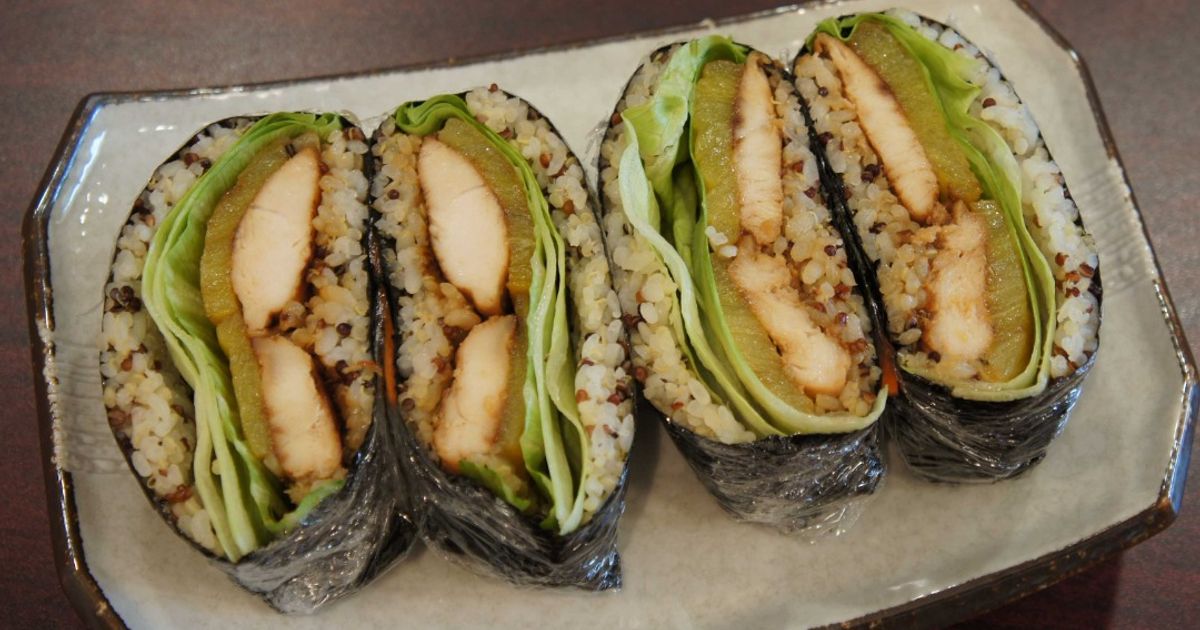
Place 2 to 3 pieces of lettuce on top of the rice. Add 2 pieces of grilled pineapple and 2 to 3 pieces of chicken on the top
-
10
Drizzle with some teriyaki sauce. Finish off with a layer of 1/2 cup of rice.
-
11
To wrap the onigirazu, using both hands, start folding all the corners of the nori sheet towards the center. Fold gently but tightly. When all four corners are folded in, the onigirazu will have a square shape with a height no taller than 1 and a half inches.
-
12
Mark which way you would cut in half with a thin piece of vegetable. Let the onigirazu sit for about 10 sec and then cut in half following your mark. Wet the knife before cutting will prevent the rice from sticking, allows you to have a clean cut.
-
13
Video: https://youtu.be/5AjKViKZkF8
More about this recipe
Nutrition
1 of 4 servings · about 139 g Whole recipe · about 554 g · servings estimated · High confidence
| % DV* | ||
|---|---|---|
| Total Fat | 1.5 g | 2% |
| Saturated Fat | 0.36 g | 2% |
| Trans Fat | 0.002 g | |
| Cholesterol | 25 mg | 8% |
| Sodium | 453 mg | 20% |
| Total Carbohydrate | 75.8 g | 28% |
| Dietary Fiber | 1.2 g | 4% |
| Total Sugars | 1.7 g | |
| Protein | 14.9 g | 30% |
| Vitamin D | 0 mcg | 0% |
| Calcium | 32 mg | 2% |
| Iron | 4.3 mg | 24% |
| Potassium | 246 mg | 5% |
* % Daily Value is based on a 2,000-calorie diet.
- Carbs 81%
- Fat 4%
- Protein 16%
Vitamins & minerals
| Vitamin A | 3.1 mcg | 0% |
|---|---|---|
| Vitamin C | 0.022 mg | 0% |
| Vitamin D | 0 mcg | 0% |
| Vitamin E | 0.3 mg | 2% |
| Vitamin K | 0.59 mcg | 0% |
| Thiamin (B1) | 0.57 mg | 47% |
| Riboflavin (B2) | 0.11 mg | 9% |
| Niacin (B3) | 7.3 mg | 46% |
| Pantothenic acid (B5) | 1.5 mg | 29% |
| Vitamin B6 | 0.44 mg | 26% |
| Folate | 363 mcg DFE | 91% |
| Vitamin B12 | 0.071 mcg | 3% |
| Choline | 36 mg | 6% |
| Calcium | 32 mg | 2% |
| Iron | 4.3 mg | 24% |
| Potassium | 246 mg | 5% |
| Magnesium | 40 mg | 10% |
| Phosphorus | 196 mg | 16% |
| Zinc | 1.3 mg | 11% |
| Copper | 0.23 mg | 25% |
| Manganese | 1 mg | 44% |
| Selenium | 21.8 mcg | 40% |
Fats & carbs in detail
| Monounsaturated fat | 0.43 g | |
|---|---|---|
| Polyunsaturated fat | 0.31 g | |
| Omega-3 | 0.038 g | 2% |
| Omega-6 | 0.25 g | 1% |
| Starch | 0 g | |
| Net carbs | 74.6 g | |
| Omega-6 : Omega-3 ratio | 6.6 : 1 |
Amino acids (protein building blocks)
| Histidine | 0.44 g | |
|---|---|---|
| Isoleucine | 0.66 g | |
| Leucine | 1.2 g | |
| Lysine | 0.97 g | |
| Methionine | 0.35 g | |
| Cystine | 0.22 g | |
| Phenylalanine | 0.66 g | |
| Tyrosine | 0.5 g | |
| Threonine | 0.58 g | |
| Tryptophan | 0.17 g | |
| Valine | 0.8 g |
How we calculated this
| Ingredient | Counted as | g | kcal |
|---|---|---|---|
| Half a chicken breast | Chicken, broiler or fryers, breast, skinless, boneless, meat only, raw | 136 | 163 |
| 2-3 tbsp. teriyaki sauce (store-bought or homemade) | Sauce, teriyaki, ready-to-serve | 45 | 40 |
| 2 cups cooked rice | Rice, white, long-grain, regular, raw, enriched | 370 | 1350 |
| Lettuce (Separate the leaves, rinse and dry) | Not counted — no amount (to taste / garnish) | ||
| Pineapple | Not counted — no amount (to taste / garnish) | ||
| sheets Nori | Seaweed, kelp, raw | 3 | 1 |
Matched to the USDA FoodData Central database (SR Legacy). Amounts are converted with USDA portion weights where they exist, otherwise typical sizes. Open in the analyzer to adjust a match →
Estimated from the ingredient list — brands, exact sizes and cooking losses vary. Not medical advice.
Allergens
-
Poultry meat › Chicken
In: Half a chicken breast
Chicken, turkey, duck and goose meat (separate from egg allergy).
-
Pineapple
In: Pineapple
-
Rice
In: 2 cups cooked rice
-
Soy › Soy sauce & tamari (brewed)
In: 2-3 tbsp. teriyaki sauce (store-bought or homemade)
Fermented soy sauces. Much of the protein is broken down in brewing.
-
Gluten › Wheat
In: 2-3 tbsp. teriyaki sauce (store-bought or homemade)
Wheat, barley, rye and oats (oats are often cross-contaminated). Celiac disease and wheat allergy are different — pick just Wheat if only wheat is the problem.
Found by reading the ingredient names. Brands and "may contain" warnings vary, so always check the label.
Questions about this recipe
- Can I make these ahead of time for work or school?
- Yes, but keep them wrapped in plastic wrap to prevent the nori from drying out or getting too chewy. Assemble them and store them in the fridge until you are ready to eat.
- How should I store or freeze the onigirazu?
- Store them in an airtight container in the refrigerator for up to 3 days. Freezing is not recommended as the lettuce will wilt and the nori will become soggy upon thawing.
- What can I use if I don't have pineapple?
- Sliced avocado or sautéed mushrooms work well as creamy or savory alternatives that pair perfectly with teriyaki chicken.
- How do I know when the chicken is fully cooked?
- The chicken should be golden brown on the outside and no longer pink in the center; use a meat thermometer to ensure it reaches 165°F (74°C).
- What should I serve with these rice sandwiches?
- They pair well with a side of edamame, a crisp cucumber salad, or a bowl of miso soup for a complete Japanese-inspired meal.
My notes
Log in to keep private notes on recipes.
Learn while you cook
Learn library →- Techniques · 6 min read Cooking Rice & Grains Rinse most rice, measure water by the grain (white 1:1½, brown 1:2), cook covered on the lowest heat, then rest 10 minu…
- Techniques · 5 min read Creaming & Folding Cream cool-room-temperature butter (65°F) with sugar for 3–5 minutes until pale and fluffy to build air; fold gently in…
- Grilling & Barbecue · 5 min read How Heat Moves on a Grill A grill cooks with conduction, convection and radiation at once. Choose direct heat for thin, quick food and indirect h…
Words in this recipe
- Marinate
- To soak food in a seasoned, often acidic or salty liquid. It mostly flavors the surface; salt is what penetrates. Learn more
- Pan-fry
- To cook in a moderate amount of fat, more than a sauté but not enough to submerge the food.
- Caramelize
- To brown sugar with heat, creating hundreds of new flavor compounds. Loosely, also used for browning onions and vegetables, which mostly involves the Maillard reaction too. Learn more
- Fold
- To combine a light, airy mixture (whipped cream, egg whites) into a heavier one with gentle cutting and turning strokes, keeping as much air as possible. Learn more
Handy for this recipe Safe Cooking TemperaturesSubstitution Finder