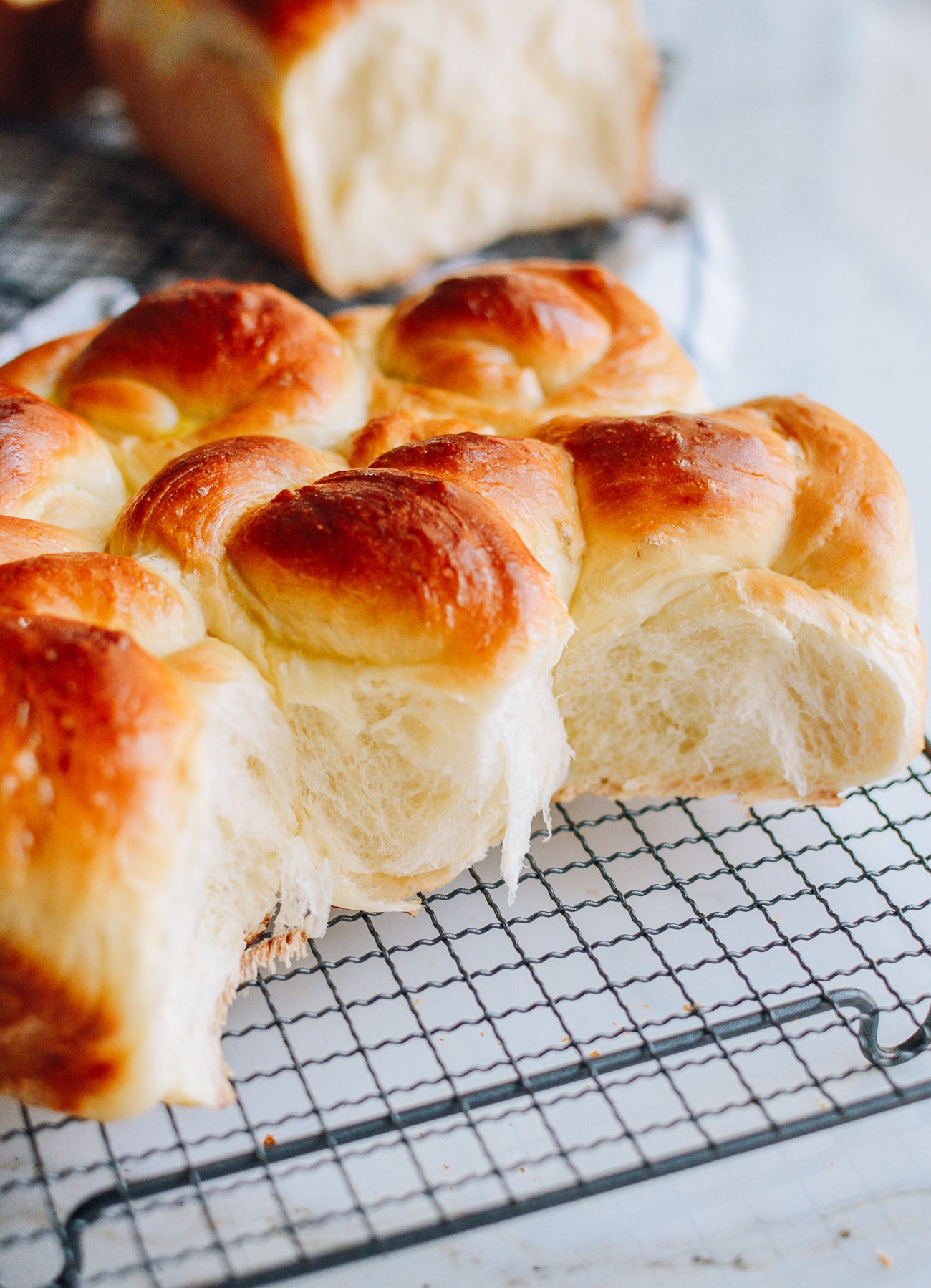
Milk Bread
Printed from nanasfogon.com/recipe/89860-best-milk-bread · Original: https://food52.com/recipes/89860-best-milk-bread
- Prep
- 2 hr
- Cook
- 50 min
- Total
- 2 hr 50 min
Ingredients
Dairy-free version. Swapped:
whole milk → unsweetened oat milk; unsalted butter → dairy-free plant butter (pareve)
Good for vegan, lactose-free and kosher meat meals. Check labels: some plant butters and creamers aren't certified parve or contain nuts or coconut.
- For the starter:
- 1/3 cup (45 grams) bread flour About bread flour →
- 1 cup whole milk About whole milk →
- 1/2 cup water
- For the dough:
- 2 3/4 cup (370 grams) bread flour About bread flour →
- 1/4 cup (60 grams) sugar
- 2 1/4 teaspoon (1 packet) active dry yeast About yeast →
- 1 teaspoon salt About table salt →
- 1 egg About eggs →
- 2 tablespoon honey About honey →
- 1/2 cup plus 2 tablespoons whole milk, plus more for brushing on the dough before baking About whole milk →
- 4 tablespoon unsalted butter, cut into pieces and brought to room temperature, plus more for buttering mixing bowl and baking pan About unsalted butter →
Out of something?
- Bread flour
- for 1 cup, use 1 cup all-purpose flour (plus 1 tsp vital wheat gluten if you have it). Less chew and rise; dough feels slacker, so hold back a spoonful of water.
- Milk
- for 1 cup, use 1/2 cup evaporated milk + 1/2 cup water, or 2/3 cup skim milk + 1/3 cup half-and-half. Evaporated milk tastes slightly cooked; fine in baking.
- Active dry yeast
- for 1 packet (2 1/4 tsp), use 2 1/4 tsp instant yeast, mixed straight into the flour. Instant rises a little faster; start checking the first rise early. Skip the proofing step.
- Egg
- As a binder: for 1 large, use 1 tbsp ground flaxseed + 3 tbsp water, rested 10 minutes until gloppy. Binds cookies, muffins and quick breads. It won't lift a sponge cake or set a custard, and adds a nutty flavor and flecks.
- For moisture: for 1 large, use 1/4 cup unsweetened applesauce or mashed ripe banana. Denser, moister crumb; banana flavor shows. Best when the recipe calls for only 1–2 eggs.
- for 1 large, use 2 large egg yolks + 1 tbsp water. Richer, more tender, slightly denser. Handy when you have leftover yolks.
- Honey
- for 1 cup, use 1 cup maple syrup or silan (date syrup). Maple is thinner and less sweet; silan is darker and fruitier. Vegans who avoid honey use either.
- Unsalted butter
- Melted, in cakes & muffins: for 1 cup, use 3/4 cup neutral oil. Moister, more tender, keeps longer; no buttery flavor. Not for recipes that cream butter and sugar.
- For sautéing: for 1 tbsp, use 1 tbsp olive oil or neutral oil, or schmaltz in meat dishes. Less browning flavor. Schmaltz gives savory depth to onions, potatoes and kasha.
- Vegan, for baking: for 1 cup, use 1 cup refined coconut oil: solid for creaming, melted where melted butter is called for. Refined has no coconut taste. Coconut oil is 100% fat, so cookies spread more and pastry is crumblier; chill doughs well.
Steps
- For the starter:
-
1
In a small saucepan, whisk together the flour, milk, and ½ cup water until smooth. Set over medium low heat and stir as you bring it to a simmer. Continue stirring and cook the mixture until it’s thickened but pourable (like a béchamel), about 10 minutes. Scrape enough starter into a ½ cup measuring cup to fill to the rim, cover with plastic wrap, and let cool (discard the remaining starter or make a second loaf!).
- For the dough:
-
2
In the bowl of a stand mixer fitted with a dough hook, combine the flour, sugar, yeast, and salt and mix for a few seconds, just until blended. Add the egg, milk, honey, and ½ cup starter. Mix on low speed until a dough forms; knead for 5 minutes.
-
3
Add the room temperature butter to the mixer and knead another 10 to 12 minutes. The dough should be soft and smooth.
-
4
Butter the inside of a bowl that’s at least twice the volume of the dough. Scrape the dough from the mixer onto a lightly floured countertop. Shape into a ball and place in the buttered bowl. Cover with a kitchen towel and let the dough rise until doubled in size. This will take about an hour; start checking after 30 minutes.
-
5
Punch the dough down, fold in the sides and scrape it onto a work surface. Using a bench scraper or knife, cut the dough into 4 pieces. Shape each piece of dough into a ball; Place them 4 inches apart on the countertop, cover with the dishtowel and let them rise until puffy, but not doubled, 10 to 15 minutes.
-
6
Heat the oven to 350°F. Generously butter a 9x5-inch loaf pan. Working with one ball at a time, turn the ball over onto a lightly floured surface and using the base of your palm, pat the dough into a flat oval, about 4 inches wide. Working from one of the narrow ends, roll the oval into a log just wide enough to fit crosswise into the pan. Place the log in the pan, seam side-down and crosswise. Repeat with the remaining balls of dough, so that you have 4 dough logs equally spaced on the base of the pan.
-
7
Cover and let rest until the dough is rising above the edge of the pan and is springy when gently pressed, about 40 minutes.
-
8
Brush the top of the loaf with milk and bake until golden brown, about 40 minutes. Remove from the oven to a baking rack.
-
9
Let the loaf cool in the pan for 10 minutes, then invert the loaf onto the wire rack, set right side up and let cool.
Flavor map
How Nana pairs flavors →This one is sweet and rich.
Goes well with
 Goes with
Edna Lewis & Scott Peacock's Sweet Potato Casserole
52% flavor match
Vanilla with milk is a natural match; both lean on honey and milk.
 Also on the table
Poppy Seed Pierogi (Pierogi Z Makiem) Recipe
50% flavor match
Both lean on honey and milk; apricot loves honey.
Log in to tell Nana which pairings are good. Your votes improve the map.
More about this recipe
Nutrition
1 of 5 servings · about 164 g Whole recipe · about 818 g · servings estimated · High confidence
| % DV* | ||
|---|---|---|
| Total Fat | 4 g | 5% |
| Saturated Fat | 1.4 g | 7% |
| Trans Fat | 0.003 g | |
| Cholesterol | 38 mg | 13% |
| Sodium | 508 mg | 22% |
| Total Carbohydrate | 81.4 g | 30% |
| Dietary Fiber | 2.5 g | 9% |
| Total Sugars | 19.7 g | |
| Protein | 13.5 g | 27% |
| Vitamin D | 0.81 mcg | 4% |
| Calcium | 74 mg | 6% |
| Iron | 4 mg | 22% |
| Potassium | 183 mg | 4% |
* % Daily Value is based on a 2,000-calorie diet.
- Carbs 78%
- Fat 9%
- Protein 13%
Vitamins & minerals
| Vitamin A | 36.5 mcg | 4% |
|---|---|---|
| Vitamin C | 0.048 mg | 0% |
| Vitamin D | 0.81 mcg | 4% |
| Vitamin E | 0.46 mg | 3% |
| Vitamin K | 0.43 mcg | 0% |
| Thiamin (B1) | 0.91 mg | 76% |
| Riboflavin (B2) | 0.63 mg | 49% |
| Niacin (B3) | 7.2 mg | 45% |
| Pantothenic acid (B5) | 0.94 mg | 19% |
| Vitamin B6 | 0.093 mg | 5% |
| Folate | 292 mcg DFE | 73% |
| Vitamin B12 | 0.3 mcg | 12% |
| Choline | 42 mg | 8% |
| Calcium | 74 mg | 6% |
| Iron | 4 mg | 22% |
| Potassium | 183 mg | 4% |
| Magnesium | 28 mg | 7% |
| Phosphorus | 152 mg | 12% |
| Zinc | 1.2 mg | 11% |
| Copper | 0.18 mg | 20% |
| Manganese | 0.69 mg | 30% |
| Selenium | 38.3 mcg | 70% |
Fats & carbs in detail
| Monounsaturated fat | 0.91 g | |
|---|---|---|
| Polyunsaturated fat | 0.88 g | |
| Omega-3 | 0.082 g | 5% |
| Omega-6 | 0.77 g | 5% |
| Starch | 0 g | |
| Net carbs | 78.9 g | |
| Omega-6 : Omega-3 ratio | 9.4 : 1 |
Amino acids (protein building blocks)
| Histidine | 0.3 g | |
|---|---|---|
| Isoleucine | 0.55 g | |
| Leucine | 0.99 g | |
| Lysine | 0.46 g | |
| Methionine | 0.26 g | |
| Cystine | 0.27 g | |
| Phenylalanine | 0.67 g | |
| Tyrosine | 0.42 g | |
| Threonine | 0.42 g | |
| Tryptophan | 0.16 g | |
| Valine | 0.64 g |
How we calculated this
| Ingredient | Counted as | g | kcal |
|---|---|---|---|
| 1/3 cup (45 grams) bread flour | Wheat flour, white, bread, enriched | 46 | 165 |
| 1 cup whole milk | Milk, whole, 3.25% milkfat, with added vitamin D | 244 | 149 |
| 1/2 cup water | Water | 0 | |
| 2 3/4 cup (370 grams) bread flour | Wheat flour, white, bread, enriched | 377 | 1360 |
| 1/4 cup (60 grams) sugar | Sugars, granulated | 50 | 194 |
| 2 1/4 teaspoon (1 packet) active dry yeast | Leavening agents, yeast, baker's, active dry | 9 | 29 |
| 1 teaspoon salt | Salt, table | 6 | 0 |
| 1 egg | Egg, whole, raw, fresh | 44 | 63 |
| 2 tablespoon honey | Honey | 42 | 129 |
| 1/2 cup plus 2 tablespoons whole milk, plus more for brushing on the dough before baking | Not counted — incomplete line | ||
| 4 tablespoon unsalted butter, cut into pieces and brought to room temperature, plus more for buttering mixing bowl and baking pan | Not counted — kitchen equipment |
Matched to the USDA FoodData Central database (SR Legacy). Amounts are converted with USDA portion weights where they exist, otherwise typical sizes. Open in the analyzer to adjust a match →
Estimated from the ingredient list — brands, exact sizes and cooking losses vary. Not medical advice.
Allergens
-
Egg
In: 1 egg
Whole eggs, yolks, whites and egg-based sauces like mayonnaise, aioli and hollandaise.
-
Honey & bee products
In: 2 tablespoon honey
-
Milk / dairy
In: 1 cup whole milk; 1/2 cup plus 2 tablespoons whole milk, plus more for brushing on the dough before baking; 4 tablespoon unsalted butter, cut into pieces and brought to room temperature, plus more for buttering mixing bowl and baking pan
Cow's milk and anything made from it: butter, cream, cheese, yogurt, whey, casein, ghee.
-
Gluten › Wheat
In: 1/3 cup (45 grams) bread flour; 2 3/4 cup (370 grams) bread flour
Wheat, barley, rye and oats (oats are often cross-contaminated). Celiac disease and wheat allergy are different — pick just Wheat if only wheat is the problem.
-
Yeast
In: 2 1/4 teaspoon (1 packet) active dry yeast
Found by reading the ingredient names. Brands and "may contain" warnings vary, so always check the label.
Questions about this recipe
- Can I make this dough ahead of time?
- Yes, you can prepare the dough and let it rise in the refrigerator overnight; just bring it back to room temperature before shaping and the final proof.
- How should I store or freeze the finished loaf?
- Store the loaf in an airtight bag at room temperature for up to 4 days, or slice and freeze with parchment paper between slices for up to 3 months.
- What can I use if I don't have bread flour?
- You can substitute all-purpose flour in a 1:1 ratio, though the final loaf may be slightly less airy and fluffy.
- How do I tell when the bread is fully baked?
- The loaf should be golden brown on top and sound hollow when you tap the bottom of the loaf.
- What goes well with this milk bread?
- Because of its mild sweetness, it's perfect for jam and butter, toasted with honey, or used as the base for a French toast breakfast.
My notes
Log in to keep private notes on recipes.
Learn while you cook
Learn library →- Why It Works · 5 min read Gluten & Kneading Two wheat proteins plus water make gluten, a stretchy net that traps gas; kneading and time build it for chewy bread, w…
- Techniques · 5 min read Creaming & Folding Cream cool-room-temperature butter (65°F) with sugar for 3–5 minutes until pale and fluffy to build air; fold gently in…
- Why It Works · 5 min read Why We Rest Meat & Dough Meat keeps cooking after it leaves the heat, so pull it early and let it rest; dough rests so gluten relaxes and flour …
Words in this recipe
- Simmer
- Liquid just below a boil, about 185 to 205°F, with small bubbles rising gently.
- Knead
- To work dough by pressing, folding and turning, developing gluten for structure and chew. Learn more
- Fold
- To combine a light, airy mixture (whipped cream, egg whites) into a heavier one with gentle cutting and turning strokes, keeping as much air as possible. Learn more
- Rest
- To let food sit after cooking (meat) or mixing (dough, batter) so juices redistribute or gluten relaxes. Learn more
Handy for this recipe Measurements & ConversionsSubstitution Finder