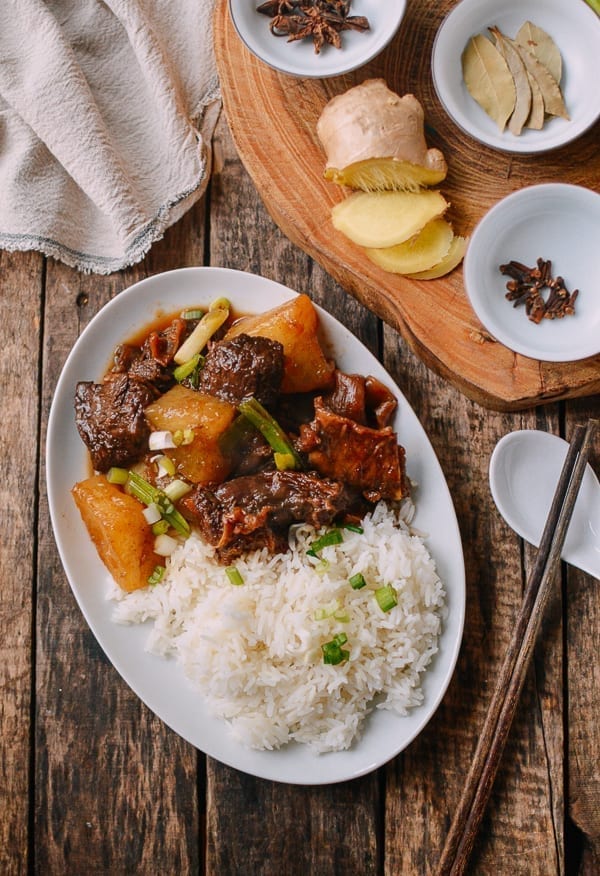
Red Braised Daikon
Printed from nanasfogon.com/recipe/89913-red-braised-daikon · Original: https://food52.com/recipes/89913-red-braised-daikon
- Prep
- 25 min
- Cook
- 1 hr 15 min
- Total
- 1 hr 40 min
Ingredients
- 1 daikon (about 450 grams; 1 pound) About daikon →
- 1 tablespoon (about 11 grams) uncooked rice About rice →
- 1 1/2-inch knob fresh ginger (about ½ ounce; 15 grams), smashed and sliced thinly About fresh ginger →
- 2 scallions (around 1 ounce; 30 grams), chopped into ½-inch segments About scallion →
- 4 garlic cloves, peeled and smashed About garlic →
- 1/2 tablespoon (around 5 grams) dried Szechuan peppercorns Can't find it? ½ tsp black pepper + ½ tsp coriander seed + a little lemon zest per tsp
- 2 cup plus 1 tablespoon water, divided
- 1 tablespoon (30 grams) light soy sauce, preferably reduced sodium About soy sauce →
- 1 tablespoon (15 grams) dark soy sauce Can't find it? Regular soy sauce plus 1/2 tsp molasses for each tablespoon
- 1 tablespoon (15 grams) seasoning sauce
- 1 tablespoon (15 grams) oyster sauce About oyster sauce (and vegetarian "oyster" sauce) →
- 1/2 tablespoon white sugar About granulated sugar →
- 1 tablespoon (10 grams) corn starch or potato starch About cornstarch →
Out of something?
- Ginger
- for 1 tbsp grated, use 1/4 tsp ground ginger. Warm and dusty, not bright and juicy. Fine in baking and braises; weak in stir-fries.
- Scallion
- for 1/4 cup sliced, use Chives (for the greens), or minced shallot or red onion (for the whites). Chives are milder and grassier.
- Garlic
- for 1 clove, use 1/8 tsp garlic powder, or 1/2 tsp jarred minced garlic. Powder is mellow and toasty, not pungent; fine in rubs and soups, poor in aioli or garlic bread.
- Light soy sauce
- Gluten-free: for 1 tbsp, use 1 tbsp tamari (check the label for wheat-free) or coconut aminos. Tamari is a bit richer; coconut aminos are sweeter and much less salty.
- Dark soy sauce
- Gluten-free: for 1 tbsp, use 1 tbsp tamari (check the label for wheat-free) or coconut aminos. Tamari is a bit richer; coconut aminos are sweeter and much less salty.
- Oyster sauce
- for 1 tbsp, use 1 tbsp vegetarian (mushroom) oyster sauce with a hechsher, or 2 tsp hoisin + 1 tsp soy sauce. Mushroom versions are close and parve. Hoisin is sweeter and spiced.
- Cornstarch
- for 1 tbsp, use 1 tbsp potato starch or arrowroot, or 2 tbsp all-purpose flour. Potato starch thickens at a lower temperature and turns stringy if boiled hard. Flour makes an opaque, less glossy sauce and needs a few minutes' simmer.
Prep first
Get these done before you turn on the heat. Cooks call it mise en place.
Steps
-
1
First, process the daikon. Slice off the stem and tip. Using a y-peeler, peel the daikon until no veins are visible. Cut the daikon into ½-inch-thick disks. Using the peeler again, chamfer thet top and bottom edges, rounding them off to prevent the edges of the daikon from chipping during the cook. Finally, cut shallow ⅛-inch crosses along the diameter of one side of the daikon, to allow for flavor penetration.
-
2
Place the daikon in a medium pot with the rice. Cover with cold water by 1-inch and bring to a simmer over medium heat. Cook the daikon, uncovered, for 30 minutes until barely fork tender. Strain and remove the daikon from the pot and set aside. Discard the liquid and the rice.
-
3
Heat a small amount of oil in a skillet or a wok over medium-high heat until barely smoking. Turn to medium. Add the ginger, scallions, garlic, and Szechuan peppercorn. Stir-fry until aromatic and golden brown, about 1 minute. Carefully watching for splatter, add water and bring to a boil. Add the light soy sauce, dark soy sauce, seasoning sauce, oyster sauce, and sugar. Mix to combine. Add the parcooked daikon into the pot and cook, maintaining a simmer for 30 minutes. Remove the daikon with a slotted spoon and set aside.
-
4
To finish the dish, thicken the sauce. Taste the sauce for seasoning and adjust if necessary. In a small bowl, combine the starch and water to form a slurry. Bring the sauce to a boil and add the starch slurry, stirring constantly until the sauce thickens. The sauce should coat the back of a spoon. Ladle the sauce over the cooked daikon and serve warm with warm rice.
Flavor map
How Nana pairs flavors →This one is savory and garlicky.
Goes well with
 Serve it with
Restaurant Style Chinese Broccoli with Oyster Sauce
83% flavor match
Sesame oil and soy sauce are a classic pair; both lean on oyster sauce and soy sauce.
 Serve it with
Stir-Fried Sesame Baby Bok Choy
81% flavor match
They share soy sauce and ginger; sesame oil and soy sauce are a classic pair.
 Start with
Sichuan Hot Pot Soup Base (川式清油火锅底料)
92% flavor match
Same Chinese roots; doubanjiang with sichuan peppercorn is a natural match.
 Finish with
Coconut-Sweet Potato Pie With Spiced Crust
78% flavor match
A light meal leaves room for something rich; coconut milk suits a Chinese meal.
 Pour
Masala Chai (Spiced Indian Tea)
72% flavor match
A classic Chinese pour: tea; crisp and bright next to dinner.
Log in to tell Nana which pairings are good. Your votes improve the map.
More about this recipe
Nutrition
1 of 2 servings · about 62 g Whole recipe · about 123 g · High confidence
| % DV* | ||
|---|---|---|
| Total Fat | 0.47 g | 1% |
| Saturated Fat | 0.15 g | 1% |
| Trans Fat | 0.001 g | |
| Cholesterol | 0 mg | 0% |
| Sodium | 1127 mg | 49% |
| Total Carbohydrate | 17.9 g | 6% |
| Dietary Fiber | 1.5 g | 5% |
| Total Sugars | 3.7 g | |
| Protein | 2.6 g | 5% |
| Vitamin D | 0 mcg | 0% |
| Calcium | 53 mg | 4% |
| Iron | 1.8 mg | 10% |
| Potassium | 183 mg | 4% |
* % Daily Value is based on a 2,000-calorie diet.
- Carbs 83%
- Fat 5%
- Protein 12%
Vitamins & minerals
| Vitamin A | 11 mcg | 1% |
|---|---|---|
| Vitamin C | 3.3 mg | 4% |
| Vitamin D | 0 mcg | 0% |
| Vitamin E | 0.17 mg | 1% |
| Vitamin K | 52.5 mcg | 44% |
| Thiamin (B1) | 0.057 mg | 5% |
| Riboflavin (B2) | 0.062 mg | 5% |
| Niacin (B3) | 0.93 mg | 6% |
| Pantothenic acid (B5) | 0.15 mg | 3% |
| Vitamin B6 | 0.087 mg | 5% |
| Folate | 39.5 mcg DFE | 10% |
| Vitamin B12 | 0.037 mcg | 2% |
| Choline | 7 mg | 1% |
| Calcium | 53 mg | 4% |
| Iron | 1.8 mg | 10% |
| Potassium | 183 mg | 4% |
| Magnesium | 27 mg | 7% |
| Phosphorus | 50 mg | 4% |
| Zinc | 0.38 mg | 3% |
| Copper | 0.1 mg | 11% |
| Manganese | 0.78 mg | 34% |
| Selenium | 1.9 mcg | 3% |
Fats & carbs in detail
| Monounsaturated fat | 0.088 g | |
|---|---|---|
| Polyunsaturated fat | 0.15 g | |
| Omega-3 | 0.035 g | 2% |
| Omega-6 | 0.11 g | 1% |
| Starch | 0 g | |
| Net carbs | 16.3 g | |
| Omega-6 : Omega-3 ratio | 3.1 : 1 |
Amino acids (protein building blocks)
| Histidine | 0.047 g | |
|---|---|---|
| Isoleucine | 0.09 g | |
| Leucine | 0.16 g | |
| Lysine | 0.097 g | |
| Methionine | 0.031 g | |
| Cystine | 0.031 g | |
| Phenylalanine | 0.098 g | |
| Tyrosine | 0.071 g | |
| Threonine | 0.076 g | |
| Tryptophan | 0.025 g | |
| Valine | 0.1 g |
How we calculated this
| Ingredient | Counted as | g | kcal |
|---|---|---|---|
| 1 daikon (about 450 grams; 1 pound) | Not found — no matching food | ||
| 1 tablespoon (about 11 grams) uncooked rice | Rice, white, long-grain, regular, raw, enriched | 12 | 42 |
| 1 1/2-inch knob fresh ginger (about ½ ounce; 15 grams), smashed and sliced thinly | Ginger root, raw | 9 | 7 |
| 2 scallions (around 1 ounce; 30 grams), chopped into ½-inch segments | Onions, spring or scallions (includes tops and bulb), raw | 30 | 10 |
| 4 garlic cloves, peeled and smashed | Spices, cloves, ground | 0 | 1 |
| 1/2 tablespoon (around 5 grams) dried Szechuan peppercorns | Spices, pepper, black | 4 | 9 |
| 2 cup plus 1 tablespoon water, divided | Not counted — incomplete line | ||
| 1 tablespoon (30 grams) light soy sauce, preferably reduced sodium | Soy sauce made from soy and wheat (shoyu) | 16 | 8 |
| 1 tablespoon (15 grams) dark soy sauce | Soy sauce made from soy and wheat (shoyu) | 16 | 8 |
| 1 tablespoon (15 grams) seasoning sauce | Spices, poultry seasoning | 4 | 14 |
| 1 tablespoon (15 grams) oyster sauce | Sauce, oyster, ready-to-serve | 18 | 9 |
| 1/2 tablespoon white sugar | Sugars, granulated | 6 | 24 |
| 1 tablespoon (10 grams) corn starch or potato starch | Cornstarch | 8 | 30 |
Matched to the USDA FoodData Central database (SR Legacy). Amounts are converted with USDA portion weights where they exist, otherwise typical sizes. Open in the analyzer to adjust a match →
Estimated from the ingredient list — brands, exact sizes and cooking losses vary. Not medical advice.
Allergens
-
Black & white pepper
In: 1/2 tablespoon (around 5 grams) dried Szechuan peppercorns
-
Corn
In: 1 tablespoon (10 grams) corn starch or potato starch
Corn and corn products: cornstarch, corn syrup, cornmeal, polenta, masa, corn oil.
-
Onion & garlic family › Garlic
In: 4 garlic cloves, peeled and smashed
Onions, shallots, garlic, leeks, scallions and chives, including powders.
-
Ginger
In: 1 1/2-inch knob fresh ginger (about ½ ounce; 15 grams), smashed and sliced thinly
-
Onion & garlic family › Leek, scallion & chives
In: 2 scallions (around 1 ounce; 30 grams), chopped into ½-inch segments
Onions, shallots, garlic, leeks, scallions and chives, including powders.
-
Shellfish › Molluscs › Oyster
In: 1 tablespoon (15 grams) oyster sauce
Clams, mussels, oysters, scallops, squid, octopus, snails.
-
Nightshades › Potato
In: 1 tablespoon (10 grams) corn starch or potato starch
Tomato, potato, peppers (sweet and hot), eggplant, tomatillo and goji. Sweet potatoes are not nightshades.
-
Rice
In: 1 tablespoon (about 11 grams) uncooked rice
-
Soy › Soy sauce & tamari (brewed)
In: 1 tablespoon (30 grams) light soy sauce, preferably reduced sodium; 1 tablespoon (15 grams) dark soy sauce
Fermented soy sauces. Much of the protein is broken down in brewing.
-
Gluten › Wheat
In: 1 tablespoon (30 grams) light soy sauce, preferably reduced sodium; 1 tablespoon (15 grams) dark soy sauce
Wheat, barley, rye and oats (oats are often cross-contaminated). Celiac disease and wheat allergy are different — pick just Wheat if only wheat is the problem.
Found by reading the ingredient names. Brands and "may contain" warnings vary, so always check the label.
Questions about this recipe
- Can I make this ahead of time?
- Yes, you can braise the daikon in advance and store it in the sauce; just reheat gently before serving.
- How should I store or freeze the leftovers?
- Store in an airtight container in the refrigerator for up to 4 days. Freezing is not recommended as it alters the texture of the daikon.
- What can I use if I don't have seasoning sauce or oyster sauce?
- You can substitute both with a mixture of soy sauce, a pinch of sugar, and a bit of mushroom powder or hoisin sauce for depth.
- How do I know when the daikon is properly cooked?
- The daikon is done when it is tender enough to be pierced easily by a fork but still holds its rounded shape.
- What is the best side dish to serve with this?
- This dish pairs perfectly with steamed white rice to soak up the rich, savory sauce.
My notes
Log in to keep private notes on recipes.
Learn while you cook
Learn library →- Techniques · 6 min read Braising Brown tough, well-marbled meat, half-submerge it in flavorful liquid, cover, and cook low (300–325°F) until a fork slid…
- Ingredient Deep-Dives · 8 min read The Onion Family Yellow onions for cooking, red for raw, shallots for sauces; the finer you cut garlic or onion, the stronger it gets, a…
- Techniques · 6 min read Cooking Rice & Grains Rinse most rice, measure water by the grain (white 1:1½, brown 1:2), cook covered on the lowest heat, then rest 10 minu…
Words in this recipe
- Simmer
- Liquid just below a boil, about 185 to 205°F, with small bubbles rising gently.
- Slurry
- Starch (cornstarch, potato starch) stirred into cold liquid, then added to a hot liquid to thicken it without lumps. Learn more
Handy for this recipe Substitution Finder