Mom’s best duck pancakes (春饼, mandarin pancakes)
Printed from nanasfogon.com/recipe/duck-pancakes · Original: https://omnivorescookbook.com/duck-pancakes/
- Prep
- 90 min
- Cook
- 15 min
- Total
- 1 hr 45 min
Ingredients
- 2 cups (300 grams) all-purpose flour (please read how to convert grams to cups properly), and extra to dust the working surface About all-purpose flour →
- 3/4 cup (180 milliliters) boiling water
- 90 milliliters 1/4 cup + 2 tablespoons cool water (room temperature)
- 2 tablespoons vegetable oil for brushing About neutral oil →
Out of something?
- Flour
- For thickening: for 1 tbsp, use 1/2 tbsp potato starch or cornstarch, mixed into cold liquid first. Clearer, glossier sauce. Add at the end and don't boil long: starches thin out if overcooked.
- For dredging: for 1 cup, use 1 cup potato starch, rice flour or matzo cake meal. Starch gives a thinner, crisper coating; matzo cake meal browns like flour. Rice is kitniyot for Ashkenazim.
Steps
-
1
Prepare dough
-
2
Bring a small pot of water to a boil. Dust a working surface with plenty of flour.
-
3
Add 150 grams (1 cup) flour into a large bowl. Slowly add boiling water into the first bowl. Whisk with a pair of chopsticks (or a spatula), until the water is fully absorbed. It will form a soft, sticky mass. Use a spatula to scrape the dough onto the working surface.
-
4
Add the remaining 150 grams (1 cup) flour into the same bowl. Slowly add cool water and whisk until the water is fully absorbed. It will form a soft mass, but should not be too sticky. Scrape dough onto the first dough on the working surface.
-
5
Dust both hands with flour. Knead and press the two doughs together. Dust with more flour if needed. Knead the dough by hand until texture turns consistent, about 5 minutes. You should feel that the dough is slightly sticky while kneading, but it shouldn’t stick to your hands. Be careful not to dust the working surface with too much flour. The dough will become less tender as you blend in more dry flour.
-
6
Dust the dough with flour. Cover with plastic wrap and let rest for 30 minutes.
-
7
Shape pancakes
-
8
Dust working surface with flour again. Knead the dough a few times until smooth. Do not over-knead it.
-
9
(Optional) The dough might still be springy and a bit difficult to roll. Dust the dough with flour and cover with plastic wrap again. Let rest for another 10 to 20 minutes.
-
10
Shape the dough into a log and divide it into two equal pieces. Wrap one piece with plastic wrap (to prevent the dough from drying out) and work on the other piece.
-
11
Pull and roll the dough log back and forth until it turns into a long roll, about 36 cm (18 inches) in length. Cut into 2-cm (1-inch) pieces. You should get 18 pieces of dough. Dust both cut sides of each dough piece with flour and let stand on one of the cut sides.
-
12
Work on the dough pieces two at a time. Cover the rest of the dough pieces loosely with plastic wrap (or a clean, damp towel), to prevent drying out.
-
13
Add oil into a small bowl. Prepare a small brush.
-
14
Shape two doughs into a cylinder shape and press them as much as you can into two small, round discs.
-
15
Brush oil thoroughly onto the top of one dough disc. Make sure the oil covers the entire surface, otherwise the two pancakes will be difficult to separate later. This process of doubling up the pancakes cuts rolling and cooking time in half.
-
16
Place the other one onto it, to form a two-layer pancake. Press the two doughs again, into a flat disc.
-
17
Dust the working surface with flour. Use a rolling pin to roll the double pancake into a thin round disc, about 13 to 15 cm (5 to 6 inches) in diameter. Turn the dough a few times during rolling, to ensure both pancakes are evenly rolled out. The pancakes will be very thin and might stick to the working surface when rolled. Dust with more flour if needed.
-
18
Dust both sides of the double pancake with flour again and place it aside, keeping them in a single stack. Cover with a damp towel (or damp paper towel) to prevent the pancakes from drying out.
-
19
When you finish working on the first batch of dough pieces, you should have 9 double-pancake doughs. You should cook them before rolling out the rest of the dough pieces. Because the pancake dough is very moist and tender, the pancakes will stick together if let sit for too long. On the other hand, if you’re cooking with your family or friends, you can have someone else help you cook the pancakes while you work on the rest of the dough.
-
20
Cook pancakes
-
21
Prepare two plates beside the stove.
-
22
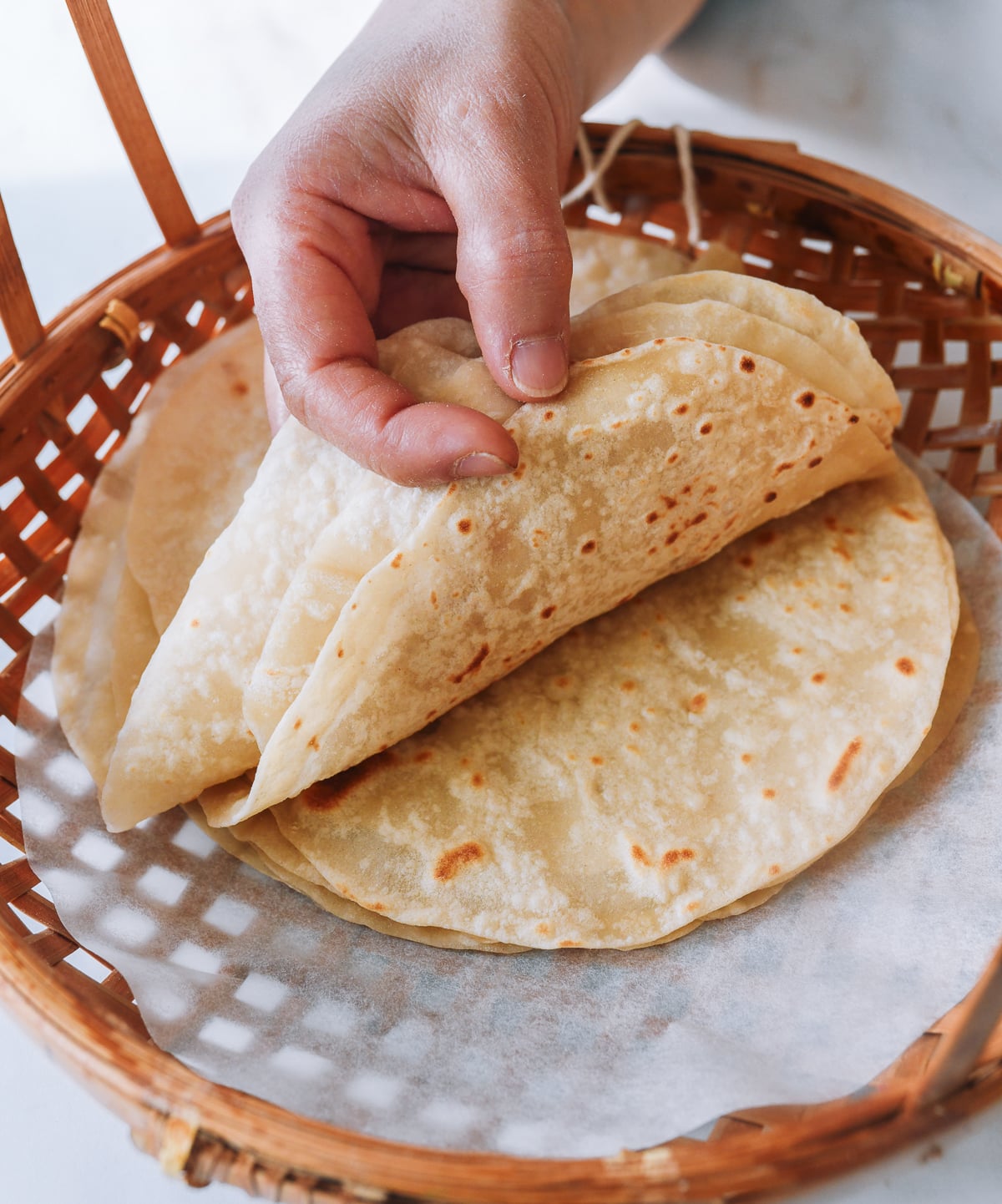
Heat a heavy skillet over medium high heat until hot. Turn to medium low heat. Place a pancake in the center and let cook until the surface puffs up and the bottom side shows small light-brown spots, about 30 to 40 seconds.
-
23
Flip and cook the other side. The whole process should take 1 minute or less. The finished pancake should be tender, springy, and slightly crispy on the surface. It should not feel dry.
-
24
If the pan is too hot, the pancakes will burn too quickly before they puff up. If the pan is not hot enough, the pancakes will dry out due to the long cooking time. Adjust the heat of the pan and keep the total cooking time for each double pancake under 1 minute.
-
25
Transfer the cooked pancakes to a plate to cool. Place another raw double pancake into the skillet. While cooking that pancake, split the just-finished double pancake in two by peeling off the top layer. If the pancake is too hot to touch, you can wait a bit longer and cook other pancakes first. Since we brushed oil between the pancakes, it should be very easy to separate them. Place the separated pancakes on top of each other on the other plate. Repeat the process until you’ve finished 30 pancakes. Cover the pancakes with a damp paper towel to keep them moist.
-
26
(Option 1)
-
27
If you will be serving the pancakes immediately after cooking, you can serve them directly. They will be very tasty, even after they’ve cooled off.
-
28
(Option 2)
-
29
You can make the pancakes ahead of time and reheat them when you’re ready to serve the meal.
-
30
To serve them the next day or within the next few hours, let the pancakes stay covered, and wait until they’ve cooled off. Transfer them to an air-tight container and store them at room temperature for up to half a day, or in the fridge overnight.
-
31
To serve the pancakes, place them onto a heatproof plate or a bamboo steaming rack. Steam until hot, 3 to 5 minutes. Serve immediately.
-
32
(Option 3)
-
33
If you will serve the pancakes a few days later, you can freeze them. Let the pancakes cool off completely. Wrap tightly with plastic wrap and seal in a ziplock bag. Store in the freezer for up to a month.
-
34
To serve the pancakes, reheat them by steaming until hot and tender, 10 to 15 minutes. You don’t need to thaw the pancakes before steaming.
-
35
How to serve
-
36
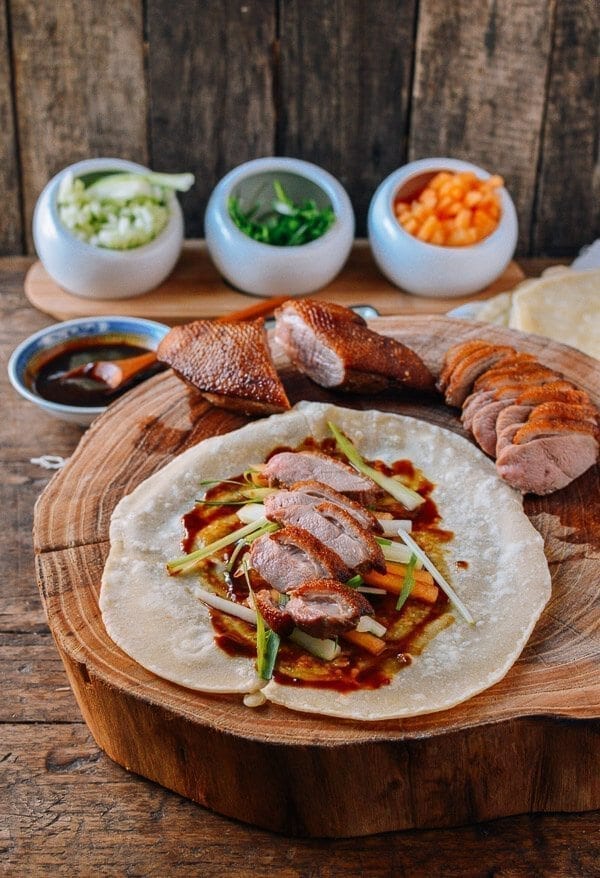
(Option 1) Serve with duck - you can cook pan-seared duck breast according to this recipe (minus the sauce). Serve the duck breast, hoisin sauce, green onions, and sliced cucumber with the pancakes. If you prepare the pancakes ahead of time, you can easily serve a Peking duck dinner for four in just 30 minutes.
-
37
(Option 2) Serve with moo shu vegetables or other stir-fried veggies (vegetarian meal - refer to the blog post above this recipe). If you’re cooking other stir-fried veggies, try to select veggies with lower moisture content (such as root vegetables).
Find that page on the original recipe at omnivorescookbook.com ↗
-
38
(Option 3) Serve with scrambled eggs, green onion, and hoisin sauce - this is the easiest way to enjoy these fresh pancakes.
-
39
(Option 4) Serve with crispy chicken - Use this recipe to cook crispy chicken without deep-frying. Serve with hoisin sauce, green onion, and sliced carrot (or cucumber).
Flavor map
How Nana pairs flavors →Goes well with
 Pour
Paper Plane Cocktail
69% flavor match
A classic American pour: bourbon; crisp and fruity next to dinner.
 Pour
Whiskey Sour
69% flavor match
Crisp and fruity next to dinner; a classic American pour: bourbon.
Log in to tell Nana which pairings are good. Your votes improve the map.
More about this recipe
Nutrition
1 of 36 servings · about 8 g Whole recipe · about 277 g · Good estimate
| % DV* | ||
|---|---|---|
| Total Fat | 0.83 g | 1% |
| Saturated Fat | 0.13 g | 1% |
| Trans Fat | 0.004 g | |
| Cholesterol | 0 mg | 0% |
| Sodium | 0 mg | 0% |
| Total Carbohydrate | 5.3 g | 2% |
| Dietary Fiber | 0.19 g | 1% |
| Total Sugars | 0.019 g | |
| Protein | 0.72 g | 1% |
| Vitamin D | 0 mcg | 0% |
| Calcium | 1 mg | 0% |
| Iron | 0.32 mg | 2% |
| Potassium | 7 mg | 0% |
* % Daily Value is based on a 2,000-calorie diet.
- Carbs 67%
- Fat 24%
- Protein 9%
Vitamins & minerals
| Vitamin A | 0 mcg | 0% |
|---|---|---|
| Vitamin C | 0 mg | 0% |
| Vitamin D | 0 mcg | 0% |
| Vitamin E | 0.066 mg | 0% |
| Vitamin K | 1.4 mcg | 1% |
| Thiamin (B1) | 0.055 mg | 5% |
| Riboflavin (B2) | 0.034 mg | 3% |
| Niacin (B3) | 0.41 mg | 3% |
| Pantothenic acid (B5) | 0.03 mg | 1% |
| Vitamin B6 | 0.003 mg | 0% |
| Folate | 20.2 mcg DFE | 5% |
| Vitamin B12 | 0 mcg | 0% |
| Choline | 1 mg | 0% |
| Calcium | 1 mg | 0% |
| Iron | 0.32 mg | 2% |
| Potassium | 7 mg | 0% |
| Magnesium | 2 mg | 0% |
| Phosphorus | 8 mg | 1% |
| Zinc | 0.049 mg | 0% |
| Copper | 0.01 mg | 1% |
| Manganese | 0.047 mg | 2% |
| Selenium | 2.4 mcg | 4% |
Fats & carbs in detail
| Monounsaturated fat | 0.18 g | |
|---|---|---|
| Polyunsaturated fat | 0.47 g | |
| Omega-3 | 0.053 g | 3% |
| Omega-6 | 0.41 g | 2% |
| Starch | 0 g | |
| Net carbs | 5.1 g | |
| Omega-6 : Omega-3 ratio | 7.7 : 1 |
Amino acids (protein building blocks)
| Histidine | 0.016 g | |
|---|---|---|
| Isoleucine | 0.025 g | |
| Leucine | 0.049 g | |
| Lysine | 0.016 g | |
| Methionine | 0.013 g | |
| Cystine | 0.015 g | |
| Phenylalanine | 0.036 g | |
| Tyrosine | 0.022 g | |
| Threonine | 0.02 g | |
| Tryptophan | 0.009 g | |
| Valine | 0.029 g |
How we calculated this
| Ingredient | Counted as | g | kcal |
|---|---|---|---|
| 2 cups (300 grams) all-purpose flour (please read how to convert grams to cups properly), and extra to dust the working surface | Wheat flour, white, all-purpose, enriched, bleached | 250 | 910 |
| 3/4 cup (180 milliliters) boiling water | Water | 0 | |
| 90 milliliters 1/4 cup + 2 tablespoons cool water (room temperature) | Not found — no matching food | ||
| 2 tablespoons vegetable oil for brushing | Oil, soybean, salad or cooking | 27 | 241 |
Matched to the USDA FoodData Central database (SR Legacy). Amounts are converted with USDA portion weights where they exist, otherwise typical sizes. Open in the analyzer to adjust a match →
Estimated from the ingredient list — brands, exact sizes and cooking losses vary. Not medical advice.
Allergens
-
Gluten › Wheat
In: 2 cups (300 grams) all-purpose flour (please read how to convert grams to cups properly), and extra to dust the working surface
Wheat, barley, rye and oats (oats are often cross-contaminated). Celiac disease and wheat allergy are different — pick just Wheat if only wheat is the problem.
Found by reading the ingredient names. Brands and "may contain" warnings vary, so always check the label.
Questions about this recipe
- Can I make these pancakes ahead of time?
- You can prepare the dough and let it rest, but the pancakes should be cooked fresh to maintain their moist, tender texture.
- How do I store or freeze leftovers?
- Store cooked pancakes in an airtight container in the fridge; to reheat, steam them briefly or microwave with a damp paper towel to restore moisture.
- What can I use if I don't have a rolling pin?
- A smooth glass bottle or a heavy PVC pipe can be used to roll the dough into thin discs.
- How do I tell when the pancakes are perfectly cooked?
- They are done when the surface puffs up and small light-brown spots appear on the bottom, usually within 30 to 40 seconds per side.
- What is the best way to serve these?
- These are traditional wraps; serve them with roast duck, sliced cucumbers, spring onions, and hoisin sauce.
My notes
Log in to keep private notes on recipes.
Learn while you cook
Learn library →- Why It Works · 5 min read Gluten & Kneading Two wheat proteins plus water make gluten, a stretchy net that traps gas; kneading and time build it for chewy bread, w…
- Techniques · 5 min read Searing Dry the surface, heat the pan until the oil shimmers, lay the food down and leave it alone until it releases on its own.
- Why It Works · 5 min read Why We Rest Meat & Dough Meat keeps cooking after it leaves the heat, so pull it early and let it rest; dough rests so gluten relaxes and flour …
Words in this recipe
- Knead
- To work dough by pressing, folding and turning, developing gluten for structure and chew. Learn more
- Rest
- To let food sit after cooking (meat) or mixing (dough, batter) so juices redistribute or gluten relaxes. Learn more
Handy for this recipe Safe Cooking TemperaturesMeasurements & ConversionsSubstitution Finder