
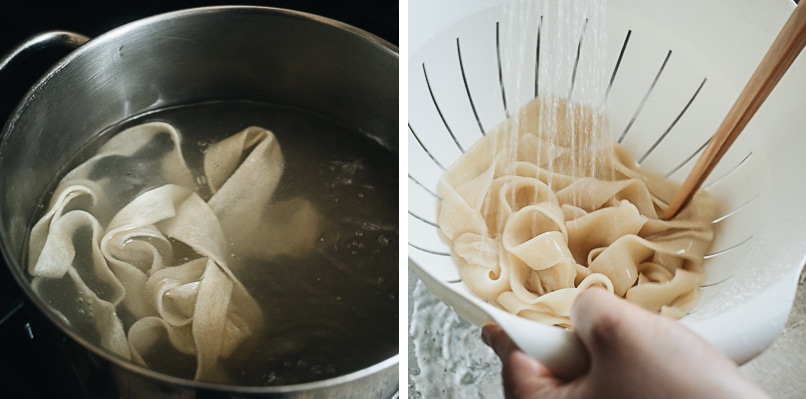
Hand-Pulled Noodles
- Prep
- 20 min
- Cook
- 2 min
- Total
- 22 min
Ingredients
- 2 2/3 cup all-purpose flour (*Footnote 1) About all-purpose flour →
- 1/2 teaspoon salt About table salt →
- 1 cup water , room temperature
- Vegetable oil to coat the dough About neutral oil →
Steps
-
1
Make the dough by hand (Option 1)
-
2
Combine the water and salt in a small bowl. Stir to dissolve the salt.
-
3
Add the flour into a large bowl. Bit by bit, pour the water into the flour, mixing with a pair of chopsticks or a spatula as you go.
-
4
Once all the water is added, the dough should be in shaggy threads with little/no dry flour in the bowl. Begin pressing the dough together. If you find the dough is too dry and there’s still dry flour that’s hard to incorporate into the dough, drizzle more water onto the dry flour and mix it again, until there’s no dry flour left. Knead the dough until a rough, firm ball is formed, about 2 minutes.
-
5
Cover the bowl with plastic wrap and let it rest for 20 minutes.
-
6
Once the dough is rested, knead it again until it becomes smooth, 1 to 2 minutes.
-
7
Make the dough using KitchenAid (Option 2)
-
8
Mix the flour and salt in the bowl of the KitchenAid mixer and add the dough hook. Turn it to the mix setting. Slowly drizzle the water down the side, all along the bowl. This should take about 1 minute. Once the water is incorporated, turn to setting 2 and knead until a rough dough ball is formed, another 2 to 3 minutes.
-
9
First rest
-
10
Cover the dough with plastic wrap and let it rest for 20 minutes.
-
11
Second kneading
-
12
Either knead in the machine on setting 4 for 30 seconds or by hand for 1 to 2 minutes. Then shape the dough.
-
13
(Optional) If you plan to store/freeze the dough, coat the dough with oil and store it in a sealed plastic bag. Refrigerate for up to 2 days or freeze for up to 3 months.
-
14
Shape the dough
-
15
FOR THIN NOODLES: Divide the dough to halves and roll each dough into a 1/2” (1 cm) thick oval.
-
16
FOR FLAT NOODLES: Divide the dough to halves and roll each and roll each dough into a 1/4” (1/2 cm) thick oval.
-
17
FOR WIDE NOODLES: Cut the dough into 8 pieces. Roll each piece into approximately 3”x5” (8x13 cm) ovals, 1/4” (1/2 cm) high.
-
18
Second rest
-
19
Coat the dough(s) generously with oil and cover with plastic. Let rest for 2 hours.
-
20
Pull and cook the noodles
-
21
Bring a medium-sized pot of water to a boil.
-
22
FOR THIN NOODLES: Cut long the longer side of the oval, slicing the dough into 1/2” (1 cm) wide strips and rolling each piece slightly to the side with each cut to prevent them from sticking together. Cover the cut pieces with the plastic again to prevent them from drying out. Starting with the first strip you cut off, pick it up on both ends. (*Footnote 2) In one swift motion, tug the noodle about an arm’s length and gently bounce it on the working surface once or twice until it forms a long, thin noodle. Rest the noodle on your working surface as you fold it over, so that both ends are in one hand. Hook the other side with your thumb. Give it a couple light tugs and bounces until the noodles get longer and reach the desired thin shape. Then pull off the thick ends collected in one hand and lay the noodle out on the working surface. Repeat with the rest of your noodles.
-
23
FOR FLAT NOODLES: Cut along the longer side of the oval, slicing the dough into 1 1/2” (3 cm) wide strips. Cover the cut pieces with the plastic again to prevent from drying out. Starting with the first strip you cut off, pick it up on both ends. (*Footnote 2) In one swift motion, tug the noodle to about an arm’s length and gently bounce it on the working surface once or twice. Rest the noodle on your working surface for 10-20 seconds, then give it a couple extra-light tugs and bounces until it forms a flat long noodle. Then pull off the thick ends and lay the noodle out. Repeat with the rest of your noodles. Drop the noodles into the boiling water, a few at a time, and cook for 1 to 1.5 minutes.
-
24
FOR WIDE NOODLES: One at a time, grip the short ends of a strip (*Footnote 2) and pull it apart in one swift motion until the dough feels taut. It should be between 1 to 2 feet. Bounce it on the table a couple times. Pull off the thick ends and lay the noodle out, covering it with plastic to prevent drying out.
-
25
Cook the noodles
-
26
Drop the noodles, a few pieces at a time, into the boiling water and cook for 1 to 1.5 minutes, until tender but still with a chewy texture. Do not cook too many noodles at a time! It’s hard to control the texture that way and the noodles might stick together.
-
27
Storage
-
28
Store the cooked noodles: If you plan on reheating, you can slightly undercook the noodles (to al dente) to create a better texture once reheated. Store the noodles in an airtight container or a ziplock bag in the fridge for up to 3 days or in the freezer for up to 3 months.
-
29
For frozen/refrigerated dough; let the frozen dough thaw in the fridge overnight. Transfer the refrigerated dough to room temperature. Rest for 2 hours. The dough will become super soft and can be gently shaped, rested for another 10 minutes or so, and pulled. Cook according to the instructions above.
-
30
Reheating cooked noodles
-
31
To reheat, bring a pot of water to a boil and add the cooked noodles. Separate with a pair of chopsticks and cook until the noodles are just heated through.
-
32
For a quicker and lazier reheating method (for leftovers), reheat the refrigerated noodles in the microwave until heated, then quickly rinse the noodles with tap water in a colander. Drain the water thoroughly before serving.
-
33
If you plan to use the thin noodles for fried noodles, you don’t need to reheat them before using. Thaw them if frozen. Then run the noodles with tap water in a colander and separate gently with chopsticks. Drain thoroughly before using for stir fried noodles.
Flavor map
How Nana pairs flavors →Goes well with
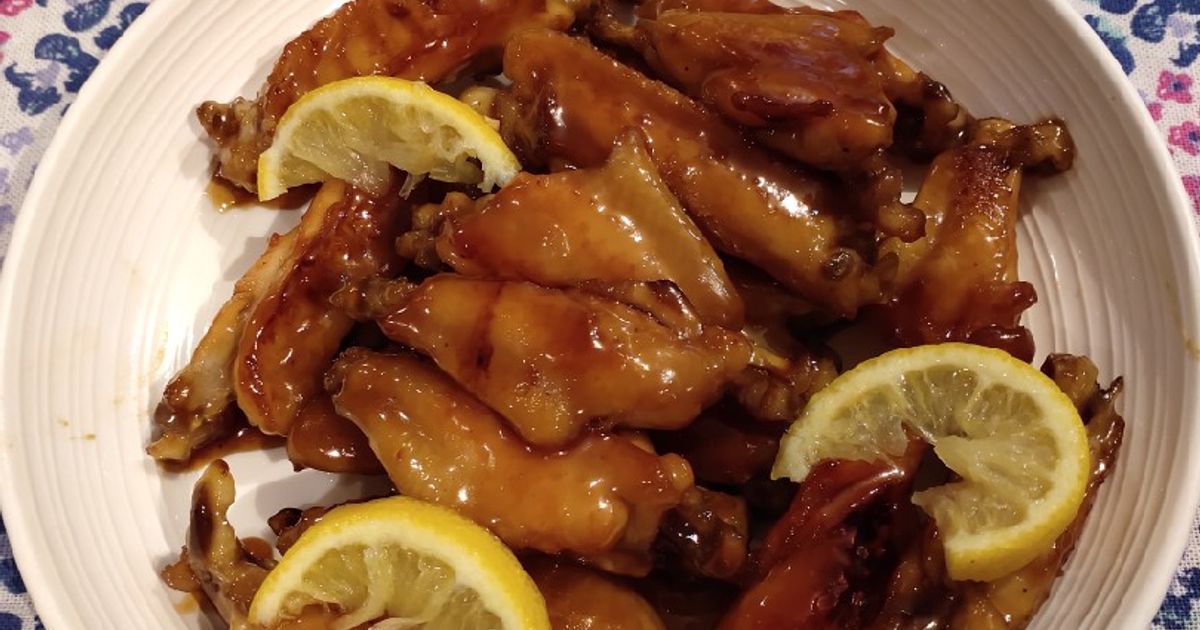 Start with
Lemon and Honey Chicken Wings
65% flavor match
Same American roots.
 Finish with
Chez Panisse’s Blueberry Cobbler
75% flavor match
A classic American finish: cobbler; a light meal leaves room for something rich.
 Pour
Paper Plane Cocktail
69% flavor match
Crisp and fruity next to dinner; a classic American pour: bourbon.
 Pour, alcohol-free
Shikanji Nimbu Pani (Indian Lemonade)
69% flavor match
A classic American pour: lemonade; crisp and fruity next to dinner.
Log in to tell Nana which pairings are good. Your votes improve the map.
More about this recipe
Nutrition
1 of 4 servings · about 84 g Whole recipe · about 336 g · High confidence
| % DV* | ||
|---|---|---|
| Total Fat | 0.82 g | 1% |
| Saturated Fat | 0.13 g | 1% |
| Trans Fat | 0 g | |
| Cholesterol | 0 mg | 0% |
| Sodium | 296 mg | 13% |
| Total Carbohydrate | 63.6 g | 23% |
| Dietary Fiber | 2.2 g | 8% |
| Total Sugars | 0.23 g | |
| Protein | 8.6 g | 17% |
| Vitamin D | 0 mcg | 0% |
| Calcium | 13 mg | 1% |
| Iron | 3.9 mg | 21% |
| Potassium | 89 mg | 2% |
* % Daily Value is based on a 2,000-calorie diet.
- Carbs 86%
- Fat 2%
- Protein 12%
Vitamins & minerals
| Vitamin A | 0 mcg | 0% |
|---|---|---|
| Vitamin C | 0 mg | 0% |
| Vitamin D | 0 mcg | 0% |
| Vitamin E | 0.05 mg | 0% |
| Vitamin K | 0.25 mcg | 0% |
| Thiamin (B1) | 0.65 mg | 55% |
| Riboflavin (B2) | 0.41 mg | 32% |
| Niacin (B3) | 4.9 mg | 31% |
| Pantothenic acid (B5) | 0.36 mg | 7% |
| Vitamin B6 | 0.037 mg | 2% |
| Folate | 242 mcg DFE | 61% |
| Vitamin B12 | 0 mcg | 0% |
| Choline | 9 mg | 2% |
| Calcium | 13 mg | 1% |
| Iron | 3.9 mg | 21% |
| Potassium | 89 mg | 2% |
| Magnesium | 18 mg | 4% |
| Phosphorus | 90 mg | 7% |
| Zinc | 0.58 mg | 5% |
| Copper | 0.12 mg | 13% |
| Manganese | 0.57 mg | 25% |
| Selenium | 28.3 mcg | 51% |
Fats & carbs in detail
| Monounsaturated fat | 0.072 g | |
|---|---|---|
| Polyunsaturated fat | 0.34 g | |
| Omega-3 | 0.018 g | 1% |
| Omega-6 | 0.33 g | 2% |
| Starch | 0 g | |
| Net carbs | 61.3 g | |
| Omega-6 : Omega-3 ratio | 18.3 : 1 |
Amino acids (protein building blocks)
| Histidine | 0.19 g | |
|---|---|---|
| Isoleucine | 0.3 g | |
| Leucine | 0.59 g | |
| Lysine | 0.19 g | |
| Methionine | 0.15 g | |
| Cystine | 0.18 g | |
| Phenylalanine | 0.43 g | |
| Tyrosine | 0.26 g | |
| Threonine | 0.23 g | |
| Tryptophan | 0.11 g | |
| Valine | 0.35 g |
How we calculated this
| Ingredient | Counted as | g | kcal |
|---|---|---|---|
| 2 2/3 cup all-purpose flour (*Footnote 1) | Wheat flour, white, all-purpose, enriched, bleached | 333 | 1213 |
| 1/2 teaspoon salt | Salt, table | 3 | 0 |
| 1 cup water , room temperature | Water | 0 | |
| Vegetable oil to coat the dough | Not counted — no amount (to taste / garnish) |
Matched to the USDA FoodData Central database (SR Legacy). Amounts are converted with USDA portion weights where they exist, otherwise typical sizes. Open in the analyzer to adjust a match →
Estimated from the ingredient list — brands, exact sizes and cooking losses vary. Not medical advice.
Allergens
-
Gluten › Wheat
In: 2 2/3 cup all-purpose flour (*Footnote 1)
Wheat, barley, rye and oats (oats are often cross-contaminated). Celiac disease and wheat allergy are different — pick just Wheat if only wheat is the problem.
Found by reading the ingredient names. Brands and "may contain" warnings vary, so always check the label.
Questions about this recipe
- Can I make the dough ahead of time?
- Yes, you can coat the dough in oil and store it in a sealed bag in the refrigerator for up to 2 days or in the freezer for up to 3 months.
- How do I know when the noodles are finished cooking?
- Cook them for 1 to 1.5 minutes; they are done when they are tender but still retain a characteristic chewy texture.
- What can I use instead of all-purpose flour?
- While all-purpose flour is standard for this chew, you can try bread flour for a slightly firmer bite, though you may need a touch more water.
- How should I store the cooked noodles for later?
- Store them in an airtight container or ziplock bag; slightly undercooking them to al dente will help maintain a better texture upon reheating.
My notes
Log in to keep private notes on recipes.
Learn while you cook
Learn library →- Why It Works · 5 min read Gluten & Kneading Two wheat proteins plus water make gluten, a stretchy net that traps gas; kneading and time build it for chewy bread, w…
- Why It Works · 5 min read Why We Rest Meat & Dough Meat keeps cooking after it leaves the heat, so pull it early and let it rest; dough rests so gluten relaxes and flour …
- Ingredient Deep-Dives · 8 min read Xanthan Gum & Lecithin: The Missing Pieces Xanthan gum thickens a sauce and keeps it from separating, lecithin ties fat to water and keeps baked goods soft, and y…
Words in this recipe
- Knead
- To work dough by pressing, folding and turning, developing gluten for structure and chew. Learn more
- Rest
- To let food sit after cooking (meat) or mixing (dough, batter) so juices redistribute or gluten relaxes. Learn more
- Fold
- To combine a light, airy mixture (whipped cream, egg whites) into a heavier one with gentle cutting and turning strokes, keeping as much air as possible. Learn more
- Al dente
- Italian for 'to the tooth': pasta or vegetables cooked through but still firm when bitten, with no chalky center.
Handy for this recipe Measurements & ConversionsSubstitution Finder


