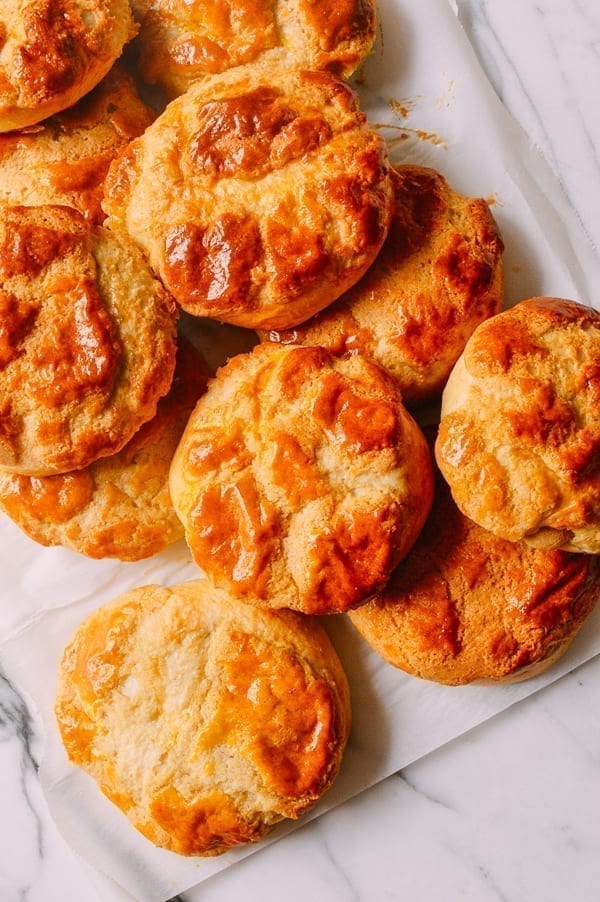
Pineapple Buns
Ingredients
Dairy-free version. Swapped:
milk → unsweetened oat milk; warm milk → unsweetened oat milk; unsalted butter → dairy-free plant butter (pareve)
Good for vegan, lactose-free and kosher meat meals. Check labels: some plant butters and creamers aren't certified parve or contain nuts or coconut.
- ¼ cup plus 3 tablespoons (100g) milk About whole milk →
- 2 tablespoons (20g) bread flour About bread flour →
- ½ cup plus 1 Tbsp. (125g) warm milk, at 110ºF About whole milk →
- 1 tsp. active dry yeast About yeast →
- ¼ cup (50g) granulated sugar, plus a pinch About granulated sugar →
- 2⅔ cups (335g) bread flour, plus more for work surface About bread flour →
- ½ teaspoon coarse salt About kosher salt →
- 1 large egg About eggs →
- 4 Tbsp. (55g) unsalted butter, cut into pieces and softened About unsalted butter →
- 1 tsp. canola or other neutral flavored oil, for bowl
- 2 cups (250g) all-purpose flour About all-purpose flour →
- ¼ teaspoon baking soda About baking soda →
- ¼ teaspoon coarse salt About kosher salt →
- 1 stick (113g) unsalted butter, softened About unsalted butter →
- ½ cup (100g) sugar
- 1 large egg About eggs →
- ½ teaspoon pure vanilla extract About vanilla extract →
- 2 drops yellow food coloring
- 1 large egg, white and yolk separated into two small bowls About eggs →
Steps
-
1
Milk Bread
-
2
Make the tangzhong: In a small saucepan over low heat, combine the flour and milk and cook, whisking constantly, until thickened to a paste, 2 to 3 minutes. Immediately transfer the paste into a small bowl, scraping the sides of the saucepan with a flexible spatula; let cool until warm, 5 to 10 minutes. Texture should resemble mashed potatoes.
-
3
Make the milk bread: In a clean or new small saucepan, scald the milk over medium heat, bringing the milk to a gentle simmer (watch carefully as milk tends to boil over). Pour milk into a small bowl and cool until warm to the touch (about 110°F). Stir in yeast and a pinch of sugar, and set aside until the surface of the mixture is foamy, 5 to 10 minutes.
-
4
In the bowl of an electric mixer fitted with a dough hook, combine the sugar, flour, salt, and egg. Add the tangzhong and milk and mix on low until shaggy. Add the softened butter one piece at a time, mixing until fully incorporated before adding the next. Increase the speed to medium-high and continue to knead the dough until it is tacky and slightly sticky, 8 to 9 minutes. Transfer the dough to a lightly floured work surface. Wet your hands to prevent the dough from sticking, pinch and pull the ends of the dough to form a smooth ball.
-
5
Coat a large mixing bowl with 1 teaspoon of oil. Add the dough to the bowl, gently turning it to cover with oil. Cover the bowl with plastic wrap and set in a warm spot to proof until doubled in size, about 2 hours (or place in the refrigerator to proof for at least 8 hours or overnight).
-
6
Buns
-
7
While the dough is proofing, line two large rimmed baking sheets with parchment paper.
-
8
Make the buns: After the first proof, punch down to deflate the dough and transfer it to a lightly floured surface. Pinch and pull the ends of the dough to form a smooth ball. Divide the dough into 12 equal portions with a bench scraper (for accuracy, weigh with a digital scale if you have one). Form each portion of dough into a smooth ball by pulling the ends of the dough underneath and then rolling between the palms of your hand, and arrange on the prepared sheets, spacing at least 3 inches apart. Cover with a damp, clean kitchen towel and set aside in a warm spot until the buns are doubled in size, 45 minutes to 1 hour.
-
9
Meanwhile, make the topping: In a small bowl, whisk together flour, baking soda, and salt. In a medium bowl, combine the softened butter and sugar with a flexible spatula until smooth. Add the egg, vanilla, and food coloring, mixing until smooth. Fold the flour mixture into the butter mixture to form a sandy dough, then knead by hand until smooth. Pat into a disc and divide the dough into 12 equal portions with a bench scraper (for accuracy, weigh with a digital scale if you have one). Roll one piece into a smooth ball, then flatten into a 4-inch round with a dowel rolling pin. Score a crosshatch pattern into the dough with the edge of a bench scraper or knife, being careful not to cut all the way through. Use the edge of the bench scraper to lift the topping off the work surface. Repeat with remaining topping dough, setting each round aside until ready to top the buns. (Alternatively, you can skip making the crosshatch pattern. The topping will still crack beautifully as it bakes, just not as neatly.)
-
10
Preheat the oven to 350°F. Brush the tops of the buns lightly with the egg white to help the topping adhere. Place one topping dough round on each bun, gently pressing to cover the entire outer edge (you want the dough to fully encase the top of the bun, if possible). Whisk the egg yolk in a small bowl and lightly brush over the topping of each bun.
-
11
Bake the buns until golden brown, 18 to 20 minutes. Transfer the sheets to a wire rack. Let the buns cool for 5 minutes on sheets, then transfer to the rack to cool. Serve warm or at room temperature.
More about this recipe
Nutrition
1 of 12 servings · about 93 g Whole recipe · about 1114 g · High confidence
| % DV* | ||
|---|---|---|
| Total Fat | 13.4 g | 17% |
| Saturated Fat | 7.7 g | 38% |
| Trans Fat | 0.005 g | |
| Cholesterol | 77 mg | 26% |
| Sodium | 194 mg | 8% |
| Total Carbohydrate | 51.8 g | 19% |
| Dietary Fiber | 1.4 g | 5% |
| Total Sugars | 12.7 g | |
| Protein | 7.8 g | 16% |
| Vitamin D | 0.25 mcg | 1% |
| Calcium | 19 mg | 1% |
| Iron | 2.6 mg | 14% |
| Potassium | 79 mg | 2% |
* % Daily Value is based on a 2,000-calorie diet.
- Carbs 58%
- Fat 34%
- Protein 9%
Vitamins & minerals
| Vitamin A | 117 mcg | 13% |
|---|---|---|
| Vitamin C | 0.001 mg | 0% |
| Vitamin D | 0.25 mcg | 1% |
| Vitamin E | 0.6 mg | 4% |
| Vitamin K | 1.2 mcg | 1% |
| Thiamin (B1) | 0.46 mg | 39% |
| Riboflavin (B2) | 0.34 mg | 26% |
| Niacin (B3) | 3.8 mg | 24% |
| Pantothenic acid (B5) | 0.48 mg | 10% |
| Vitamin B6 | 0.048 mg | 3% |
| Folate | 166 mcg DFE | 42% |
| Vitamin B12 | 0.14 mcg | 6% |
| Choline | 45 mg | 8% |
| Calcium | 19 mg | 1% |
| Iron | 2.6 mg | 14% |
| Potassium | 79 mg | 2% |
| Magnesium | 15 mg | 3% |
| Phosphorus | 84 mg | 7% |
| Zinc | 0.62 mg | 6% |
| Copper | 0.1 mg | 11% |
| Manganese | 0.4 mg | 17% |
| Selenium | 23.8 mcg | 43% |
Fats & carbs in detail
| Monounsaturated fat | 3.9 g | |
|---|---|---|
| Polyunsaturated fat | 0.98 g | |
| Omega-3 | 0.075 g | 5% |
| Omega-6 | 0.8 g | 5% |
| Starch | 0 g | |
| Net carbs | 50.4 g | |
| Omega-6 : Omega-3 ratio | 10.7 : 1 |
Amino acids (protein building blocks)
| Histidine | 0.17 g | |
|---|---|---|
| Isoleucine | 0.31 g | |
| Leucine | 0.57 g | |
| Lysine | 0.26 g | |
| Methionine | 0.16 g | |
| Cystine | 0.17 g | |
| Phenylalanine | 0.39 g | |
| Tyrosine | 0.24 g | |
| Threonine | 0.24 g | |
| Tryptophan | 0.095 g | |
| Valine | 0.37 g |
How we calculated this
| Ingredient | Counted as | g | kcal |
|---|---|---|---|
| ¼ cup plus 3 tablespoons (100g) milk | Not counted — incomplete line | ||
| 2 tablespoons (20g) bread flour | Wheat flour, white, bread, enriched | 17 | 62 |
| ½ cup plus 1 Tbsp. (125g) warm milk, at 110ºF | Not counted — incomplete line | ||
| 1 tsp. active dry yeast | Leavening agents, yeast, baker's, active dry | 4 | 13 |
| ¼ cup (50g) granulated sugar, plus a pinch | Sugars, granulated | 50 | 194 |
| 2⅔ cups (335g) bread flour, plus more for work surface | Wheat flour, white, bread, enriched | 365 | 1319 |
| ½ teaspoon coarse salt | Salt, table | 3 | 0 |
| 1 large egg | Egg, whole, raw, fresh | 50 | 72 |
| 4 Tbsp. (55g) unsalted butter, cut into pieces and softened | Butter, without salt | 57 | 407 |
| 1 tsp. canola or other neutral flavored oil, for bowl | Not counted — kitchen equipment | ||
| 2 cups (250g) all-purpose flour | Wheat flour, white, all-purpose, enriched, bleached | 250 | 910 |
| ¼ teaspoon baking soda | Leavening agents, baking soda | 1 | 0 |
| ¼ teaspoon coarse salt | Salt, table | 2 | 0 |
| 1 stick (113g) unsalted butter, softened | Butter, without salt | 113 | 810 |
| ½ cup (100g) sugar | Sugars, granulated | 100 | 387 |
| 1 large egg | Egg, whole, raw, fresh | 50 | 72 |
| ½ teaspoon pure vanilla extract | Vanilla extract | 2 | 6 |
| 2 drops yellow food coloring | Trace amount | 0 | |
| 1 large egg, white and yolk separated into two small bowls | Egg, whole, raw, fresh | 50 | 72 |
Matched to the USDA FoodData Central database (SR Legacy). Amounts are converted with USDA portion weights where they exist, otherwise typical sizes. Open in the analyzer to adjust a match →
Estimated from the ingredient list — brands, exact sizes and cooking losses vary. Not medical advice.
Allergens
-
Egg
In: 1 large egg; 1 large egg; 1 large egg, white and yolk separated into two small bowls
Whole eggs, yolks, whites and egg-based sauces like mayonnaise, aioli and hollandaise.
-
Artificial food dyes
In: 2 drops yellow food coloring
-
Milk / dairy
In: ¼ cup plus 3 tablespoons (100g) milk; ½ cup plus 1 Tbsp. (125g) warm milk, at 110ºF; 4 Tbsp. (55g) unsalted butter, cut into pieces and softened; 1 stick (113g) unsalted butter, softened
Cow's milk and anything made from it: butter, cream, cheese, yogurt, whey, casein, ghee.
-
Vanilla
In: ½ teaspoon pure vanilla extract
-
Gluten › Wheat
In: 2 tablespoons (20g) bread flour; 2⅔ cups (335g) bread flour, plus more for work surface; 2 cups (250g) all-purpose flour
Wheat, barley, rye and oats (oats are often cross-contaminated). Celiac disease and wheat allergy are different — pick just Wheat if only wheat is the problem.
-
Yeast
In: 1 tsp. active dry yeast
Found by reading the ingredient names. Brands and "may contain" warnings vary, so always check the label.
Questions about this recipe
- Can I make these buns ahead of time?
- You can prepare the dough and topping in advance, but for the best texture, shape and bake them fresh. If made ahead, store them in an airtight container and reheat briefly in the oven to restore the crust's crispiness.
- How should I store or freeze the finished buns?
- Store them in an airtight container at room temperature for 2-3 days. To freeze, wrap individual buns tightly in plastic wrap and foil; thaw and warm in a 350°F oven for a few minutes.
- What can I use if I don't have bread flour?
- You can substitute the bread flour with all-purpose flour, though the buns may be slightly less chewy and airy.
- How do I tell when the buns are done baking?
- The buns are done when the crust is golden brown and has developed its characteristic cracked pattern, and the base of the bun feels firm.
- What should I serve with these buns?
- These dairy-based buns are delicious served warm with a slab of salted butter or a thick slice of cold coconut-flavored butter in the center.
My notes
Log in to keep private notes on recipes.
Learn while you cook
Learn library →- Why It Works · 5 min read Gluten & Kneading Two wheat proteins plus water make gluten, a stretchy net that traps gas; kneading and time build it for chewy bread, w…
- Techniques · 5 min read Creaming & Folding Cream cool-room-temperature butter (65°F) with sugar for 3–5 minutes until pale and fluffy to build air; fold gently in…
- Why It Works · 4 min read Baking Soda vs. Baking Powder Baking soda is a base that needs an acid in the recipe to work; baking powder is soda with its acid already mixed in — …
Words in this recipe
- Scald
- To heat milk until small bubbles form around the edge, just below a simmer.
- Simmer
- Liquid just below a boil, about 185 to 205°F, with small bubbles rising gently.
- Knead
- To work dough by pressing, folding and turning, developing gluten for structure and chew. Learn more
- Proof
- In baking, the final rise of shaped dough; also to test yeast in warm water. In spirits, twice the alcohol by volume (80 proof is 40% ABV). Learn more
Handy for this recipe Measurements & ConversionsSubstitution Finder