Squirrel Fish
- Prep
- 60 min
- Cook
- 30 min
- Total
- 1 hr 30 min
Ingredients
- 3 tablespoons sugar
- 1/2 cup hot water
- 1 1/2 teaspoons cornstarch About cornstarch →
- 6 tablespoons white vinegar About distilled white vinegar →
- 3 tablespoons pineapple juice
- 3/4 teaspoon salt About table salt →
- 1/8 teaspoon white pepper About white pepper →
- 1 tablespoon ketchup
- 2 1/2 tablespoons tomato paste About tomato paste →
- 1 1/2 tablespoons water
- 1 whole freshwater bass, sea bass, or branzino (about 1 1/2 to 2 pounds/680-900g; scaled, cleaned, and gutted)
- 1/4 teaspoon salt About table salt →
- 1/8 teaspoon white pepper About white pepper →
- 2 teaspoons clear rice wine
- 1/4 teaspoon sesame oil About toasted sesame oil →
- 1 egg yolk About eggs →
- 2/3 cup cornstarch About cornstarch →
- 6 cups peanut oil or canola oil (for frying) About neutral oil →
- 1 tablespoon pine nuts
- 1 tablespoon frozen peas
- 2 tablespoons onion (finely chopped) About yellow onion →
Steps
-
1
Make the sauce mixtures:
-
2
Make the vinegar mixture: In a medium bowl, dissolve the sugar in ½ cup of hot water, and mix in the cornstarch, white vinegar, pineapple juice, salt, and white pepper.
-
3
Make the tomato mixture: In a separate small bowl, mix the ketchup, tomato paste, and 1½ tablespoons hot water until smooth.
-
4
Fillet the fish and make crosshatch pattern:
-
5
First, place your knife diagonally across the fish, just behind the head, collar and pectoral fins. Slice into the fish until you reach the backbone. Turn the fish so the belly is towards you. Place your knife at the head end, just above the backbone. Angle your knife blade slightly up (away from the backbone), and run the knife along it, pulling the meat up as you cut between the fillet and the bone. Then with your knife perpendicular to the fish, finish slicing the fillet from head to tail, using the backbone as a guide and stopping about 1-inch short of the tail. Flip the fish over and do the same on the other side.
-
6
Next, cut the spine of the fish at the base of the tail. This will separate the tail and the two attached fillets from the rest of the fish.
-
7
Using the heel of your knife, make a cut through the backbone just behind the head and the collar. The head should be able to sit on a flat surface with the mouth pointed up at an angle and each side of the pelvic fin portion of the fish flared to each side, supporting the head. The meat on the pelvic fin area can be a delicacy or fishy depending on the fish, so this is primarily for presentation. You may need to use your cleaver to flatten it slightly, so it sits at the correct angle. Set aside.
-
8
Back to the fillets. With your knife at a slight angle, carefully score the fillets lengthwise—deep enough to reach the skin beneath without actually cutting through the skin. (Slicing the fish at an angle makes each segment longer with more surface area, and also helps prevent the knife from cutting through the skin.)
-
9
Space the cuts ½ inch apart (you should be able to make 3-4 cuts easily, depending on how fat your fish is). Next, score the fish crosswise (again, at an angle), cutting down and away from the tail. Once again, make the cuts deep enough to reach the skin without cutting through it. This will create a crosshatch pattern. Each fillet segment should be roughly a ½-inch square.
-
10
Dip the fish into an ice bath to rinse off any debris from processing and to tighten up the meat. Pat thoroughly dry with a paper towel. You should have two pieces: the head with the pectoral fin pieces attached and one large tail piece with the two cross-hatched fillets attached to it.
-
11
Dredge the fish:
-
12
In a large bowl, combine the salt, white pepper, clear rice wine, sesame oil, and egg yolk. Coat the fish--the head and the fillets with the tail--in the mixture, ensuring all the nooks and crannies are covered.
-
13
Pour the cornstarch onto a small sheet pan and dust the fish with it, thoroughly coating all of the nooks and crannies and shaking off any excess. You may have to repeat the process for full coverage. If desired, you can wedge a half a toothpick between the top and bottom of the fish mouth so it stays open during the frying process.
-
14
Fry:
-
15
Heat 6 cups of oil in a wok to 425°F.
-
16
Now you’re ready to fry the big piece of fish with the fillets. First, use one hand to grab the fish by the tail. With your other hand, use a pair of tongs to grab the opposite end, clamping the two fillets together by the skin so the skin is facing up, and the cross-hatched pieces curl and flare outward. Lower the fish into the oil carefully for 10-15 seconds to set the shape, keeping both ends of the fish out of the oil. This not only allows you to hold onto either end safely, it gives the fish a slight curled shape. (If preferred, you may use 2 pairs of tongs, though it may be harder to maintain a good grip on both ends of the fish.)
-
17
When the cornstarch coating is fried to the point that the two fillets are grafted together, release the fish gently into the oil, and let it fry for 5 minutes. The temperature will have lowered when the fish was added to the oil—keep it at 350°F/175°C. The fish should keep its shape (the fillets shouldn’t float apart in the oil). Do not move or flip the fish. Just use a wok spatula or ladle to carefully spoon the hot oil over the top of the fish for even frying. After 5 minutes, use a wide spatula to carefully lift the fish out of the oil (it’s a good time to grab a kitchen assistant!), and transfer it to an oblong serving plate.
-
18
Next, fry the fish head until golden brown, again ladling the oil over any exposed areas. After 4 to 5 minutes, when the fish head is a light golden brown, lift the fish head out of the oil using a strainer/spider and spatula, and let any excess oil drain off. Place the fried fish head at the front of the fish, with the pelvic fins flanking the head on either side. Remove the toothpick if you used one.
-
19
Finish the dish:
-
20
Place the pine nuts into a fine-mesh strainer and lower them into the oil. Fry for 30 seconds Transfer to a plate lined with a paper towel to drain. Carefully transfer the hot oil to a different pot (you can use a clean, dry ladle to do this), and leave about 2 ½ tablespoons in the wok.
-
21
Prep the peas. Blanch in boiling water until hot, for about 15-30 seconds. You can also microwave them for 1-2 minutes until hot, but still bright green. Drain and set aside.
-
22
Heat a wok over medium heat. To the 2½ tablespoons of the frying oil remaining in the wok, add the onion, and stir-fry for 30 seconds, until fragrant but not browned. Add the tomato paste and ketchup mixture, and stir constantly for 30 seconds to cook. Give the water and vinegar mixture a good stir and add it to the wok. Bring to a simmer until the sauce is just thick enough to coat a spoon. It should be thin enough to pool around the fish and be absorbed into the fish when it is poured over.
-
23
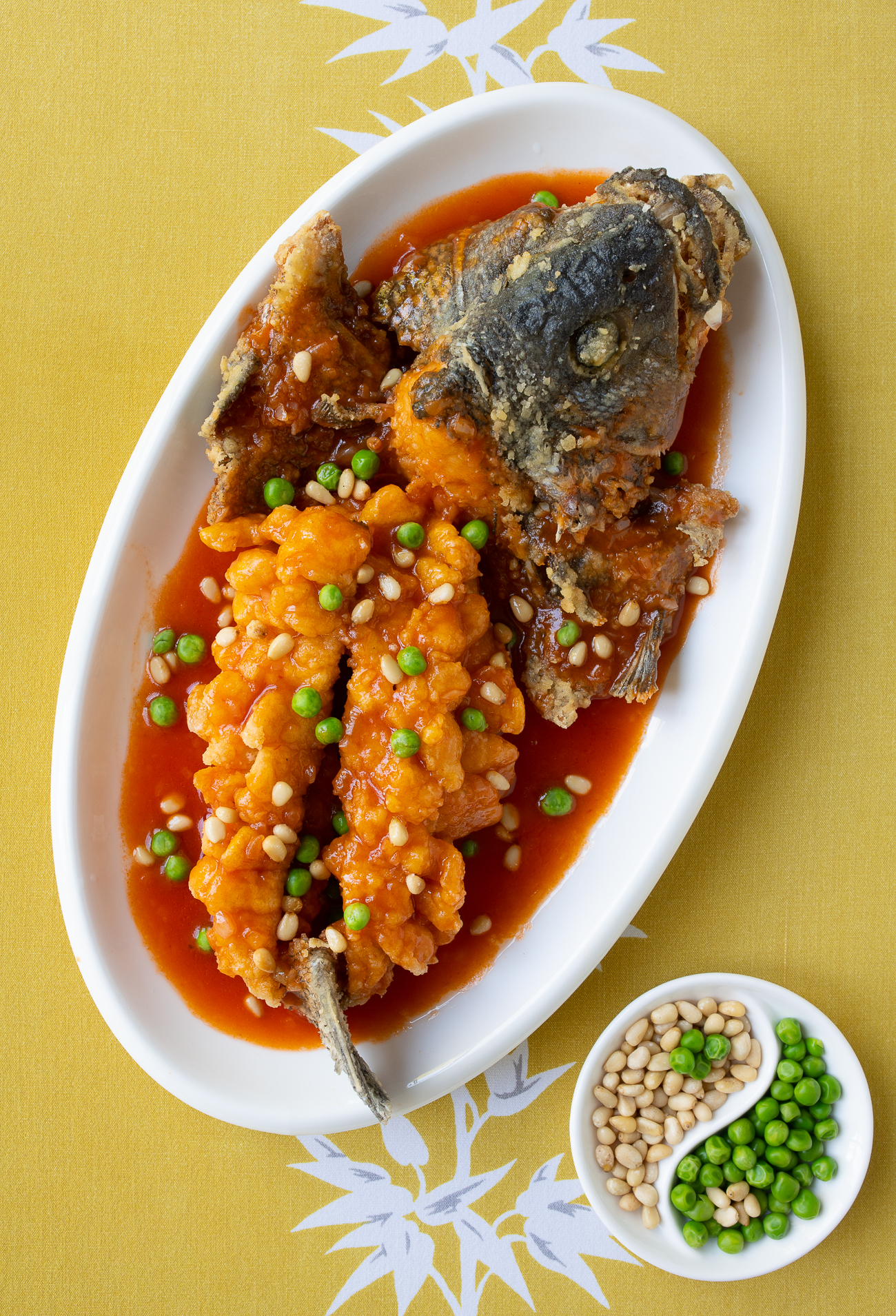
Spoon the sauce over the fish, sprinkle the peas and pine nuts over the top, and serve!
More about this recipe
Nutrition
1 of 16 servings · about 148 g Whole recipe · about 2367 g · servings estimated · High confidence
| % DV* | ||
|---|---|---|
| Total Fat | 82.5 g | 106% |
| Saturated Fat | 14.1 g | 70% |
| Trans Fat | 0 g | |
| Cholesterol | 29 mg | 10% |
| Sodium | 188 mg | 8% |
| Total Carbohydrate | 8.9 g | 3% |
| Dietary Fiber | 0.26 g | 1% |
| Total Sugars | 3.2 g | |
| Protein | 8.3 g | 17% |
| Vitamin D | 2.4 mcg | 12% |
| Calcium | 9 mg | 1% |
| Iron | 0.33 mg | 2% |
| Potassium | 153 mg | 3% |
* % Daily Value is based on a 2,000-calorie diet.
- Carbs 4%
- Fat 92%
- Protein 4%
Vitamins & minerals
| Vitamin A | 26.3 mcg | 3% |
|---|---|---|
| Vitamin C | 2.4 mg | 3% |
| Vitamin D | 2.4 mcg | 12% |
| Vitamin E | 13.3 mg | 88% |
| Vitamin K | 1.2 mcg | 1% |
| Thiamin (B1) | 0.057 mg | 5% |
| Riboflavin (B2) | 0.067 mg | 5% |
| Niacin (B3) | 0.83 mg | 5% |
| Pantothenic acid (B5) | 0.36 mg | 7% |
| Vitamin B6 | 0.19 mg | 11% |
| Folate | 5.9 mcg DFE | 1% |
| Vitamin B12 | 0.15 mcg | 6% |
| Choline | 37 mg | 7% |
| Calcium | 9 mg | 1% |
| Iron | 0.33 mg | 2% |
| Potassium | 153 mg | 3% |
| Magnesium | 21 mg | 5% |
| Phosphorus | 94 mg | 8% |
| Zinc | 0.26 mg | 2% |
| Copper | 0.034 mg | 4% |
| Manganese | 0.045 mg | 2% |
| Selenium | 16.5 mcg | 30% |
Fats & carbs in detail
| Monounsaturated fat | 37.9 g | |
|---|---|---|
| Polyunsaturated fat | 26.4 g | |
| Omega-3 | 0.29 g | 18% |
| Omega-6 | 26.1 g | 153% |
| Starch | 0.043 g | |
| Net carbs | 8.6 g | |
| Omega-6 : Omega-3 ratio | 90.0 : 1 |
Amino acids (protein building blocks)
| Histidine | 0.24 g | |
|---|---|---|
| Isoleucine | 0.38 g | |
| Leucine | 0.67 g | |
| Lysine | 0.74 g | |
| Methionine | 0.24 g | |
| Cystine | 0.09 g | |
| Phenylalanine | 0.32 g | |
| Tyrosine | 0.28 g | |
| Threonine | 0.36 g | |
| Tryptophan | 0.092 g | |
| Valine | 0.42 g |
How we calculated this
| Ingredient | Counted as | g | kcal |
|---|---|---|---|
| 3 tablespoons sugar | Sugars, granulated | 38 | 145 |
| 1/2 cup hot water | Water | 0 | |
| 1 1/2 teaspoons cornstarch | Cornstarch | 4 | 15 |
| 6 tablespoons white vinegar | Vinegar, distilled | 89 | 16 |
| 3 tablespoons pineapple juice | Orange juice, raw (Includes foods for USDA's Food Distribution Program) | 46 | 21 |
| 3/4 teaspoon salt | Salt, table | 5 | 0 |
| 1/8 teaspoon white pepper | Spices, pepper, black | 0 | 1 |
| 1 tablespoon ketchup | Catsup | 15 | 15 |
| 2 1/2 tablespoons tomato paste | Tomato products, canned, paste, without salt added (Includes foods for USDA's Food Distribution Program) | 41 | 34 |
| 1 1/2 tablespoons water | Water | 0 | |
| 1 whole freshwater bass, sea bass, or branzino (about 1 1/2 to 2 pounds/680-900g; scaled, cleaned, and gutted) | Fish, sea bass, mixed species, raw | 680 | 660 |
| 1/4 teaspoon salt | Salt, table | 2 | 0 |
| 1/8 teaspoon white pepper | Spices, pepper, black | 0 | 1 |
| 2 teaspoons clear rice wine | Alcoholic beverage, wine, table, red | 10 | 8 |
| 1/4 teaspoon sesame oil | Oil, sesame, salad or cooking | 1 | 10 |
| 1 egg yolk | Egg, yolk, raw, fresh | 17 | 55 |
| 2/3 cup cornstarch | Cornstarch | 85 | 325 |
| 6 cups peanut oil or canola oil (for frying) | Oil, peanut, salad or cooking | 1296 | 11457 |
| 1 tablespoon pine nuts | Nuts, mixed nuts, dry roasted, with peanuts, without salt added | 8 | 50 |
| 1 tablespoon frozen peas | Peas, green, raw | 9 | 7 |
| 2 tablespoons onion (finely chopped) | Onions, raw | 20 | 8 |
Matched to the USDA FoodData Central database (SR Legacy). Amounts are converted with USDA portion weights where they exist, otherwise typical sizes. Open in the analyzer to adjust a match →
Estimated from the ingredient list — brands, exact sizes and cooking losses vary. Not medical advice.
Allergens
-
Alcohol
In: 2 teaspoons clear rice wine
Not a true allergy, but listed for people who must avoid it.
-
Fish › Bass, snapper & grouper
In: 1 whole freshwater bass, sea bass, or branzino (about 1 1/2 to 2 pounds/680-900g; scaled, cleaned, and gutted)
Finned fish. Fish sauce, Worcestershire and Caesar dressing usually contain anchovy.
-
Black & white pepper
In: 1/8 teaspoon white pepper; 1/8 teaspoon white pepper
-
Corn
In: 1 1/2 teaspoons cornstarch; 2/3 cup cornstarch
Corn and corn products: cornstarch, corn syrup, cornmeal, polenta, masa, corn oil.
-
Egg
In: 1 egg yolk
Whole eggs, yolks, whites and egg-based sauces like mayonnaise, aioli and hollandaise.
-
Onion & garlic family › Onion & shallot
In: 2 tablespoons onion (finely chopped)
Onions, shallots, garlic, leeks, scallions and chives, including powders.
-
Legumes › Pea & pea protein
In: 1 tablespoon frozen peas
Beans, peas, lentils, chickpeas and their relatives, including lupin, fenugreek and guar gum. Peanut and soy are legumes too: checking the whole family avoids them as well.
-
Peanut
In: 6 cups peanut oil or canola oil (for frying)
Peanuts are legumes, not tree nuts. Satay sauce and many "mixed nuts" contain them.
-
Tree nuts › Pine nut
In: 1 tablespoon pine nuts
Almonds, cashews, walnuts, pecans, pistachios, hazelnuts and other nuts that grow on trees. Peanuts are a legume and listed separately.
-
Pineapple
In: 3 tablespoons pineapple juice
-
Rice
In: 2 teaspoons clear rice wine
-
Sesame
In: 1/4 teaspoon sesame oil
Sesame seeds and oil, tahini, halva; za'atar and furikake usually contain sesame.
-
Sulfites
In: 2 teaspoons clear rice wine
Sulfites are preservatives found in wine, wine and balsamic vinegar, dried fruit and pickled foods.
-
Nightshades › Tomato
In: 1 tablespoon ketchup; 2 1/2 tablespoons tomato paste
Tomato, potato, peppers (sweet and hot), eggplant, tomatillo and goji. Sweet potatoes are not nightshades.
Found by reading the ingredient names. Brands and "may contain" warnings vary, so always check the label.
Questions about this recipe
- Can I make this fish ahead of time?
- The sauce can be prepared in advance, but the fish must be dredged and fried immediately before serving to maintain its signature crispiness and structural shape.
- How do I store or freeze leftovers?
- Store leftovers in an airtight container in the fridge for up to 2 days; freezing is not recommended as the fried starch coating will become soggy upon thawing.
- What can I use if I can't find branzino or sea bass?
- Any firm-fleshed white fish like cod or halibut works well, though you may need to adjust the crosshatch depth based on the fillet thickness.
- How do I tell when the fish is officially done?
- The fish is done after 5 minutes of frying at 350°F, once the coating is golden brown and the meat is opaque and flakes easily.
- What should I serve with Squirrel Fish to complete the meal?
- Serve it with steamed jasmine rice and sautéed bok choy or gai lan to balance the sweet and sour flavors of the sauce.
My notes
Log in to keep private notes on recipes.
Learn while you cook
Learn library →- Why It Works · 4 min read Browning: Maillard vs. Caramelization Browning is two different reactions — Maillard (proteins plus sugars, from about 280°F) and caramelization (sugar alone…
- Techniques · 7 min read Knife Skills Pinch the blade, curl your fingertips into a claw, and keep the knife sharp — even cuts cook evenly, and a sharp knife …
- Ingredient Deep-Dives · 8 min read Xanthan Gum & Lecithin: The Missing Pieces Xanthan gum thickens a sauce and keeps it from separating, lecithin ties fat to water and keeps baked goods soft, and y…
Words in this recipe
- Rest
- To let food sit after cooking (meat) or mixing (dough, batter) so juices redistribute or gluten relaxes. Learn more
- Score
- To cut shallow slashes in bread dough, meat or fish, controlling how bread expands or helping fat render and marinades penetrate.
- Dredge
- To coat food lightly in flour, starch or crumbs before frying or browning. Shake off the excess.
- Blanch
- To boil briefly, then usually plunge into ice water. Sets color, loosens skins, and par-cooks vegetables before freezing or finishing.
Handy for this recipe Safe Cooking TemperaturesSubstitution Finder