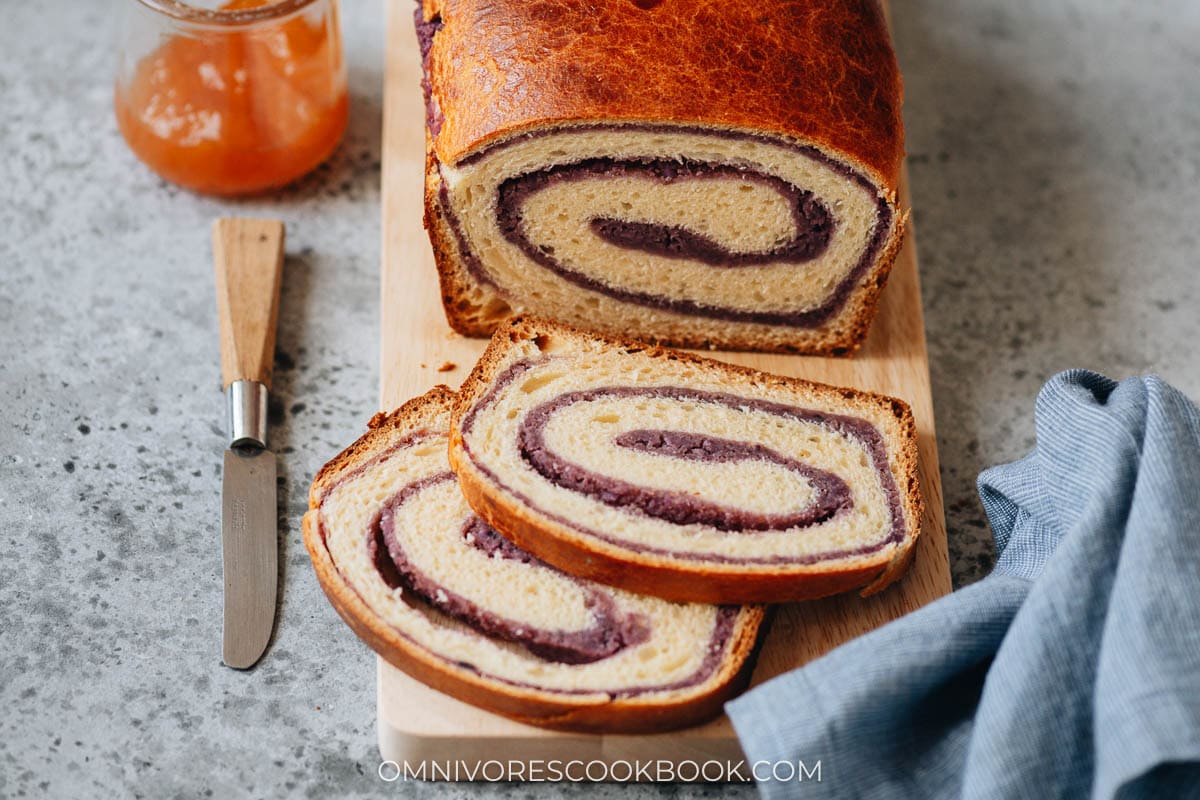
Taro Bread
- Prep
- 60 min
- Cook
- 60 min
- Total
- 2 hr
Ingredients
Dairy-free version. Swapped:
whole milk → unsweetened oat milk; milk → unsweetened oat milk; butter → dairy-free plant butter (pareve); sweetened condensed milk → sweetened condensed coconut milk
Good for vegan, lactose-free and kosher meat meals. Check labels: some plant butters and creamers aren't certified parve or contain nuts or coconut.
- 2 1/2 cups bread flour About bread flour →
- 1/2 cup whole milk , and extra for brushing onto the bread About whole milk →
- 1 teaspoon active dry yeast About yeast →
- 2 1/2 tablespoons sugar
- 1 teaspoon salt About table salt →
- 1/3 cup + 1 tablespoon condensed milk
- 4 tablespoons butter , melted
- 1 large egg About eggs →
- 300 g taro
- 150 g purple sweet potato
- 1/4 cup sugar
- 1/4 cup sweetened condensed milk
- 1/2 teaspoon salt About table salt →
- 1/4 cup milk About whole milk →
- 1 large egg About eggs →
- 1 tablespoon whole milk About whole milk →
Steps
-
1
Prepare the bread dough - 1st rise
-
2
Add the milk into a small bowl and warm to approximately 100-110°F (38°C), about 30 seconds in the microwave. The milk should be warm, just a bit above body temperature. Add a pinch of sugar and the active dry yeast, stir a few times. Let sit for 5 minutes so the yeast will activate.
-
3
While the yeast activates, add the rest of the ingredients into your mixer bowl.
-
4
Once the yeast is activated, you should see bubbles on the surface of the mixture. Pour it into the mixer bowl. Mix with a spatula until the dough just comes together. Cover with plastic wrap and let rest for 20 minutes.
-
5
Install the dough hook on your mixer (I used a KitchenAid). Start at low speed, then gradually increase to setting 8 out of 10. Knead for 10 to 12 minutes, until the dough is very smooth. Stop the mixer in the middle and scrape the dough from the sides of the bowl. Test the dough by pulling a piece of it using both of your hands. It should stretch into a very thin and translucent sheet. The dough should be wet and a bit sticky.
-
6
Grease a big bowl with a thin layer of oil. Place the dough into the bowl. Cover with plastic wrap. Let rise until the dough doubles in size, about 1 hour.
-
7
Prepare the taro filling
-
8
Peel the taro and sweet potato, then cut them into 1” (2.5 cm) cubes. Prepare a steamer by boiling 2” water. Place the taro and sweet potato onto a steaming rack and steam until fork-tender, 10 to 15 minutes.
-
9
Transfer the steamed taro and sweet potato into a food processor if using one, and pulse until smooth. If not using a food processor, add them to a large bowl and mash with a fork until broken down.
-
10
Add the remaining filling ingredients. Blend in the food processor until smooth. Or if by hand, mix with a fork, mashing any remaining lumps until mostly smooth. Set aside to cool before adding it to the bread.
-
11
Assemble the bread and 2nd rise
-
12
Grease a 9” x 5” (23cm x 12.7cm) loaf pan with a thin layer of oil.
-
13
Punch the air out of the dough. Gently round out the dough using both of your hands without kneading. Transfer it onto a lightly floured working surface.
-
14
Roll the dough into a rectangle about the width of your loaf pan until it’s about 1/2” (1.3 cm) thick, with the short end facing you.
-
15
Start by adding about a half of the taro filling onto the dough, and add more if needed. Spread the taro filling using an offset spatula into a thick layer, covering the dough almost all the way to edges, leaving a 1/2” (1.3cm) border on the edge. You will probably end up using 2/3 to 3/4 of the filling, with some left over. (*Footnote 1)
-
16
Start rolling up the dough from the short end that is closest to you, into a tight log. Pinch both ends lightly to seal in the filling. Gently push both ends of the dough with your hands to adjust the size of the loaf, so it will fit evenly in the loaf pan. Transfer the rolled log into the lightly greased loaf pan, seam side down.
-
17
Cover loosely with plastic wrap, and let proof in a warm place until puffy and reaching the top of the pan, 40 minutes to an hour.
-
18
Bake the bread
-
19
Mix the egg wash ingredients together in a small bowl. Preheat the oven to 325° F (163° C).
-
20
Once the loaf is fully proofed, gently brush the egg wash onto the top.
-
21
Bake at 325°F (163°C) for about 40 to 45 mins, or until the thermometer reads 180°F (82°C) when inserted into the thickest part.
-
22
Let the bread rest in the pan for 5 minutes, then transfer it onto a cooling rack. Let cool completely before slicing.
-
23
Store & serve
-
24
Once the bread has cooled completely, you can store it in an airtight container on your kitchen counter for up to 2 days or in the fridge for 4 to 5 days. For longer storage, place the bread in a ziplock bag, squeeze out as much air as possible, and store it in the freezer for up to a month. If you have stored the bread in the fridge or freezer, it's best to toast the bread before serving.
-
25
Serve the sliced bread by itself or with butter and jam, or make it into French toast. Enjoy!
More about this recipe
Nutrition
1 of 7 servings · about 188 g Whole recipe · about 1318 g · servings estimated · High confidence
| % DV* | ||
|---|---|---|
| Total Fat | 10.8 g | 14% |
| Saturated Fat | 5.9 g | 29% |
| Trans Fat | 0.27 g | |
| Cholesterol | 77 mg | 26% |
| Sodium | 622 mg | 27% |
| Total Carbohydrate | 70.4 g | 26% |
| Dietary Fiber | 3.7 g | 13% |
| Total Sugars | 20.2 g | |
| Protein | 10.7 g | 21% |
| Vitamin D | 0.68 mcg | 3% |
| Calcium | 106 mg | 8% |
| Iron | 2.8 mg | 16% |
| Potassium | 480 mg | 10% |
* % Daily Value is based on a 2,000-calorie diet.
- Carbs 67%
- Fat 23%
- Protein 10%
Vitamins & minerals
| Vitamin A | 253 mcg | 28% |
|---|---|---|
| Vitamin C | 2.7 mg | 3% |
| Vitamin D | 0.68 mcg | 3% |
| Vitamin E | 1.6 mg | 11% |
| Vitamin K | 1.7 mcg | 1% |
| Thiamin (B1) | 0.55 mg | 46% |
| Riboflavin (B2) | 0.46 mg | 35% |
| Niacin (B3) | 4.4 mg | 27% |
| Pantothenic acid (B5) | 1 mg | 20% |
| Vitamin B6 | 0.23 mg | 14% |
| Folate | 176 mcg DFE | 44% |
| Vitamin B12 | 0.32 mcg | 13% |
| Choline | 73 mg | 13% |
| Calcium | 106 mg | 8% |
| Iron | 2.8 mg | 16% |
| Potassium | 480 mg | 10% |
| Magnesium | 40 mg | 9% |
| Phosphorus | 179 mg | 14% |
| Zinc | 1 mg | 9% |
| Copper | 0.22 mg | 24% |
| Manganese | 0.62 mg | 27% |
| Selenium | 27.1 mcg | 49% |
Fats & carbs in detail
| Monounsaturated fat | 2.8 g | |
|---|---|---|
| Polyunsaturated fat | 1 g | |
| Omega-3 | 0.11 g | 7% |
| Omega-6 | 0.82 g | 5% |
| Starch | 2.7 g | |
| Net carbs | 66.7 g | |
| Omega-6 : Omega-3 ratio | 7.5 : 1 |
Amino acids (protein building blocks)
| Histidine | 0.25 g | |
|---|---|---|
| Isoleucine | 0.46 g | |
| Leucine | 0.82 g | |
| Lysine | 0.45 g | |
| Methionine | 0.22 g | |
| Cystine | 0.21 g | |
| Phenylalanine | 0.54 g | |
| Tyrosine | 0.36 g | |
| Threonine | 0.37 g | |
| Tryptophan | 0.14 g | |
| Valine | 0.56 g |
How we calculated this
| Ingredient | Counted as | g | kcal |
|---|---|---|---|
| 2 1/2 cups bread flour | Wheat flour, white, bread, enriched | 342 | 1236 |
| 1/2 cup whole milk , and extra for brushing onto the bread | Milk, whole, 3.25% milkfat, with added vitamin D | 122 | 74 |
| 1 teaspoon active dry yeast | Leavening agents, yeast, baker's, active dry | 4 | 13 |
| 2 1/2 tablespoons sugar | Sugars, granulated | 31 | 121 |
| 1 teaspoon salt | Salt, table | 6 | 0 |
| 1/3 cup + 1 tablespoon condensed milk | Not counted — incomplete line | ||
| 4 tablespoons butter , melted | Butter, salted | 57 | 407 |
| 1 large egg | Egg, whole, raw, fresh | 50 | 72 |
| 300 g taro | Taro, raw | 300 | 336 |
| 150 g purple sweet potato | Sweet potato, raw, unprepared (Includes foods for USDA's Food Distribution Program) | 150 | 129 |
| 1/4 cup sugar | Sugars, granulated | 50 | 194 |
| 1/4 cup sweetened condensed milk | Milk, canned, condensed, sweetened | 76 | 246 |
| 1/2 teaspoon salt | Salt, table | 3 | 0 |
| 1/4 cup milk | Milk, whole, 3.25% milkfat, with added vitamin D | 61 | 37 |
| 1 large egg | Egg, whole, raw, fresh | 50 | 72 |
| 1 tablespoon whole milk | Milk, whole, 3.25% milkfat, with added vitamin D | 15 | 9 |
Matched to the USDA FoodData Central database (SR Legacy). Amounts are converted with USDA portion weights where they exist, otherwise typical sizes. Open in the analyzer to adjust a match →
Estimated from the ingredient list — brands, exact sizes and cooking losses vary. Not medical advice.
Allergens
-
Egg
In: 1 large egg; 1 large egg
Whole eggs, yolks, whites and egg-based sauces like mayonnaise, aioli and hollandaise.
-
Milk / dairy
In: 1/2 cup whole milk , and extra for brushing onto the bread; 1/3 cup + 1 tablespoon condensed milk; 4 tablespoons butter , melted; 1/4 cup sweetened condensed milk; 1/4 cup milk; 1 tablespoon whole milk
Cow's milk and anything made from it: butter, cream, cheese, yogurt, whey, casein, ghee.
-
Gluten › Wheat
In: 2 1/2 cups bread flour; 1/2 cup whole milk , and extra for brushing onto the bread
Wheat, barley, rye and oats (oats are often cross-contaminated). Celiac disease and wheat allergy are different — pick just Wheat if only wheat is the problem.
-
Yeast
In: 1 teaspoon active dry yeast
Found by reading the ingredient names. Brands and "may contain" warnings vary, so always check the label.
My notes
Log in to keep private notes on recipes.
Learn while you cook
Learn library →- Why It Works · 5 min read Gluten & Kneading Two wheat proteins plus water make gluten, a stretchy net that traps gas; kneading and time build it for chewy bread, w…
- Why It Works · 5 min read Why We Rest Meat & Dough Meat keeps cooking after it leaves the heat, so pull it early and let it rest; dough rests so gluten relaxes and flour …
- Grilling & Barbecue · 5 min read Doneness & Thermometers Time, colour and touch lie; a thermometer doesn't. Buy a fast digital instant-read, insert it into the thickest part, p…
Words in this recipe
- Rest
- To let food sit after cooking (meat) or mixing (dough, batter) so juices redistribute or gluten relaxes. Learn more
- Knead
- To work dough by pressing, folding and turning, developing gluten for structure and chew. Learn more
- Fork-tender
- Cooked until a fork slides in and out with almost no resistance.
- Proof
- In baking, the final rise of shaped dough; also to test yeast in warm water. In spirits, twice the alcohol by volume (80 proof is 40% ABV). Learn more
Handy for this recipe Measurements & ConversionsSubstitution Finder