Chinese Pork Belly Bun (Rou Jia Mo, 肉夹馍)
Printed from nanasfogon.com/recipe/authentic-pork-belly-bun · Original: https://omnivorescookbook.com/authentic-pork-belly-bun/
- Prep
- 70 min
- Cook
- 120 min
- Total
- 3 hr 10 min
Ingredients
- 2 lb pork belly , cut into 2-inch (4.5-cm) chunks (*Footnote 1)
- 3 cups water
- 2 dried Chinese chili peppers , seeds removed
- 3 cloves
- 2 whole star anise pods About star anise →
- 1 cinnamon stick About cinnamon →
- 1 thumb ginger , sliced About fresh ginger →
- 4 green onions , halved crosswise About scallion →
- 1/4 cup Shaoxing wine About shaoxing wine →
- 1/4 cup light soy sauce About soy sauce →
- 1.5 tablespoons dark soy sauce Can't find it? Regular soy sauce plus 1/2 tsp molasses for each tablespoon
- 1 tablespoon sugar
- 1 teaspoon fennel seeds
- 1 teaspoon Sichuan peppercorns Can't find it? ½ tsp black pepper + ½ tsp coriander seed + a little lemon zest per tsp
- 1/2 teaspoon salt About table salt →
- 1/8 teaspoon grated nutmeg About nutmeg →
- 1 1/2 teaspoons instant yeast About yeast →
- 1 cup + 2 tablespoons warm water (110ºC)
- 3 1/2 cups all-purpose flour About all-purpose flour →
- 1/2 teaspoon baking powder About baking powder →
- 1 tablespoon vegetable oil About neutral oil →
- 1 cup cilantro , coarsely chopped About cilantro →
- 2 to 3 chili peppers , small diced (I used Chinese long pepper) Can't find it? 1 tsp black pepper + a pinch of nutmeg or cinnamon per tsp
- Homemade chili oil (Optional) Medium (1,000–15,000 SHU). Swap: Red pepper flakes fried for a minute in neutral oil with sliced garlic
Out of something?
- Thumb ginger
- for 1 tbsp grated, use 1/4 tsp ground ginger. Warm and dusty, not bright and juicy. Fine in baking and braises; weak in stir-fries.
- Scallion
- for 1/4 cup sliced, use Chives (for the greens), or minced shallot or red onion (for the whites). Chives are milder and grassier.
- Shaoxing wine
- for 1 tbsp, use 1 tbsp dry sherry; alcohol-free: 1 tbsp chicken stock + 1/2 tsp rice vinegar + pinch of sugar. Sherry is close. The alcohol-free version loses the aroma.
- Light soy sauce
- Gluten-free: for 1 tbsp, use 1 tbsp tamari (check the label for wheat-free) or coconut aminos. Tamari is a bit richer; coconut aminos are sweeter and much less salty.
- Dark soy sauce
- Gluten-free: for 1 tbsp, use 1 tbsp tamari (check the label for wheat-free) or coconut aminos. Tamari is a bit richer; coconut aminos are sweeter and much less salty.
- Instant yeast
- for 1 packet (2 1/4 tsp), use 2 1/4 tsp active dry yeast, bloomed 5–10 minutes in some of the recipe's warm (105–110°F) liquid. Rises a bit slower. Take the bloom liquid from the recipe's total.
- Flour
- For thickening: for 1 tbsp, use 1/2 tbsp potato starch or cornstarch, mixed into cold liquid first. Clearer, glossier sauce. Add at the end and don't boil long: starches thin out if overcooked.
- For dredging: for 1 cup, use 1 cup potato starch, rice flour or matzo cake meal. Starch gives a thinner, crisper coating; matzo cake meal browns like flour. Rice is kitniyot for Ashkenazim.
- Baking powder
- for 1 tsp, use 1/4 tsp baking soda + 1/2 tsp cream of tartar. This is single-acting: it starts working when it gets wet, so get the batter into the oven right away.
Prep first
Get these done before you turn on the heat. Cooks call it mise en place.
Steps
-
1
Cook the pork
-
2
Blanch the pork: Place pork belly in a large pot and add cold tap water to cover the pork by 1” (2 cm). Bring to a boil. Turn to medium heat and boil for 10 minutes, until there’s no more brown foam forming. Discard the water and transfer the pork to a clean pot that’s just big enough to hold the pork.
-
3
Braise the pork: Pour 3 cups of water and add all the braising ingredients except the salt. Bring to a boil over medium-high heat, then turn to medium-low heat. Simmer, covered, for 2 hours, until the pork is very tender. Add 1/2 teaspoon salt halfway through and taste the broth. It should taste slightly salty. If not salty enough, add more.
-
4
Prepare the buns
-
5
Activate yeast: Start the dough when the pork is cooking. Pour the warm water in a small bowl and add the yeast. Let sit for 10 minutes to activate the yeast.
-
6
Mix the dough: Mix the flour and baking powder together in a large bowl. Slowly pour in the water with yeast a few times, stirring with a pair of chopsticks in a clockwise direction, until water is fully incorporated and semi-firm dough flakes form. There should be little dry flour left in the bowl. Drizzle a little more water if needed. Add the oil and mix again. Dust both hands with flour and start by using one hand to knead until dough begins to form. The dough should be quite firm and not stick to the bottom of the bowl. Add more flour and keep kneading if the dough sticks to your hands, 1 teaspoon at a time.
-
7
1st rise: Transfer the dough to a medium bowl and cover with plastic wrap. Rest the dough for 10 to 15 minutes. This brief process helps the dough to hydrate and is easier to knead.
-
8
2nd rise: Then knead the dough again until quite smooth, 10 to 15 minutes or so. Rub some oil onto a large bowl, place the dough into it, and cover with plastic wrap. Rest until the dough has doubled in size, about 1 hour.
-
9
Divide the dough: Once rested, knead the dough a few times again until it returns to the original size. Divide the dough into 10 equal parts, about 75g per dough, and shape each one into a ball by hand. Transfer the dough onto a tray and cover with plastic wrap. Let rest for another 10 minutes. So the dough is easier to roll.
-
10
Roll out flatbread: Place one dough ball on the working surface, then press it with your palm into a round shape. Use a rolling pin to flatten the dough into a long oval shape that’s narrow on both ends, 8” long and 3” wide (*Footnote 2). Fold lengthwise, then roll up the roll into a coil. Use a rolling pin to flatten the bread into a 4” thick disk. Place the rolled dough onto a greased tray. Shape the rest of the dough balls the same way. Once all the dough has been shaped, let it rest until the bread has relaxed and slightly expanded, 10 minutes after you finish rolling the last dough piece. (*Footnote 3)
-
11
Cook the bread: Heat a cast iron pan over medium heat until hot. Start with the first flatbread you rolled out. Place the bread into the pan, 1” (2.5 cm) apart. Cook covered, until the bread is cooked through and has turned golden on the surface, about 2 minutes or so per side. If the bread browns too quickly, turn to medium-low heat. If the surface is not quite golden after the full 4 minutes, uncover the pan, then keep cooking the flatbreads for 1 minute per side. Once done, set aside to cool.
-
12
Assemble
-
13
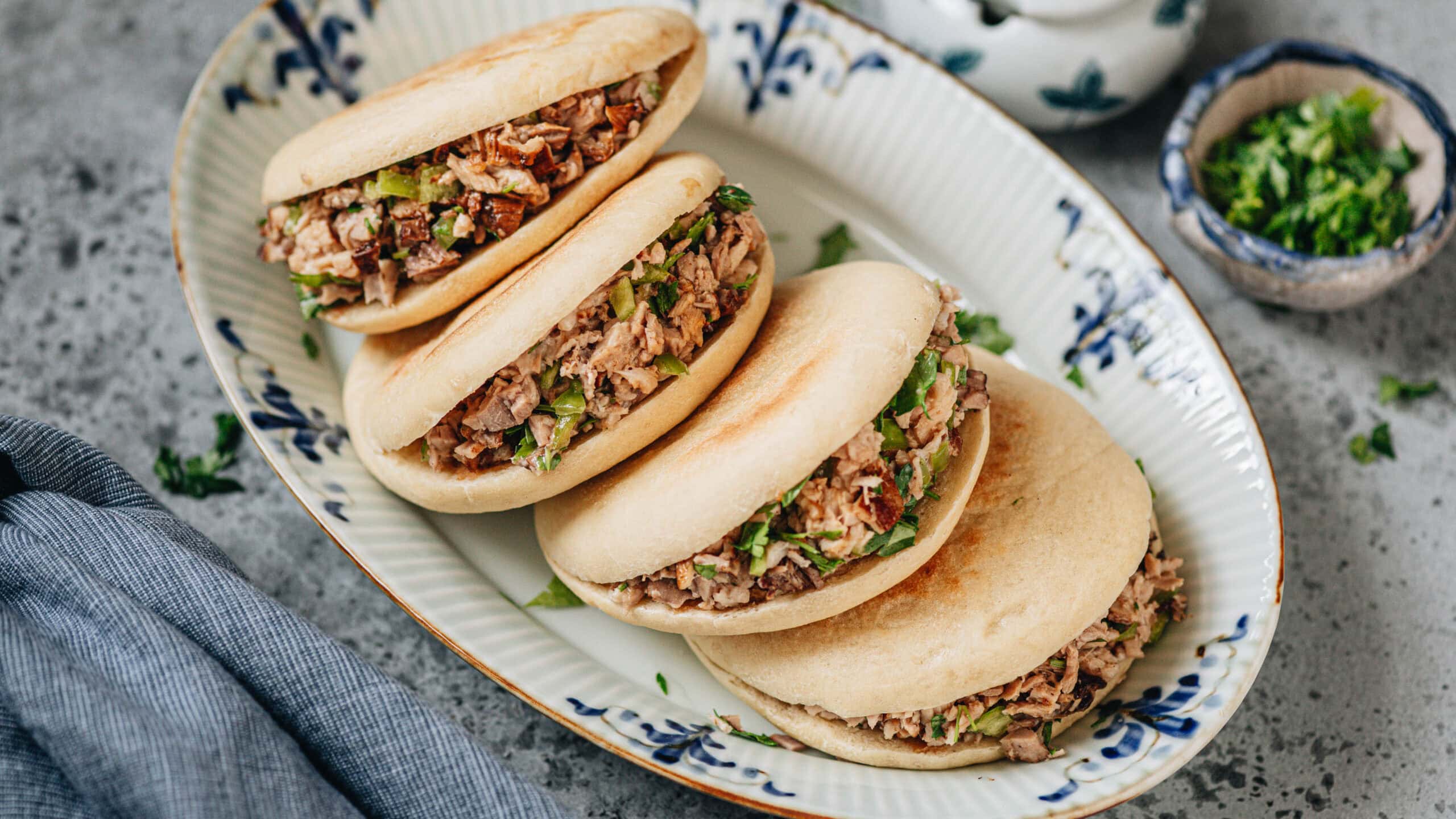
Transfer one piece of pork belly onto a cutting board, cut it coarsely into small chunks. Place a handful of cilantro and a handful of diced peppers on top of the pork. Use a knife to chop and mix everything together. Slice the buns horizontally in half to form a pocket, with the end still attached. Use a spoon to stuff the pork mixture into the bun and drizzle a spoonful broth onto the pork. You can add a few drops of chili oil if needed. Serve immediately.
Flavor map
How Nana pairs flavors →This one is spicy, savory and warmly spiced.
Goes well with
 Serve it with
Má Là Pig Ears
90% flavor match
Rock sugar with star anise is a natural match; both lean on chili oil and sichuan peppercorn.
 Serve it with
Shanghai Smoked Fish, Xun Yu (上海熏鱼)
88% flavor match
Both lean on star anise and shaoxing wine; rock sugar with star anise is a natural match.
 Start with
Chinese Beef Dumplings
89% flavor match
Same Chinese roots; sesame oil and soy sauce are a classic pair.
 Finish with
Arroz con Dulce (Puerto Rican Rice Pudding)
84% flavor match
The cream coconut cools things down after the heat; coconut milk suits a Chinese meal.
 Pour
Masala Chai (Spiced Indian Tea)
86% flavor match
A classic Chinese pour: tea; cold citrus against the heat.
Log in to tell Nana which pairings are good. Your votes improve the map.
More about this recipe
Nutrition
1 of 10 servings · about 164 g Whole recipe · about 1644 g · High confidence
| % DV* | ||
|---|---|---|
| Total Fat | 23.2 g | 30% |
| Saturated Fat | 7.1 g | 36% |
| Trans Fat | 0.21 g | |
| Cholesterol | 73 mg | 24% |
| Sodium | 701 mg | 30% |
| Total Carbohydrate | 36.6 g | 13% |
| Dietary Fiber | 1.9 g | 7% |
| Total Sugars | 1.7 g | |
| Protein | 19.8 g | 40% |
| Vitamin D | 2.1 mcg | 10% |
| Calcium | 46 mg | 4% |
| Iron | 3.3 mg | 18% |
| Potassium | 360 mg | 8% |
* % Daily Value is based on a 2,000-calorie diet.
- Carbs 34%
- Fat 48%
- Protein 18%
Vitamins & minerals
| Vitamin A | 9.8 mcg | 1% |
|---|---|---|
| Vitamin C | 2.9 mg | 3% |
| Vitamin D | 2.1 mcg | 10% |
| Vitamin E | 0.57 mg | 4% |
| Vitamin K | 20.9 mcg | 17% |
| Thiamin (B1) | 0.71 mg | 59% |
| Riboflavin (B2) | 0.5 mg | 38% |
| Niacin (B3) | 7.4 mg | 46% |
| Pantothenic acid (B5) | 0.89 mg | 18% |
| Vitamin B6 | 0.59 mg | 35% |
| Folate | 148 mcg DFE | 37% |
| Vitamin B12 | 0.35 mcg | 14% |
| Choline | 62 mg | 11% |
| Calcium | 46 mg | 4% |
| Iron | 3.3 mg | 18% |
| Potassium | 360 mg | 8% |
| Magnesium | 35 mg | 8% |
| Phosphorus | 205 mg | 16% |
| Zinc | 2.8 mg | 25% |
| Copper | 0.16 mg | 18% |
| Manganese | 0.49 mg | 21% |
| Selenium | 35 mcg | 64% |
Fats & carbs in detail
| Monounsaturated fat | 8.2 g | |
|---|---|---|
| Polyunsaturated fat | 4.6 g | |
| Omega-3 | 0.18 g | 11% |
| Omega-6 | 4.3 g | 25% |
| Starch | 0 g | |
| Net carbs | 34.8 g | |
| Omega-6 : Omega-3 ratio | 23.7 : 1 |
Amino acids (protein building blocks)
| Histidine | 0.73 g | |
|---|---|---|
| Isoleucine | 0.89 g | |
| Leucine | 1.6 g | |
| Lysine | 1.5 g | |
| Methionine | 0.48 g | |
| Cystine | 0.27 g | |
| Phenylalanine | 0.86 g | |
| Tyrosine | 0.7 g | |
| Threonine | 0.79 g | |
| Tryptophan | 0.22 g | |
| Valine | 0.97 g |
How we calculated this
| Ingredient | Counted as | g | kcal |
|---|---|---|---|
| 2 lb pork belly , cut into 2-inch (4.5-cm) chunks (*Footnote 1) | Pork, fresh, spareribs, separable lean and fat, raw | 907 | 2513 |
| 3 cups water | Water | 0 | |
| 2 dried Chinese chili peppers , seeds removed | Peppers, serrano, raw | 12 | 4 |
| 3 cloves | Spices, cloves, ground | 0 | 1 |
| 2 whole star anise pods | Spices, anise seed | 1 | 3 |
| 1 cinnamon stick | Spices, cinnamon, ground | 1 | 1 |
| 1 thumb ginger , sliced | Ginger root, raw | 6 | 5 |
| 4 green onions , halved crosswise | Onions, spring or scallions (includes tops and bulb), raw | 60 | 19 |
| 1/4 cup Shaoxing wine | Alcoholic beverage, wine, table, red | 59 | 50 |
| 1/4 cup light soy sauce | Soy sauce made from soy and wheat (shoyu) | 64 | 34 |
| 1.5 tablespoons dark soy sauce | Soy sauce made from soy and wheat (shoyu) | 24 | 13 |
| 1 tablespoon sugar | Sugars, granulated | 12 | 48 |
| 1 teaspoon fennel seeds | Fennel, bulb, raw | 2 | 1 |
| 1 teaspoon Sichuan peppercorns | Spices, pepper, black | 2 | 6 |
| 1/2 teaspoon salt | Salt, table | 3 | 0 |
| 1/8 teaspoon grated nutmeg | Spices, nutmeg, ground | 0 | 1 |
| 1 1/2 teaspoons instant yeast | Leavening agents, yeast, baker's, active dry | 6 | 20 |
| 1 cup + 2 tablespoons warm water (110ºC) | Not counted — incomplete line | ||
| 3 1/2 cups all-purpose flour | Wheat flour, white, all-purpose, enriched, bleached | 438 | 1592 |
| 1/2 teaspoon baking powder | Leavening agents, baking powder, double-acting, sodium aluminum sulfate | 2 | 1 |
| 1 tablespoon vegetable oil | Oil, soybean, salad or cooking | 14 | 120 |
| 1 cup cilantro , coarsely chopped | Coriander (cilantro) leaves, raw | 16 | 4 |
| 2 to 3 chili peppers , small diced (I used Chinese long pepper) | Peppers, serrano, raw | 15 | 5 |
| Homemade chili oil (Optional) | Not counted — no amount (to taste / garnish) |
Matched to the USDA FoodData Central database (SR Legacy). Amounts are converted with USDA portion weights where they exist, otherwise typical sizes. Open in the analyzer to adjust a match →
Estimated from the ingredient list — brands, exact sizes and cooking losses vary. Not medical advice.
Allergens
-
Alcohol
In: 1/4 cup Shaoxing wine
Not a true allergy, but listed for people who must avoid it.
-
Black & white pepper
In: 1 teaspoon Sichuan peppercorns
-
Nightshades › Hot chili peppers
In: 2 dried Chinese chili peppers , seeds removed; 2 to 3 chili peppers , small diced (I used Chinese long pepper); Homemade chili oil (Optional)
Tomato, potato, peppers (sweet and hot), eggplant, tomatillo and goji. Sweet potatoes are not nightshades.
-
Cinnamon
In: 1 cinnamon stick
-
Coriander & cilantro
In: 1 cup cilantro , coarsely chopped
-
Fennel, anise & licorice
In: 2 whole star anise pods; 1 teaspoon fennel seeds
-
Ginger
In: 1 thumb ginger , sliced
-
Onion & garlic family › Leek, scallion & chives
In: 4 green onions , halved crosswise
Onions, shallots, garlic, leeks, scallions and chives, including powders.
-
Nutmeg & mace
In: 1/8 teaspoon grated nutmeg
-
Red meat (alpha-gal) › Pork
In: 2 lb pork belly , cut into 2-inch (4.5-cm) chunks (*Footnote 1)
Mammalian meat and by-products. Alpha-gal syndrome, often from a tick bite, causes delayed reactions to beef, pork, lamb and gelatin; some people also react to dairy.
-
Soy › Soy sauce & tamari (brewed)
In: 1/4 cup light soy sauce; 1.5 tablespoons dark soy sauce
Fermented soy sauces. Much of the protein is broken down in brewing.
-
Sulfites
In: 1/4 cup Shaoxing wine
Sulfites are preservatives found in wine, wine and balsamic vinegar, dried fruit and pickled foods.
-
Gluten › Wheat
In: 1/4 cup light soy sauce; 1.5 tablespoons dark soy sauce; 3 1/2 cups all-purpose flour
Wheat, barley, rye and oats (oats are often cross-contaminated). Celiac disease and wheat allergy are different — pick just Wheat if only wheat is the problem.
-
Yeast
In: 1 1/2 teaspoons instant yeast
Found by reading the ingredient names. Brands and "may contain" warnings vary, so always check the label.
Questions about this recipe
- Can I make the pork and buns ahead of time?
- Yes, the braised pork stores well in its gravy; just reheat it before assembling. The buns are best made fresh, but you can store them in an airtight container and reheat them in a pan for a few seconds.
- How do I store or freeze the leftovers?
- Store the pork and gravy in the fridge for up to 4 days or freeze for up to a month. Freeze the buns individually wrapped and toast them before serving.
- What can I use if I can't find Shaoxing wine?
- You can substitute Shaoxing wine with a dry sherry or a mixture of water and a splash of rice vinegar.
- How do I tell when the pork and buns are actually done?
- The pork is done when it is very tender and can be easily broken apart. The buns are finished when they are cooked through and have a golden brown surface.
- What should I serve with these pork belly buns?
- These pair perfectly with a side of pickled cucumbers, a cold sesame noodle salad, or steamed bok choy.
My notes
Log in to keep private notes on recipes.
Learn while you cook
Learn library →- Techniques · 6 min read Braising Brown tough, well-marbled meat, half-submerge it in flavorful liquid, cover, and cook low (300–325°F) until a fork slid…
- Why It Works · 5 min read Gluten & Kneading Two wheat proteins plus water make gluten, a stretchy net that traps gas; kneading and time build it for chewy bread, w…
- Why It Works · 4 min read Baking Soda vs. Baking Powder Baking soda is a base that needs an acid in the recipe to work; baking powder is soda with its acid already mixed in — …
Words in this recipe
- Blanch
- To boil briefly, then usually plunge into ice water. Sets color, loosens skins, and par-cooks vegetables before freezing or finishing.
- Braise
- To brown food, then cook it slowly, partly covered by liquid, in a covered pot. Turns tough, collagen-rich cuts tender. Learn more
- Simmer
- Liquid just below a boil, about 185 to 205°F, with small bubbles rising gently.
- Knead
- To work dough by pressing, folding and turning, developing gluten for structure and chew. Learn more
Handy for this recipe Safe Cooking TemperaturesMeasurements & ConversionsSubstitution Finder