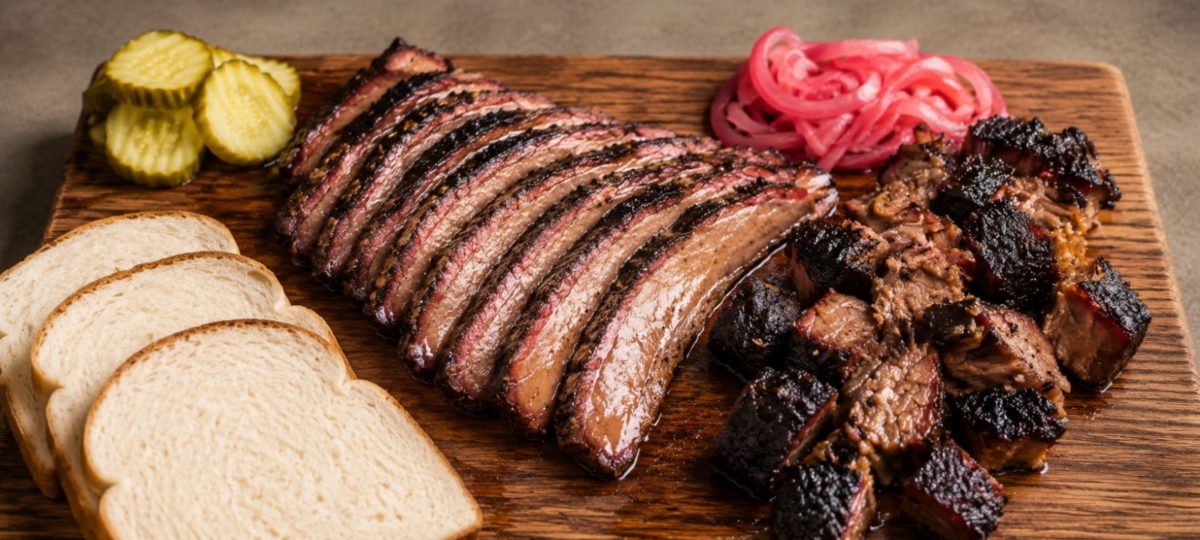
The question: why do you flash-grill a steak but smoke a brisket for ten hours?
The plain answer: because meat is three things in different amounts: muscle, fat and connective tissue. Muscle goes dry if you push it too far. Connective tissue is tough until it has had hours of moist heat. Fat melts and carries flavor. The cut tells you which one is winning, and the method follows from that.
What’s inside a piece of meat
- Muscle fibers. Long, thin bundles of protein packed with water. Cut across them and you see the “grain” end-on.
- Connective tissue. The wrapping around fibers and bundles. Its main ingredient is collagen, a tough, rubbery protein. Hard-working muscles (shoulder, chest, shank, tail) have a lot of it; muscles that barely move (tenderloin) have very little.
- Fat. Some sits as a cap on the outside, some in seams between muscles, and some as fine flecks inside the muscle (marbling).
Why hot and fast makes lean cuts good
As muscle heats, its proteins tighten. Around 140°F (60°C) they firm up and begin squeezing water out; by 160°F (71°C) and beyond the squeeze is hard, and the meat turns dry and chewy. That is why overcooked chicken breast, pork loin and filet are dry: the fibers wrung out their own moisture.
So for tender, lean cuts, you want a hot fire, a short time, and a thermometer to stop at the right point. Pull a few degrees early, because the meat keeps climbing while it rests.
Why tough cuts need hours
Collagen behaves the opposite way. At steak temperatures it hasn’t changed, so a quickly grilled shoulder or short rib chews like rubber. But hold collagen at roughly 160–205°F (70–96°C) for hours, with moisture around it, and it slowly melts into gelatin: silky, rich, and the reason a good brisket feels juicy even though the muscle fibers are well past “done.”
Two things make this work:
- Time, not temperature alone. The same melting happens faster at higher heat, but the fibers dry out faster too. Low heat gives collagen time to dissolve before the muscle is wrecked.
- Moisture. A humid cooker, a wrap, or a pot of liquid (Braising) keeps the meat from drying while the collagen breaks down.
Why it works
Muscle dries out as it heats; collagen softens as it stays hot. Tender cuts are all muscle, so you stop early. Tough cuts are packed with collagen, so you keep going well past “cooked” until it turns to gelatin. You finish when a probe slides in like it’s going into soft butter, not at a fixed number.
Fat and rendering
Fat does not stay solid at cooking temperatures. As it warms it renders: it softens, melts and bastes the meat’s own fibers from within. Marbled meat is more forgiving because there is fat running through it as the muscle tightens.
- A thick, hard fat cap needs time to render. On a fast fire it stays chewy and flares up. Trim it to about ¼ inch (6 mm) for long cooks, or score it so heat gets in.
- Fat melting out is not the same as juiciness. Plenty of juice is simply water held in the fibers.
- Rendered fat that drips onto coals makes flare-ups. Keep a cooler zone to move food to.
Why pink doesn’t mean raw (and gray doesn’t mean done)
The red-pink color comes from myoglobin, a pigment in muscle. Its color changes with chemistry, not only with temperature:
- Heat turns it from red to pink to gray-brown as it denatures. Usually, that’s a decent clue, but not a reliable one.
- Smoke and some gases can keep meat pink at fully safe temperatures. Young birds and some cuts can stay pink near the bone.
- Meat can also turn brown early or stay red a long time depending on acidity and age.
So never judge doneness by color. Use a thermometer, and check USDA’s minimums: 145°F (63°C) with a 3-minute rest for whole cuts of beef, pork, veal and lamb, 160°F (71°C) for ground meat, and 165°F (74°C) for poultry. Brisket and pulled pork are taken far past those numbers, to tenderness. See Doneness & Thermometers.
Slice against the grain
Muscle fibers run in one direction. If you slice along them, you get long, stringy strands you have to chew through. If you slice across them, each bite is short fibers that fall apart. Look at the meat before you cut: find the lines and cut perpendicular to them. Long, flat cuts such as flank and brisket matter most, and brisket’s grain changes direction between its two muscles, so you may need to turn the piece mid-slice.
Match the cut to the method
| Type of cut | What it needs | Example cuts | Method |
|---|---|---|---|
| Lean and tender (little collagen) | Quick heat, stop early | Tenderloin, strip loin, chicken breast, pork loin | Hot direct grilling or sear, then rest |
| Tender with marbling | Hot heat, a little rendering time | Rib steak, thin-cut chops, chicken thighs | Direct heat, move to cooler zone to finish |
| Thick, tender roasts | Even, gentle cooking | Rib roast, thick steaks, whole chicken | Indirect heat, optionally sear after |
| Thin, tough but grainy | Fast heat and careful slicing | Skirt, flank, hanger | Very hot grill, thin slices across the grain |
| Collagen-rich and fatty | Hours of low heat, moisture | Brisket, shoulder or butt, chuck, short ribs, shank | Low-and-slow smoking or Braising |
| Ground meat | Cooked through, but still tender | Burgers, kofta, meatballs | Medium-high direct heat to a safe temperature |
Kosher note
Which cuts you can buy kosher depends heavily on where you live; many butchers sell chuck, brisket and short ribs but fewer loin or tenderloin cuts. Availability and names vary by region, so ask your butcher what’s on hand and for the cut that fits your method, instead of buying by name. Koshered meat is already salted, which affects seasoning; see Grilling Kosher Meat.
What it means at the grill
- Ask first: is this cut lean and tender, or tough and collagen-rich?
- Tender: hot fire, stop early with a thermometer, rest.
- Tough: low temperature, lots of time, moisture, and judge by feel.
- Trim thick, hard fat; leave a thin layer.
- Ignore color. Trust a thermometer for safety and a probe for tenderness.
- Slice across the grain.
For how the fire itself delivers heat, see How Heat Moves on a Grill; for the long cooks, The Stall and Low-and-Slow, Start to Finish.