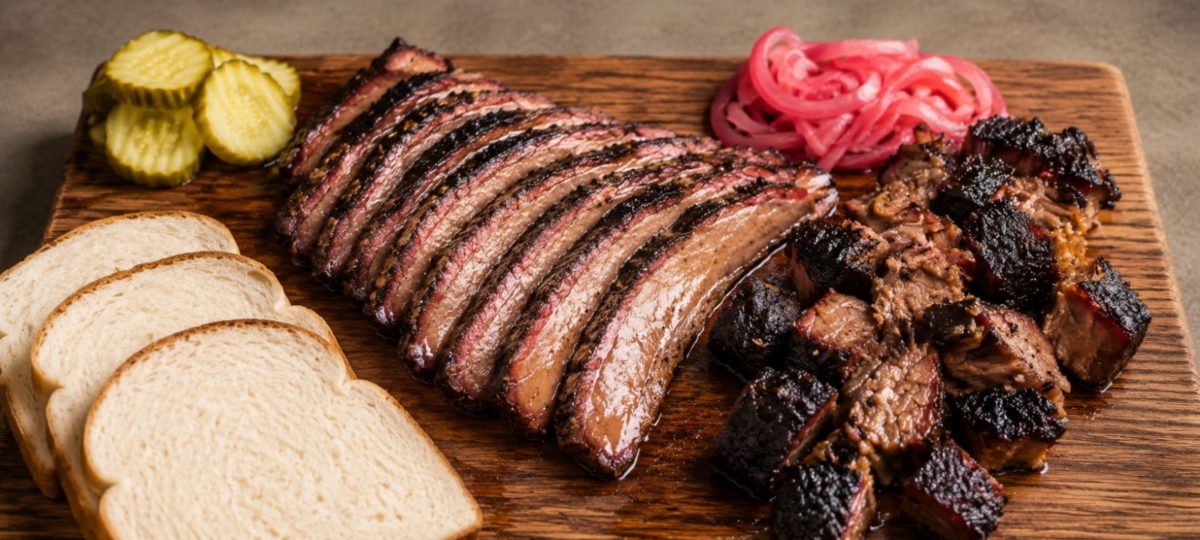
Low-and-slow means cooking tough, collagen-rich cuts in gentle, smoky heat for hours, until the connective tissue melts into something silky. It’s a braise without the pot. Use it for brisket, pork shoulder, ribs and bone-in chicken parts. The cuts do the work; you set the fire, leave it alone, and watch the thermometer.
Gear
- A grill or smoker holding 225–275°F (107–135°C) for hours. A kettle set up as in Charcoal, Gas & the Two-Zone Fire, a kamado, a pellet cooker or an offset all work.
- Two thermometers: one for the cooker’s air at grate level, one probe for the meat. An instant-read for checking.
- Wood chunks (fist size) for smoke. See Smoke & Wood.
- A small cooler and old towels, or a warm oven, for the rest.
- Butcher paper or foil if you plan to wrap.
The method
- Trim. Take off hard, waxy fat and anything dried or silvery. Leave about ¼ in (6 mm) of fat on a brisket’s top; it bastes the meat as it renders. On ribs, pull the membrane off the bone side with a paper towel.
- Season with salt ahead. Salt brisket and shoulder 12–24 hours ahead, chicken and ribs at least 4 hours, uncovered in the fridge. Salt works its way in and the surface dries, which helps bark form. See Salt Timing: Brining, Dry-Brining & Seasoning. A simple rub: equal parts Kosher salt and Black pepper, plus a little Smoked paprika or Garlic powder. Skip the sugar on anything past 275°F; it burns.
- Get the cooker steady at 250°F (121°C) for 20 minutes before the meat goes in. Don’t put meat into a still-climbing fire.
- Add wood early. Meat takes on smoke best when it’s cold and damp, in the first 2–3 hours. Two or three chunks are plenty; more makes it bitter. Look for thin, pale blue or nearly invisible smoke, not billowing white.
- Keep the lid closed. Every peek costs 10–15 minutes of recovery. Check the probe from outside.
- Read progress by temperature and feel. The meat is done when a probe slides in like it’s going into warm butter, not at a number on the clock.
- Decide on wrapping. Around 150–170°F (65–77°C) the meat stalls for hours as moisture evaporates from the surface. Wrapping in paper or foil pushes you through it, at the cost of some bark. See The Stall.
- Rest. Pull it, wrap it in towels and put it in a dry cooler, or into a 150–170°F (65–77°C) oven. Brisket and shoulder improve with an hour or two. See Why We Rest Meat & Dough.
- Slice against the grain. Look at which way the muscle fibers run and cut across them. Slices from brisket should be pencil thick; the flat and the point run in different directions, so separate them first.
Why it takes hours
Tough cuts are full of collagen, which starts to melt around 160°F (71°C) and keeps melting for hours. Cook it faster and hotter and the muscle fibers tighten and dry out before the collagen softens. See What You're Cooking: Muscle, Fat & Collagen.
Planning table
These are ranges at roughly 250°F (121°C). The thermometer and the probe decide, not this table. A cold day, a cheap grill, a thick brisket or a pit full of peeks can add hours.
| Cut | Time at 250°F | Target | Rest |
|---|---|---|---|
| Brisket, whole packer | 45–75 min per lb (1½–2½ hr per kg), wrapped | 195–205°F (90–96°C), probe tender | 1–2 hr (up to 4 in a cooler) |
| Pork shoulder, bone-in | 60–90 min per lb (2–3 hr per kg) | 195–205°F (90–96°C), bone wiggles | 45–90 min |
| Spare ribs, whole rack | 5–6 hr | 195–203°F (90–95°C); bones show, meat bends | 10–15 min |
| Baby back ribs, rack | 4–5 hr | Same; bend test | 10–15 min |
| Chicken thighs, bone-in | 1½–2 hr (at 275°F) | 175–195°F (79–90°C) | 10 min |
| Chicken drumsticks | 1½–2 hr (at 275°F) | 175–195°F (79–90°C) | 10 min |
Chicken is safe at 165°F (74°C), but dark meat tastes better, and the skin gets less rubbery, cooked well past it. All of these cuts are far beyond USDA minimum temperatures when done.
Plan backwards
Start from when you want to eat, then subtract.
- Serving time.
- Minus the slicing: 20 minutes.
- Minus the rest: 2 hours for brisket.
- Minus the cook: use the table’s high end.
- Minus a two-hour buffer. Brisket runs on its own timetable. Early is easy, because a long rest keeps it hot. Late is not.
- Minus 45 minutes to light and settle the fire.
Saturday-evening brisket (dinner at 6 pm, 12 lb / 5.4 kg packer)
| Time | What |
|---|---|
| Friday evening | Trim and salt; fridge, uncovered |
| 3:15 am Sat | Light fire, settle at 250°F |
| 4:00 am | Brisket on, fat side up; add wood |
| 9:00 am | Bark set, probe near 165°F; wrap |
| 1:30 pm | Probe tender at 200°F; pull |
| 1:45 pm | Into a towel-lined cooler |
| 5:15 pm | Unwrap, rest the point, slice |
| 6:00 pm | Eat |
If it finishes at 11 am, you simply rest it longer. A packed cooler keeps meat hot for hours, but probe it before slicing and keep it above 140°F (60°C).
A quicker alternative
Roast bone-in thighs, skin-side up, at 275°F (135°C), 1½–2 hours. Smoke on a kettle for the first 45 minutes, then finish at 425°F (220°C) for 10 minutes to crisp the skin. For a big cut with no smoker: braise the brisket in the oven (see Braising), then give it 30 minutes over a grill with wood chunks for the smoke flavor.
Safety
Food safety
USDA says to keep a smoker or grill at 225°F (107°C) or above, up to 300°F (149°C), so meat moves quickly through the 40–140°F (4–60°C) danger zone. Cooking below 225°F is a risk, particularly in the first few hours. Never leave meat out of the fridge more than 2 hours (1 hour above 90°F/32°C) before it goes on. See Cookout Food Safety.
Common mistakes
| Problem | Why | Fix |
|---|---|---|
| Dry, crumbly brisket | Pulled too early or too lean | Cook until the probe slides in with no resistance; rest it |
| Tough shoulder | Not enough time to melt collagen | Keep going to 200°F+, bone wiggles free |
| Bitter, acrid taste | Too much smoke, smoldering wood | Fewer chunks, clean thin smoke, open vents |
| Mushy bark | Wrapped too early, or foil | Wait for the bark to set; use paper |
| Meat’s done at noon, dinner’s at six | Skipped the buffer | Rest in a cooler, or hold in a 150°F oven |
| Stringy slices | Cut with the grain | Cut across the fibers |
Variations
- Pork shoulder, pulled: go to 203°F (95°C), rest in a pan, shred with gloves.
- Beef ribs: the same as brisket, 6–8 hours.
- Kosher: kosher beef and poultry are already salted during kashering, so skip the long salt-ahead, season lightly and taste. Swap beef short ribs or turkey thighs for pork, and see Grilling Kosher Meat.